
How to modify yoga for pregnancy begins with understanding the powerful transformation a woman’s body undergoes during this incredible time. The journey of pregnancy brings about extraordinary physical changes, from increased blood volume to the creation of an entirely new organ—the placenta. The uterus itself expands dramatically, from about 5 to 8 cm to as much as 38 cm in length and 26 cm in width, resulting in the beautiful and visible baby bump. These anatomical and hormonal shifts require conscious adaptations to daily life, including your yoga practice.
Why Yoga Must Evolve During Pregnancy
As your pregnancy progresses, your body continues to change in remarkable ways. Joints soften due to hormonal changes, breasts enlarge, and the center of gravity shifts significantly. These factors influence what is comfortable and safe, both off and on the yoga mat. This is why knowing how to modify yoga for pregnancy is essential for maintaining a supportive, safe, and nurturing practice.
Common Limitations and New Needs
Many daily movements and traditional yoga poses become less accessible as the pregnancy advances. For example:
- Lying on the belly is no longer an option.
- Resting on your back without support may lead to discomfort or compromised circulation.
- Balancing poses can become risky due to your shifting center of gravity.
- Deep backbends may place undue stress on the abdomen.
Recognizing these shifts is the first step in modifying your yoga practice to meet your changing needs.
Smart Tools for Pregnancy Yoga Modifications
The good news? You can absolutely continue to enjoy yoga throughout pregnancy by creatively using props such as:
- Blocks for added height and support
- Blankets or pillows for comfort and joint protection
- Chairs or walls for stability in standing or balancing postures
These tools help maintain the integrity of the poses while ensuring they are tailored to support your evolving body. Learning how to modify yoga for pregnancy involves creativity and a deep respect for what your body needs at each stage.
How to Modify Yoga for Pregnancy – Adapting 10 Common poses
This article focuses on 10 widely practiced yoga poses and shows you exactly how to modify yoga for pregnancy so you can continue your routine safely and comfortably. Each modification prioritizes your comfort, safety, and the unique physiological changes occurring during pregnancy. From gentle twists with ample space for the belly to wide-legged forward folds supported by blocks, these tweaks allow you to maintain mobility, reduce stress, and enjoy the meditative benefits of yoga throughout your trimesters.
10 yoga poses modified for pregnancy infographic
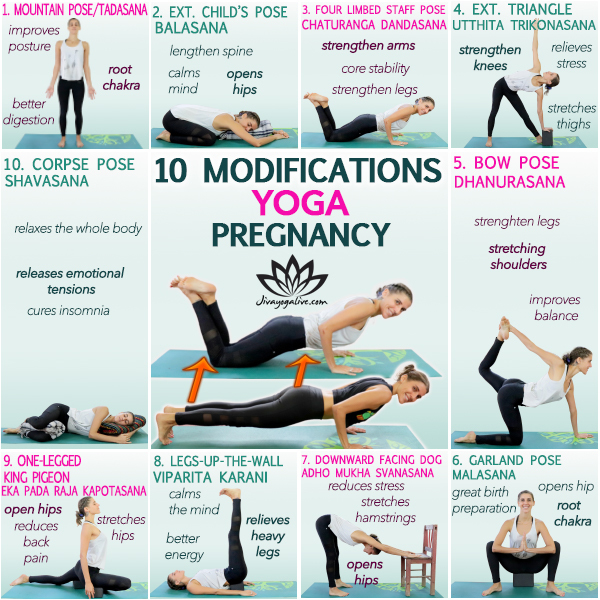
Mountain Pose Modification- Tadasana
The traditional mountain pose is practiced with the feet touching each other. During pregnancy, the body can fall out of balance more easily due to the rapid changes of shape and weight. The solution here is to simply open your feet hip width apart to make sure you are not arching your lower back by tucking the pelvis in to avoid back pain.

Extended Child’s Pose Modification – Balasana
Child’s Pose is a great pose to release the tension in your lower back and relax during a sequence. As your belly grows, open your knees wider to create more space for your abdomen. You can also rest your forehead on a block or blanket to keep your upper body away from the floor.

Four Limbed Staff Pose Modification – Chaturanga Dandasana
You may be able to perform Chaturanga (the yoga “push ups”) normally during the first trimester. But when your belly gets bigger and heavier, it might be a little more tricky. The easy solution is to place your knees on the floor and to engage your lower back to prevent it from arching.

Extended Triangle Pose Modification – Utthita Trikonasana
Triangle Pose is an amazing stretch for the hips and side body. A simple way to make it more comfortable is to put a block underneath your hand. It will allow you to go deeper into the posture and to create more space for you to twist open.

Bow Pose Modification-Dhanurasana
All the poses on the belly are a big no-no. But it doesn’t mean you have to give up front body stretches. You can replace the traditional bow pose with tiger pose. It will stretch your shoulders and strengthen your leg the same way, as well as being a good balancing exercise accessible during pregnancy.

Garland Pose Modification – Malasana
This is a very great pose to practice throughout your pregnancy as it is a great exercise for birth preparation. If your hips or your calves are too tight, you can make the pose more comfortable by placing a rolled blanket underneath your heels or by sitting down on a block.

Downward Facing Dog Pose Modification – Adho Mukha Svanasana
Downward Facing Dog is a safe pose to practice as it is during pregnancy. But if your wrist are making you suffer when you put weight on them, you can still practice a modified version of this posture. Placing your hands on a chair, walk back until your arms are straight and your upper body is long, keeping the legs extended. Push into your hands to activate the shoulders and let your chest soften towards the floor.

Legs-Up-the-Wall Pose Modification – Viparita Karani
Legs-up-the-Wall can be your solution if you’re experiencing heavy and/or puffy legs during your pregnancy. In the first and most of the second trimester, you can practice it just as it is. But when your belly and baby get bigger and it is no longer comfortable to lie on your back, you can place a blanket or two under your hips to keep them elevated and be able to enjoy this relaxing posture.

One-Legged King Pigeon Pose-Eka Pada Raja Kapotasana
This is another common pose that holds many benefits for pregnant ladies as it helps to open the hips and reduce back pain. You can make it more comfortable by placing a block or blanket underneath your front hip. If you want to fold forward, you can create extra space for your belly by placing another block under your back thigh.

Corpse Pose Modification – Shavasana
As the belly gets bigger and the weight of the baby increases, it can become very uncomfortable to rest for a while on your back. There is also a risk that the weight of the baby presses onto veins responsible to carry the oxygen and energy for the baby so it is better to avoid it from week 30 and onward.
You have several options to pimp up your Shavasana. You can place many pillows under your back to keep the upper body higher than the hips (also works for sleeping). Or reverse, placing enough pillow under your knees and hips to elevate the hips. Or you can lie on your side with a pillow underneath your head and between your thighs. Your pick!

Featured Video: Yoga Pose Modifications For Pregnancy
Conclusion
Pregnancy is not a disease (even though it may feel like one sometimes!) and if you’re experiencing an uncomplicated pregnancy, few things are out of your reach. Like the saying goes “there is no problems, only solutions!”.
You might not be able to practice yoga the way you’re used to or to perform everyday life tasks just like you normally do. But there is always a way around everything, let go of your expectations and let the creative juice flow! And like this other saying goes “this too shall pass”!
You will not be pregnant forever and in no time you will be rolling on your tummy again and getting back on the road to handstanding (or not!)! As always, listen to your body and enjoy your pregnancy!
About
Clementine
Clementine is a multi-style prenatal yoga teacher, world traveler and animal lover. She started yoga back in 2015 and fell in love with this beautiful ancient practice. Read More..
