Master Ardha Matsyendrasana ; Half Lord of the Fishes

Half Lord of the Fishes – Ardha Matsyendrasana is a seated twist suited for all levels.

It’s commonly practiced in Ashtanga, Vinyasa and Iyengar yoga. 

Ardha Matsyendrasana is pronounced ARE-dah-see-en-DRAHS-anna and translates to Half Lord of the Fishes Pose.

Ardha = half and Matsyendrasana is the Hindu sage in which the pose is named after. He is said to be one of the original founders of Hatha Yoga.

It’s said that he was rejected and abandoned by his parents and thrown into a river to die. I imagine this was the root of his suffering and what made him such an influential yogi. His story can remind us to be grateful for the challenges of life as they are ultimately the grit the produces the pearl.

Ardha Matsyendrasana Benefits & Precautions

Half Lord of the Fishes actively stretches the chest, shoulders, neck and strengthens the entire spinal column. It stimulates digestion and elimination, counters fatigue and insomnia and brings suppleness to the spine.

Precautions include any disk, spine, neck or shoulder injuries and pregnancy. 

Introduction

Matsyendrasana is considered kitchen sink pose for stretching the hips, spine, shoulders and neck. It stimulates the digestive fire and is said to cause hunger.  It’s highly therapeutic for fighting fatigue, relieving sciatica and insomnia. 

I will share alignment principles to keep you safe in the pose as well as modifications in case you are working with any physical challenges. Naturally i’ll include variations for those students who need more physicalness to stay engaged. 

Keep in mind that modifications and variations are specific to whos doing the pose in the moment they are doing it, the choice to vary up or down should be born from the moment unless you are working with an injury.

I like to always include Common Misalignments, great for teacher to keep watch for, as well as the Fix It- to bring the body back into integrity.

Ardha Matsyendrasana Infographic

Ardha Matsyendrasana Infographic

Half Lord Of The Fishes – Ardha Matsyendrasana Step by Step Instructions

Begin in Dandasana- Staff Pose, with your legs extended straight out in front of you. Bend your right knee and take your foot to the outside of your left thigh. Try and flatten your foot down to the earth.

  1. Bend your left knee and draw your left heel towards your right buttox.
  2. Place your right hand on the earth behind you and externally rotate the shoulder to open your chest.
  3. Inhale left arm up to the sky and exhale hook your left elbow past the outer edge of your right thigh.
  4. Root down evenly through both sitting bones and rebound back up through the crown of your head. Reclaim any length you may have lost during the entrance into the pose.
  5. Rest your vision over your right shoulder with gaze landing last. So in essence your twisting from below to above as a progression.
  6. Take 5-10 breaths. Smooth and steady, consistent breaths. 
  7. Release back to Dandasana for a few breaths and then repeat on your left side.

Half Lord of the Fishes - Ardha Matsyendrasana

Ardha Matsyendrasana Modifications & Variations

Modifications #1- You can take the corner of a folded blanket underneath both of your sitting bones to create levelness in the pelvis and evenness in both sides of the spine. 

Modifications #2- You can keep the side your twisting to’s opposite leg straight. So if you’re twisting the upper body to the right your, left leg remains straight. This is effective if you have any challenges with your knees.

Variations #1- You can add more challenge by creating a bind, releasing your left arm and take it in between your legs and clasp both of your hands behind your back. This is great for leveraging more rotation.

Variations #2- You can release your left arm straight and with your peace fingers take hold of your big toe. Draw your left shoulder blade into your back body and roll your left shoulder back against that, creating leverage and rotation.

Misalignment

Common Misalignment- It’s quite common to lose length in the side of the body your twisting too, this is commonly accompanied with opposite sitting bone lifting off the ground.

The Fix It- If the imbalance is dramatic stick the corner of a blanket underneath both sitting bones prior to entering the pose. To avoid compression, create length in the spine before you enter, then twist from below to above, do your best to keep your sitting bones evenly grounded. 

Featured Video:Master Ardha Matsyendrasana – Half Lord of the Fishes Pose

A great way to prepare the body is with Cow Face Pose – Gomukhasana, as it foreshadows some of the key actions in Ardha Matsyendrasana. Counter posing with Heros Pose – Virasana is recommended as it brings the body back into an anatomical neutral.

Conclusion

Half Lord of the Fishes – Ardha Matsyendrasana is a great antidote for those of us who sit throughout the day, which lets be honest, it’s most of us.  This repeated action (or non action) of sitting shortens the hip flexors which attach to the deep internal layers of the lower spine. As they lock short and tight it pulls on the lumbar spine and ultimately makes us age prematurally.

Ardha Matsyendrasana is an all levels Seated Twist and antidotal to sitting, there are  many adaptations that make it approachable for all levels and all bodies.

It actively that stretches the chest, shoulders and neck and strengthens the spinal column. It stimulates digestive fire (agni) and provolks elimination, counters fatigue, insomnia and brings alertness to the entire mind- body.

Practice this pose after a long day of sitting and let us know your experience. Did it relieve stress? Did it enliven you? Do you feel relieved?

About

Jane

 I teach a SOULFUL, slow flow alignment based Vinyasa where self inquire is encouraged and joy of being is the pinnacle. Read More..

ardha-matsyendrasana

Safe Core Exercises for Pregnancy: 6 Easy Moves to Strengthen Without Strain

When we think about core muscles, the first image that comes to mind is usually a sculpted six-pack. But your core is so much more than just the rectus abdominis. It includes a wide network of muscles that work together to support your posture, stabilize your thorax and pelvis, and generate internal pressure to support everyday functions like breathing, bowel movements—and yes, childbirth. That’s why safe core exercises for pregnancy are essential for supporting both your changing body and your baby throughout each trimester.

What Muscles Make Up the Core?

Your core muscles include:

  • Pelvic floor muscles

  • Transversus abdominis (TVA)

  • Internal and external obliques

  • Rectus abdominis

  • Erector spinae (back extensors)

  • Diaphragm

Together, these muscles create a strong, supportive unit essential during pregnancy.

Why Strong Core Muscles Matter During Pregnancy

Maintaining strong core muscles during pregnancy helps:

  • Align the pelvis, ribs, and spine

  • Support upright posture and body balance

  • Provide continence (your ability to hold in urine or bowel movements)

  • Prepare the body for labour and delivery, especially in the pushing phase

A well-functioning core supports your growing belly and helps manage increased pressure on your spine and pelvic floor. But, not all core exercises are safe during pregnancy—especially as your body changes.

Exercises to Avoid

As your belly grows, traditional crunches and sit-ups become uncomfortable and potentially harmful. Movements that compress your abdomen or require lying flat on your back for extended periods should be avoided after the first trimester.

Why?

  • They can place excess pressure on the abdominal wall

  • They may contribute to diastasis recti (separation of the abdominal muscles)

  • They may reduce blood flow by compressing the vena cava

Instead, opt for safe core exercises using a birthing ball, side-lying positions, or all-fours (quadruped) positions that support your alignment and comfort. Always listen to your body—if something doesn’t feel right, it probably isn’t.

Meet the Transversus Abdominis: Your “Baby Blanket”

The transversus abdominis (TVA) is the deepest layer of abdominal muscle. It wraps around your torso like a corset, connecting your spine, ribs, and hips. During pregnancy, it plays a vital role by supporting your expanding uterus—hence the nickname “baby blanket.”

And during labour, the TVA works with the uterus to generate pressure from the inside to help push the baby out. Think of it like preparing for a very important (and much bigger) bowel movement!

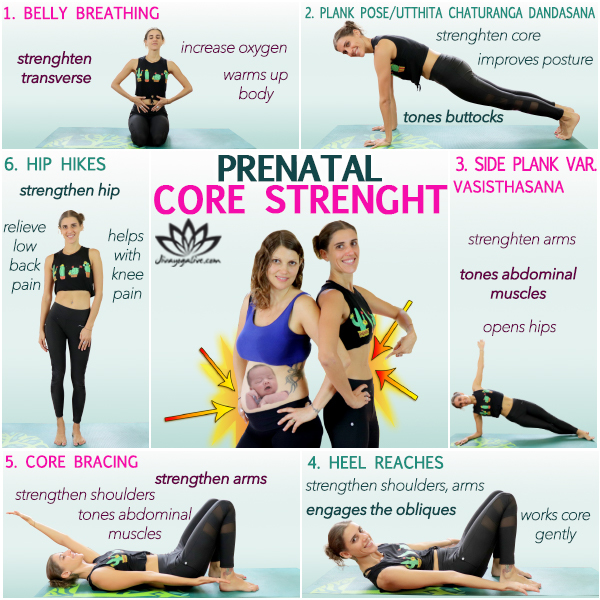
6 Easy Safe Core Exercises For Pregnancy Infographic

Core Exercises For Pregnancy

Belly Breathing

Sit in a comfortable position with your back straight and place your hands on your belly. With every inhalation, let your breath go down into your abdomen, allowing it to expand.

With every exhalation, draw your belly button in towards your spine, sucking up everything as much as you can. Repeat this for 10 to 20 breaths.

This gentle exercise will help to strengthen your transverse.

Heel Reaches -core exercise for pregnancy

Plank Pose – Utthita Chaturanga Dandasana

From a Table Top position, with the wrists aligned with your shoulders, extend your feet back, lifting your body off the ground in a straight line.

Make sure your hips stay in alignment. If this is too uncomfortable for your wrists, you can do this exercise by placing your forearms on the floor instead. Breathe deeply in this posture for 30 seconds to 1 minute.

This will engage your back muscles, your shoulders, as well as your transverse.

Plank Pose - Utthita Chaturanga Dandasana

Side Plank Pose Variation on elbows

Place your right forearm on the floor and extend your legs back, feet separated or stacked one on top of the other. Extend your left arm to the sky and  keep your body in a lateral line. If this is too difficult, you can place your right knee on the floor to get more support.

Stay in this posture for 30 seconds up to 1 minute, breathing deeply. Then repeat on the other side.

Side Plank Pose Var - Vasisthasana

Heel Reaches

Lay down on your back with your feet close to your hips and the knees pointing up. Raise your head and shoulders slightly off the ground and extend your arms by your sides, palms facing up. Reach towards your feet with your hands, alternating between each side. Reaching out on both side counts for one rep. Do 20 reps and take a break. Then repeat another 20 reps. 

This exercise will engage your transverse and your obliques.

Heel Reaches

Core Bracing

Still laying down on the floor with the feet close to the hips, extend one arm by your side and one arm overhead. Brace your abdomen muscles by pushing the floor with your back and pulling your belly button in. Coordinate your respiration with the arm mouvement, keeping the arms extended.

Inhale switch the arms, the one by your side goes up, the one up comes down by your side. Exhale switch again. This is one rep. Do 20 reps.

Core Bracing

Hip Hikes

Stand up with your feet hips-width apart. Without moving anything else, raise one hip up, trying to shorten as much as possible the space between your hip and your ribs.

Come back down and do the same motion on the other side. Perform 20 repetitions of this movement.

Hips Hikes

Featured Video: Safe Core Exercises For Pregnancy – prenatal core workout

Conclusion

Static holds, deep breathing and bracing  will be the top safe core exercises for pregnancy.  

This short workout works best when it is done frequently. You don’t need to workout one hour every day to make a difference.

Try to include in your schedule little 10, 15, 20 minute workouts to perform throughout your week. The ideal is to move everyday even if it is only for 10 minutes. With time, it will become a habit and you will be able to enjoy the benefits of an active lifestyle

About

Clementine

Clementine is a multi-style prenatal yoga teacher, world traveler and animal lover. She started yoga back in 2015 and fell in love with this beautiful ancient practice. Read More..

safe-core-exercises-for-pregnancy

Master Malasana Pose

Todays Pose Break Down features Malasana Pose or Garland pose. Mala = Garland, also translated as Rosary or Necklace and Asana = Pose or Seat. Pronounced MAA-LAA-sa-na and also called Upavesasana. 

It’s an all levels squat that opens the feet, inner groins and front body. It’s highly beneficial for those who spend time sitting regularly as it opens the hips and causes overall mobility in the body. You can find this pose practiced regularly in Hatha, Ashtanga, Vinyasa, Power, Iyengar and Pre-Natal yoga classes. 

It’s also referred to as Birth Pose as it’s an ideal position for pregnant women to give birth as it opens the  birth canal and allows the mother to push with the help of gravity. This is super useful as there is no wasted energy expended. 

It’s also highly recommended for those who travel often and become irregular with elimination as a result. It encourages the down and outward flow of Prana (Apana-Vayu) and stimulates Manipura | Root Chakra and is highly grounding. 

I will guide you into the pose with attention to proper alignment and include a few modifications for different bodies and challenges within the pose.

I’ll also include some more “advanced” variations for those of you who are naturally more bendy or are inclined to take on more challenges. 

Please understand that “advanced” variations are less about what you can do or can’t do and more about being a keen student of yourself and understanding when to add on and when to subtract, to keep things honest and engaging. 

Lastly I’ll share Common Misalignments and how to fix them. This section is great for teachers as it helps you build confidence in reading bodies and gives you a tool box to work with a variety of students.

Malasana Benefits & Pose Preperation

It’s a deep hip opener that stretches the groins and lower back, for some it’s a generous stretches for the Achilles tendon. It strengthens your back body and stimulates digestion which encourages regular bowel movements.

Great for Vata Dosha or those with a Vata imbalance.  It’s a “go to” pose for travelers, Vata imbalances and pregnant women. 

You can prepare for Garland Pose | Malasana with Baddha Konasana | Bound Angle and or Upavistha Konasana | Wide Angle Seated Forward Bend. Counter posing with Uttanasana | Standing Forward Bend and Bhujangasana | Cobra Pose. 

Take precaution or refrain if you are working with low back or knee injuries. 

Malasana Pose Infographic

Malasana pose infographic_JC-118-17

Step- By- Step Pose Breakdown of How To Do Garland Pose – Malasana

  1. With your feet wider than hips width distance and slightly turned out, bend your knees and sit your hips back and down in a squat position.

  2. Your hands come to Prayer Mudra – Namaskar, leaving your forearms parallel to the earth. 

  3. Push your elbows actively into your inner thighs and equal measure clamp your inner thighs back into the elbows. 

  4. Soften your shoulders away from your ears and accessed through the crown of your head.

  5. Use the push- pull action of the upper arms and inner thighs to claim as much length in your  spine as possible. Lengthen north to south by drawing your sternum away from your navel and broaden east to west across the collarbones. 

  6. Gaze to one fixed point and practice merging with your experience as opposed to “doing” the shape.

Malasana - Garland Pose

Featured Video: Malasana Pose – Garland Pose

Malasana Pose Modifications & Variations

Modification #1- Place a blanket underneath your heels to ground them.  This is especially good for those who have chronic tightness in their Achilies tendons. 

Modification #2- Sit your tush onto a block or two. This is super helpful if you are either injured or need some support as you are developing endurance in the pose. 

Variation #1- Bind by taking both arms in front of your shins, then bend your elbows and reach behind your back and clasp your hands.

Variation #2- Take a Half Bind Variation, by taking your right arm in front of your shin, your left arm wraps behind you and you clasp both hands. This version is a chest opener, look up over your left shoulder. 

Variation #3- Take a Half Bind Standing Variation, start by taking your right arm in front of your shin, your left arm wraps behind you and you clasp both hands. Ground through your right foot, engage your belly and slowly raise your self up to standing with your bind.

Common Misalignment

Common Misalignment #2- Allowing the knees to track in. This puts a lot of pressure on the inner knee and over time can compromise the ligaments that keep the knee in tact.

Keep in mind that the knee is a hinge joint and really only likes flexion and extension. Lateral movement is very very limited and should be avoided at all costs. 

How to FIX IT- Think Tree Pose, lengthen from the inner groin to the inner knee and traction back from the outer knee to the outer glute. Push your elbows into your inner thighs and clamp your inner thighs back into centerline.

This will help you leverage the ascending action. You will notice it’s much more of an active expression than passive. 

Conclusion

Malasana – Garland Pose! The name comes from the Sanskrit root Mala, meaning “Garland” which also translates as “Rosary.” In some schools, this is said to be a mistranslation. When pronounced with a long A sound, mala means Garland, but when pronounced with a short A, it actually translates to “excrement” which makes a lot of sense given the shape of the pose and its benefits. 

This pose is a wonderful hip opener that stretches the lower back, stimulates ManipuraRoot Chakra and is highly grounding. It encourages the downward flow of Pranic energy called Apana- Vayu (channel). Apana- Vayu is one of the five expressions of Prana and necessary for regular elimination.

No surprise Malasana is also referred to as Birth Pose, it is phenomenal for pregnant women to practice prior to giving birth and highly recommended during the actual birth process. It actively opens the birth canal and allows the momma to push with the assistance without the resistance of gravity and therefore helps her conserve energy. 

It’s also highly recommended for those who travel often and become irregular and are challenged with constipation and elimination. Travel often over stimulates Vata energies and influences all doshas (not just Vata dosha). Add this to your Vata balancing travel routine and let us know your experience! 

Keep in mind, you don’t need to be pregnant, live a sedentary lifestyle or suffer from constipated to enjoy the variety of benefits Garland Pose has to offer!

About

Jane

 I teach a SOULFUL, slow flow alignment based Vinyasa where self inquire is encouraged and joy of being is the pinnacle.Read More..

Pregnancy Arm Workout Yoga Poses: Strengthen and Tone Safely During Every Trimester

With all the changes your body goes through during pregnancy—most of which you have no control over— pregnancy arm workout yoga poses are an amazing way to stay connected to your body. They help you feel empowered, grounded, and stronger through each trimester. Not only will you build strength, but you’ll also support your growing baby and feel more in control of how those changes show up physically.

Of course, staying active is only part of the equation. Exercise is most effective when paired with a nourishing diet. Try to avoid heavily processed foods and focus instead on fresh fruits, vegetables, whole grains, and healthy fats. When your nutrition is on track, your movement practice will amplify the benefits—reducing pregnancy-related discomfort like back pain and improving your overall mood and energy.

A well-rounded workout routine during pregnancy can also help prevent excessive weight gain and reduce the likelihood of your baby growing too large, which may ease the delivery process.


What’s the Best Way to Work Out Your Arms While Pregnant?

In this article, I’ll guide you through a simple and effective pregnancy arm workout yoga poses that are gentle to stretch and strengthen. These exercises are designed to:

  • Build upper body strength

  • Improve posture and balance

  • Engage your core safely

  • Boost circulation and energy levels

No equipment is needed, and you can do it from the comfort of your home.

Pregnancy Arm Workout Yoga Poses  No Weights Infographic

prenatal arm workout no weight infographic

Arms Circles and Pulses

Start standing up, feet hip-width apart and the back straight. Extend your arms by your side and start moving them in small circles. 30 seconds in one direction and 30 seconds in the other. Then start making a pulsing motion thumbs up for 30 seconds and thumbs down for 30 seconds.

This will warm up your arms and target your deltoids.

Arm Circles and Pulses

Four Limbed Staff Pose – Chaturanga Dandasana

Start in a plank position or a plank position with your knees down. Keep your body in line, hips leveled with the rest of the body and core engaged. Do a set of 10 push-ups. If you place your hands close to your body.

You will be working out the triceps. If the hands are placed wider, it will workout the pectorals.

Four Limbed Staff Pose Modification - Chaturanga Dandasana

Plank Pose Utthita – Chaturanga Dandasana

Place your body in a high plank position. If your wrists are painful place your forearms on the floor.

Hold the position between 30 seconds and one minute, breathing deeply and keeping the hips leveled.

Plank Pose - Utthita Chaturanga Dandasana

Dolphin Plank Pose – Makara Adho Mukha Svanasana

Do a plank position with your forearms on the floor. Let your body tilt forward and backward to build strength in your shoulders. Hold the position between 30 seconds and one minute moving back and forth, breathing deeply and keeping the hips leveled.

Dolphin Plank - Makara Adho Mukha Svanasana

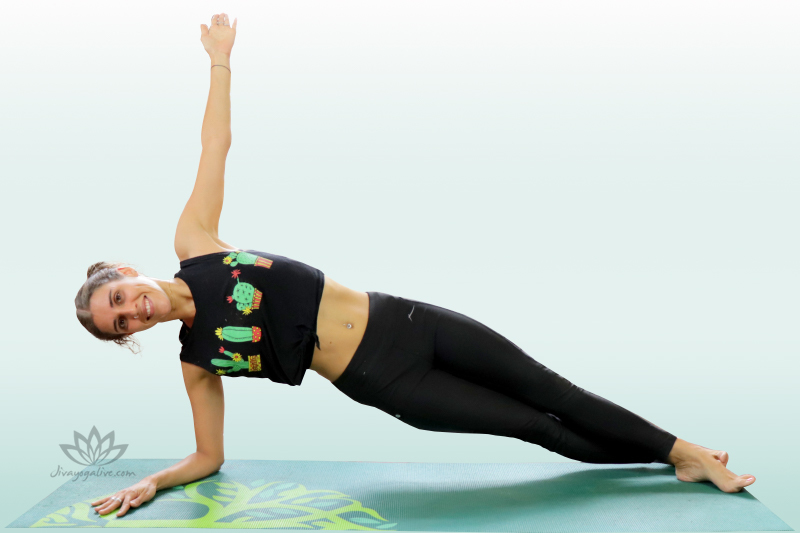
Side Plank Pose Variation – Vasisthasana on forearms

From the forearm plank position, let both feet fall to their right side, maybe stacking them one on top of the other or keeping them separate if it helps your balance. Raise your left arm in the air. Opening your chest to the side and raising your hips high.

Stay for 30 seconds and repeat on the other side.

Side Plank Pose Var - Vasisthasana

Downward Facing Dog Pose – Adho Mukha Svanasana

From a table top position, tuck your toes and raise your hips up and back into a downward facing dog. Extend your legs and firmly press the hands on the floor, opening your chest and your shoulders. Breathe deeply in this posture for 5 to 10 breaths.

After this exercise, start over from the top to perform the second set, taking the time you need to rest. When it’s done move on to the arm stretches.

Downward Facing Dog - Adho Mukha Svanasana

Arms Stretches

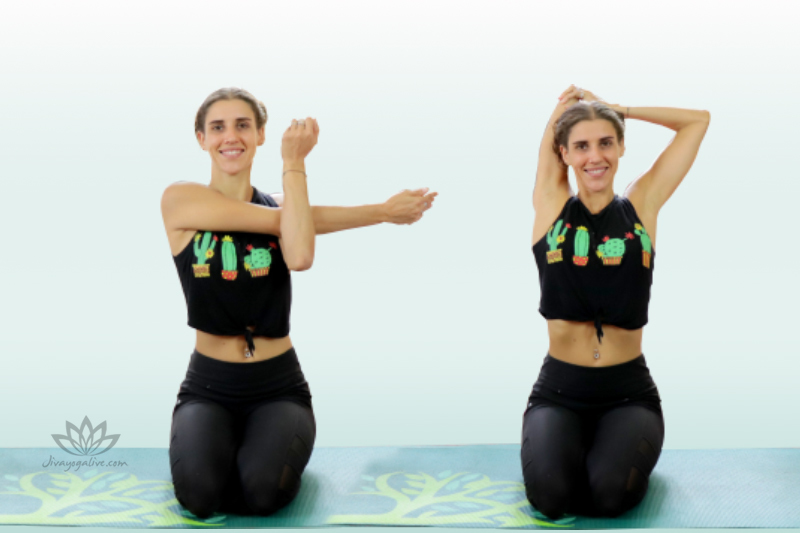
Taking a comfortable seated position, stretch your right arm across your chest and hook it with your left elbow, pulling your arm close to your body. Then raise your right arm up and bend your elbow to rest your right hand on the back of your neck or between your shoulder blades.

With your left hand, gently pull your right elbow towards the left. Take a couple of slow deep breaths in each position and then change side.

Arm Stretches

Featured Video: Killer Prenatal Arm Workout No Weights

Conclusion on Pregnancy Arm Workout Yoga Poses

When it comes to building strength during pregnancy, especially with pregnancy arm workout yoga poses, consistency is more important than intensity. Short, regular workouts will benefit you far more than one long session here and there. Your body thrives on rhythm and routine.

Set realistic goals for how many times a week you want to move—maybe it’s 3 quick sessions to start. Write them down and track your progress. As your energy and strength improve, you can gradually increase the frequency or duration. The most important thing is to listen to your body.

Some days you’ll feel energized and powerful. Other days, not so much—and that’s okay. Adapt the intensity and length of your workouts based on how you’re feeling, but try to keep showing up. That’s how you build a sustainable habit.

And if you need a little extra motivation, find a workout buddy! Moving your body is always more fun with a partner by your side.

If you’re ready to take things further, check out our prenatal course, click the link here to learn more and join us!

About

Clementine

Clementine is a multi-style prenatal yoga teacher, world traveler and animal lover. She started yoga back in 2015 and fell in love with this beautiful ancient practice. Read More..

pregnancy_arm_workout_yoga_poses

Master Extended Puppy Pose; Uttana Shishosana

Today’s featured pose is Extended Puppy Pose – Uttana Shishosana. It’s a hybrid pose that marries the upper body- chest opening of Balasana and the lower body- inversion quality of Downward Facing Dog.

Uttana Shishosana is pronounced- OO-ta-NAH she-SHO-sahna, Uttana = Intense or Extended, Shisho =  Puppy and Asana translates to Pose or Seat.

You commonly see puppies and dogs take this upon awakening from a nap. It is a prone (belly facing down) backbend commonly practiced in Hatha, Vinyasa, Yin Prenatal Yoga traditions. It’s approachable for all levels and all bodies. 

Extended Puppy Pose  Benefits & Precautions

It actively stretches the abdomen, chest, shoulders, upper back and spine. Strengthens the entire back body and calms the mind.  It stimulates Manipura – Navel Chakra and creates heart opening.

Please be cautious if you are working with a spinal, chest, shoulder or neck injury.

Uttana Shishosana Pose Breakdown

I will share purposeful alignment on how to get into the pose and what to focus on once you are there. Included will be a number of variations so all bodies are included. I’ll also share a few variations to consider if you want to level up sensation and challenge.

Generally speaking sensation should not exceed a level 7. Asanas need not be extreme, get to know the concept of perfect measure in your body. It changes and should be specific to the moment and whos doing the doing.

For the teachers, I’ll also share common misalignments and how to fix them. This is a great way to familiarise yourself with where the pose tends to lose integrity, how to assess different bodies with your eyes and really see your students. Trust me they will feel it and appreciate you for it.

Lastly, included is A TIP to enhance the shape and bring it to life,  you’ll need to stay tuned for this one!

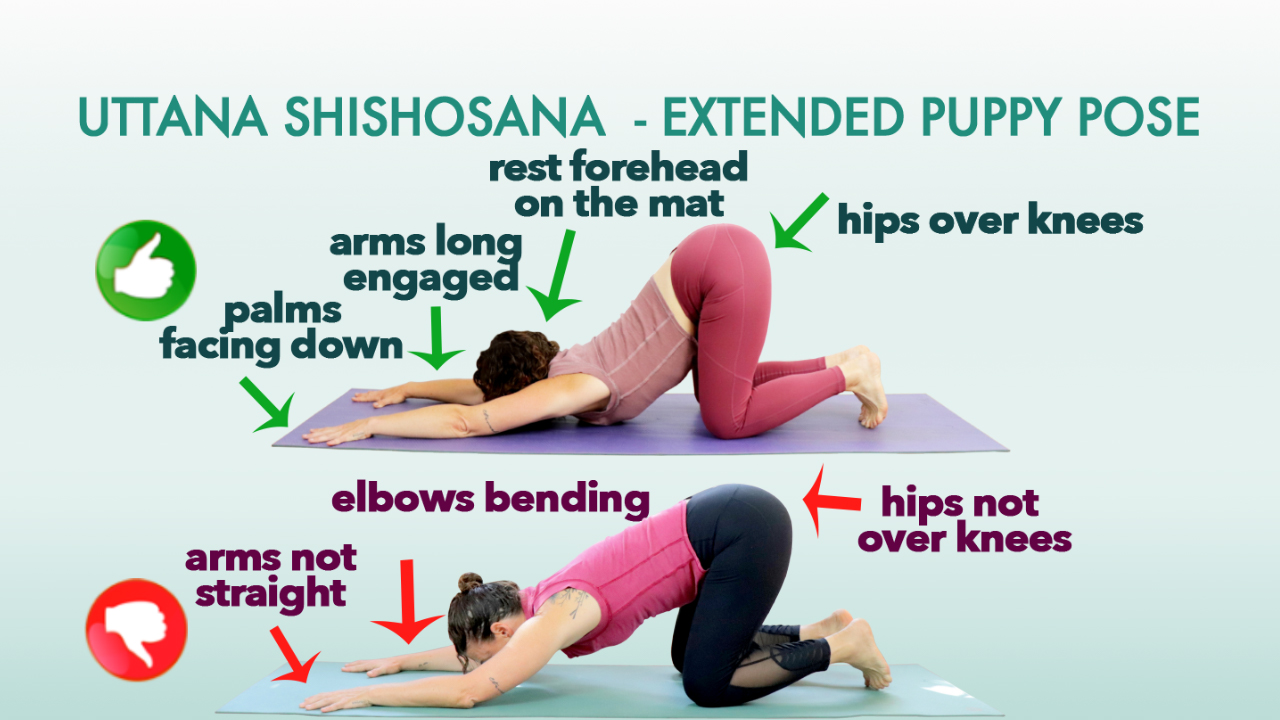
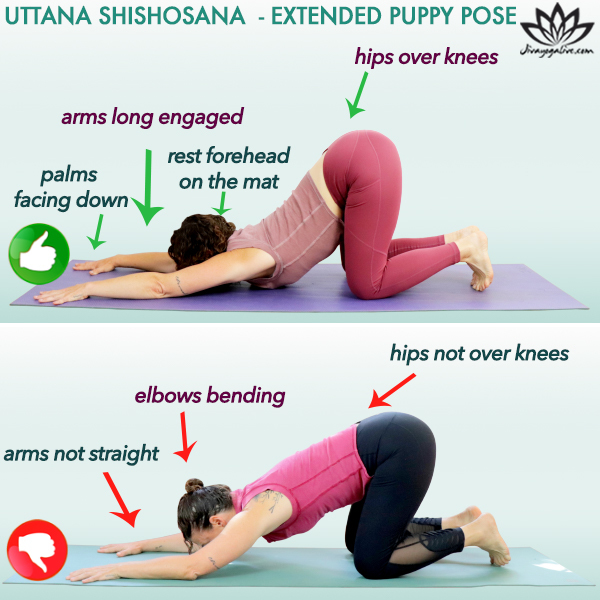
Extended Puppy Pose – Uttana Shishosana Infographic

Extended Puppy Pose - Uttana Shishosana infographic

Uttana Shishosana Instructions

  1. From Tabletop set up for Puppy Pose- Uttana Shishosana! Walk your arms out long and forward keeping them shoulder distance apart with palms facing down
  2. Keep your hips over your knees and find an anterior tilt in the pelvis so your sitting bones action up towards the sky and the natural curve in your lower spine increases.
  3. From here allow your upper thoracic spine to sink through the gateway of your shoulders. Your spine is linked to a swing bridge that is hanging from the two bookends of your spine, your hips and shoulders.
  4. You can rest your forehead on the earth. 

Extended Puppy Pose - Uttana Shishosana

Extended Puppy Pose Modifications

Modification #1- You can rest your forehead on a block (lowest height) instead of the earth.

Modification #2- You can create the same shape in the upper back, chest and shoulders up against a wall. In this modification gravity doesn’t impact the shape as much, so you can fine tune to just the right amount of mobility necessary for your body.

Uttana Shishosana Variations

Variations #1- If you have the mobility in your neck you can rest your chin on the earth, Just make sure it truly feels like a fit and you are not creating suffering.

Variations #2- You can narrow the elbows to touch, then bend them so your hands come to touch and point upwards towards the sky. Now dig down and traction the arm bones back so you feel a coiling action in your upper back. 

Uttana Shishosana Alignment

Common Misalignment- Students who are tight in the chest, shoulders or upper back or are naturally forward benders often miss the opportunity to access deep thoracic backbending here.

The Fix It- Take a block underneath each of your palms and straighten the elbows so the forearms lift from the earth. You may also need additional support underneath the head in this variation. This can help you find more articulation in the upper thoracic spine, chest and shoulders.

A TIP-  You can amplify the descending of your upper spine by coming onto the crown of your fingertips. Crawl your fingertips forward as far as possible without losing the length in the side body. Now traction both arm bones back as you energetically draw your chest forward. This is an isometric stretch, you will likely feel a strong coiling of the upper back.

Featured Video:Uttana Shishosana – Extended Puppy Pose

Prepatory & Counter Poses

You can prepare for Garland Pose | Malasana with Baddha Konasana | Bound Angle and or Upavistha Konasana | Wide Angle Seated Forward Bend. Counter posing with Uttanasana | Standing Forward Bend and Bhujangasana | Cobra Pose.

Conclusion

I don’t know anyone who doesn’t enjoy Extended Puppy Pose including my Cat!

One Last TIP: Pregnant women often slump forward in the upper body as a result of carrying the extra weight of the baby. Since the shoulders and chest are often an area of tension and congestion for this a wonderful shape to include during your prenatal asana routine.

As your belly grows, you can adjust the pose and take your knees wider, and add a block underneath your forehead.

Continue to practice this once you have delivered as now you are likely breastfeeding and experiencing the same tension, perhaps even more amplified. Uttana Shishosana is one of only a few asanas that’s antadotal to this rounding action. 

Daily practice of Extended Puppy Pose yields best results! Asana is cumulative so i’d rather see you practice 6days a week for 20min rather than twice a week for two hours each. 

It’s great to practice it first thing in the morning as the body’s been dormant and the spine is ripe for a good stretch! Practice on an empty stomach and stay curious as we learn through direct experience.

For those of you who are “with child” (aka pregnant) add it to your daily morning routine and let us know your experience. 

About

Jane

 I teach a SOULFUL, slow flow alignment based Vinyasa where self inquire is encouraged and joy of being is the pinnacle. Read More..

extended-puppy-pose

Pregnancy Stretches To Prepare For Birth: Strengthen Your Body for a Smoother Delivery

Your water just broke! Time to rush to the hospital because your baby is going to pop out any second! Or… maybe not. While this dramatic scenario plays out in every Hollywood movie, real-life labor is usually a little more drawn out—and much more manageable, especially when you’re incorporating pregnancy stretches to prepare for birth into your routine.

prepared.

Understanding Labor: It’s Not What You Think

For starters, labor doesn’t usually begin with your water breaking. In fact, it often happens much later—or not at all until you’re well into active labor. And if you’re a first-time mama, you can expect labor to last around 18 hours or more. But no, that’s not 18 hours of screaming and pushing.

One of the biggest barriers to a calm and empowered birth is fear—fear that our bodies aren’t capable. But here’s the truth: your body was made to birth. The female body has been doing this since the beginning of time, and it knows what to do—if we let it.


The Three Stages of Labor (And How to Support Each One)

1. Dilation (Early and Active Labor)
This is the longest stage of labor, beginning with your first contractions and ending when your cervix is fully dilated (10 cm). This is where pregnancy stretches and yoga exercises can be incredibly helpful.

What to do during dilation:

  • Rest or sleep to conserve energy

  • Eat light, energizing foods (like dates!)

  • Go for gentle walks

  • Take a warm bath

  • Practice pregnancy stretches to prepare for birth

  • Use breathing techniques to stay calm and help your body open

Pregnancy stretches like hip circles, cat-cow, child’s pose, butterfly stretch, and deep squats (if comfortable) can ease tension, create space in the pelvis, and encourage your baby into a good position for birth.

2. Pushing (Active Labor)
Once you’re fully dilated, your baby will start moving down the birth canal. You’ll feel a natural urge to push—and following that instinct can feel powerful and relieving.

3. Delivery of the Placenta
Usually about 20 minutes after your baby is born, the placenta is delivered. This is the final stage and usually comes with mild, painless contractions.


Natural Ways to Prepare for Labor

If your pregnancy is progressing smoothly and you’re aiming for a natural birth, your support system matters. Surround yourself with people who believe in your body: a trusted midwife or OB, a doula for emotional support, and your partner if desired.

Here are some natural ways to prepare your body for labor:

  • Practice daily pregnancy stretches to increase flexibility and ease pelvic tightness

  • Do prenatal yoga to connect with your breath and build stamina

  • Take gentle walks to encourage baby into the right position

  • Eat nourishing foods like dates (shown to support cervical dilation)

  • Use breathing and relaxation techniques to stay calm during contractions

  • Take warm baths to soothe aches and relax muscles


Why Pregnancy Stretches to Prepare for Birth Matter

In the final weeks of pregnancy, incorporating pregnancy stretches to prepare for birth can make a huge difference. These movements help open the pelvis, release tension, and make space for your baby to move down naturally.

Regular stretching:

  • Helps reduce lower back and hip pain

  • Encourages optimal fetal positioning

  • Promotes relaxation and better sleep

  • Prepares your body for each stage of labor

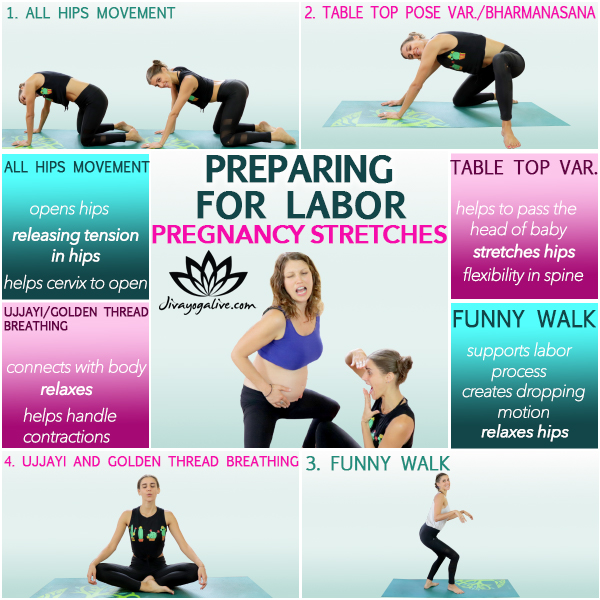
Pregnancy Stretches To Prepare For Birth Infographic

pregnancy stretches to prepare for labor infographic_CG-11

All Hips Movement on all four or against the wall

You can choose to be on all four or standing next to a wall, hands on the wall, depending on what feels better for you. 

The point here is to let the hips move freely to release any tensions and help the cervix to open. Circles, wiggles, rocking side to side, figure-8 shapes. Let your body lead the way and do what feels best for you.

All hips movement

Table Top Pose Variation – one leg to the side

From a Table Top position, open one leg to the side, foot flat on the floor, and let your hips move freely here too. Back and front, circles, side to side. In this posture, the diameter of your pelvis is the widest possible so this posture can be helpful if the head of the baby is having difficulty to pass through the pelvis.

Table Top Pose Variation - Bharmanasana

Funny Walk

Wobble for a couple of breaths, walking with your feet pointing outward. Then on an exhale, bend deeply your knees, creating a dropping motion with your hips to help the baby’s head to lower down and support the labor process. This exercise will help to keep the hips open and relaxed.

Funny Walk

Breathings – Ujjayi and Golden Thread

The first breathing technique is called Ujjayi Breathing. Sitting in a comfortable position, start by deepening your inhalations and exhalations, squeezing your throat a bit so that the air creates an ocean sound with each breath. Let the rest of the body relax and apply this breathing during 10 to 15 cycles. This will help you to connect with your body and stay relaxed.

The second breathing technique is called the Golden thread. Inhale deeply through the nose and exhale slowly through your mouth as if your breath was a delicate golden thread that you are blowing out. This breathing will help you to handle the intensity of the contractions, exhaling slowly every time a contraction comes. 

Breathings - Ujjayi and Golden Thread

Featured Video:Fun Pregnancy Exercise & Stretches To Prepare For Labor

Conclusion

The more you practice those exercises and breathing techniques before the birth, the easier it will be to apply them during your labour. Maybe practice with your partner too, so that he can help you stay focused and offer you to use a particular breathing technique or position when the intensity of the birth will put you in a state close to a trance. 

I also recommend you to read about as many positive birth stories as you can during the last trimester. This will help you to have your mind filled with powerful joyful experiences instead of scary ones. Positive thinking brings positive outcomes. The book A guide to childbirth by Ina May is a great book to read during pregnancy.

About

Clementine

Clementine is a multi-style prenatal yoga teacher, world traveler and animal lover. She started yoga back in 2015 and fell in love with this beautiful ancient practice. Read More..

pregnancy-stretches-to-prepare-for-birthhttps://www.jivasoul.com/prenatal-yoga-for-healthy-pregnancy

Yoga For Kidney And Liver 9 Strengthening Poses

Yoga for Kidney and Liver Health: Simple Practices to Support Your Detox Organs

Your liver and kidneys are vital players in the body’s detoxification process, and when they’re not functioning optimally, symptoms like fatigue, high blood pressure, acne, and even weight gain can emerge. This article will introduce you to gentle yoga for kidney and liver health and lifestyle habits that can help support these essential organs, bringing your body closer to balance and vitality.

Why Focus on the Liver and Kidneys?

The liver is responsible for processing everything from hormones to environmental toxins. When overloaded, it can struggle to detoxify efficiently—leading to a buildup of waste in the body. Issues like weight gain, hormonal imbalances, and even emotional irritability may be linked to liver stagnation.

The kidneys, often overlooked, are your body’s filtration system. They remove waste and excess water from the blood, expelling it as urine. When your kidneys aren’t filtering well, toxins can circulate through your system, affecting your skin, mood, energy levels, and immune function. Yoga for kidney and liver health can provide much-needed support to restore balance.

My Personal Healing Journey

When I first faced health challenges, I focused solely on gut health—eliminating foods, experimenting with diets, and using colon-cleansing herbs. While that helped, it wasn’t enough. The real shift happened when I started addressing kidney filtration and liver support through yoga and naturopathic practices. Healing isn’t about treating one part of the body in isolation. True wellness means supporting the whole system—and that includes your detox organs.

The Importance of Kidney Filtration

Functional medicine experts like Dr. Robert Morse and Dr. Mark Mattson emphasize the kidneys’ vital role in chronic health conditions. As Dr. Mattson puts it, “If you have a dirty pool, what do you start with first?… the filters.”

If you’re dealing with ongoing health issues, it’s worth considering whether your kidneys are doing their job efficiently. Without proper filtration, the body’s waste system becomes clogged—no matter what healing path you follow. Incorporating yoga for kidney and liver health into your routine is a gentle and effective step toward deeper detox.


Yoga Poses For Kidney and Liver Infographic

These poses form a gentle and supportive practice of yoga for kidney and liver health. They are designed to stimulate circulation, massage internal organs, and help your detox systems function more effectively.


Featured Video: Yoga Postures For Kidney & Liver Health

Yoga for kidney and liver health isn’t just about movement—it’s about supporting your body’s natural detox processes through mindful breath, intentional poses, and stress reduction. Whether you’re healing from an infection, dealing with fatigue, or simply wanting to maintain wellness, these postures can help.


Yoga for Kidney Infection

A healthy kidney is a filtering kidney, and by this I mean that it is doing its job of excreting waste and toxicity from the body. When the kidneys are down we can run into all kinds of health crises, one of them being infection. Practicing yoga for kidney and liver health regularly can aid in preventing these issues by encouraging circulation and function in your detox organs.


Restorative Yoga for Kidneys

Gentle, restorative poses are going to be more conducive to healing than any kind of intense workout, but you definitely want to keep the body moving to help activate the organs. That’s why restorative yoga for kidney and liver health is such a powerful tool. You want to ensure that all of the body’s elimination channels are kept open and free from blockages, and the kidneys are no exception.

Yoga Poses For Kidney and Liver Infographic

yoga for kidney and liver infographic

Bound Angle Pose – Baddha Konasana

Bring the soles of the feet together and remove the extra flesh from underneath the sitting bones to remove arching of the spine. Sit up tall and extend the hands and arms up towards the sky to begin. Inhale to lengthen the spine, and then exhale start to reach the arms forward, bringing them down, eventually coming down to rest them on the mat. Focus on lengthening the spine and then drop your heart forward. Use the breath to go deeper into the fold of this pose and focus on lengthening all the way through the back of the head and neck. Let the head by heavy and surrender as the hips open simultaneously. This folding of the body stimulates the kidneys, as well as the lower abdomen area.

bound angle pose - baddha konasana

Seated Forward Bend – Paschimottanasana

Come down to sitting and remove extra flesh from underneath the sitting bones. Send the legs out long and flex the feet back. Reach the arms up towards the sky, lengthening the spine and side bodies. Start to hinge at the hips and bring the torso down, continuing to reach the arms forward, eventually bringing them down. Surrender into this fold, with the heart towards the knees and release the head and neck. Allow the hands to rest down on the mat or grab for the feet, legs or wherever is comfortable. Use the breath to lengthen the spine and with every exhale fold deeper. This forward fold, compresses the abdomen which actively stimulates the internal organs promoting their efficiency and supporting detoxification.

Seated Forward Bend - Paschimottanasana yoga for kidney and liver

Boat Pose – Paripurna Navasana

Come to sitting in the center of the mat and bend the knees up. Take the hands to the back of the thighs, lengthen up through the spine up to sit up tall. Start to activate that core by lifting the legs up parallel to the mat, open the chest and focus on opening the collarbones. Take the gaze forward and start to straighten the legs. There is the option to release the legs and extend the arms straight out, otherwise continue to hold on to the back of the legs. This pose is going to strengthen the core and work deeply into the abdominal area and get the kidneys and the liver fired up. Work with the breath and find some ease in the perceived effort of this posture.

Boat pose - Paripurna navasana

Cat-Cow Pose – Marjaryasana-Bitilasana​​​​

Start in a neutral table top position and have the shoulders over the wrists and hips in line with the knees. Engage the core by drawing the belly button back towards the spine. Inhale and drop the belly down towards the ground, send the hips up, shine the chest and heart forward, to come into Cow Pose. Press into the palms to create space between the ears and the shoulders to lengthen the neck. Start to round the back, curling the spine to come back into Cat Pose.Alternate through these Cat and Cow poses, working to lengthen and then stretch the abdomen. Be as dramatic as you can be in each pose, pressing firmly into the hands, pulling the shoulder blades apart in Cat and really arching the spine in Cow Pose. This alternating movement is going to massage the internal organs.

cat-cow - marjaryasana - bitilasana yoga for kidney and liver

Downward Facing Dog – Adho Mukha Svanasana

Press down into the hands and the feet and send the hips and tailbone high for Downward Facing Dog. imagine your body to be an inverted V shape and start to peddle out the feet, bending one knee and then the other. Release any tension in the neck and head and draw the shoulders down away from the ears. Use this Downward Facing Dog as a momentary transitionary pose to create space in the body.  Find the breath and let the belly be soft.

Downward Facing Dog - Adho Mukha Shvanasana  yoga for kidney and liver

Standing Forward Bend – Uttanasana

From Downward Facing Dog, walk the feet towards the wrists and come into a Standing Forward Bend, with the feet hip width distance apart. Place a soft bend in the knees, release the hands to the mat and send the tailbone up towards the sky. Actively press into the toes and root down through the heels and release the head down. This pose stretches the entire back side of the body from the heels through to the crown of their head. To deepen into the hamstrings try straightening the legs a little more and continue to drop the torso down. This compression is going to stimulate the liver and kidneys by creating some gentle movement inside of the body to help detox and purify. 

standing forward bend - uttanasana

Chair Pose – Utkatasana

Come back to standing and connect the big toes, keeping the heels slightly apart. Bend the knees and come down into an imaginary seat. Squeeze the thighs and send the arms up towards the sky, palms facing inward. Relax the shoulders down away from the ears and continue to lengthen through the spine as the hips melt down towards the ground. Chair Pose is a great strength building pose, working deeply into the legs but also toning through the core and the internal organs. The posture provides gentle pressure to the liver and kidneys and will get them stimulated which will help to aid the digestive processes.

chair pose - utkatasana

Revolved Chair Pose – Parivritta Utkatasana

Staying low in Chair Pose, bring the hands to heart center and hinge the torso forward and then bring the left elbow to the outside edge of the right knee to come into Revolved Chair Pose. Point the fingertips towards the face, press the palms together and lengthen the spine.

Use the breath to take the twist deeper and continue to drop the hips down. Inhale and come back through center and then twist to the other side, bringing the left elbow to the outside edge of the left knee. Continue to send the hips down, press into the palms. Bring the hands back to center and forward down, straightening the legs and allowing the torso to hang heavy. Use the breath to keep lengthening the spine up in Revolved Chair Pose and use the exhales to twist deeper. Connect to the gentle movement inside of the abdomen at the core and use this twist to massage into the internal organs.

revolved chair pose - Parivrtta Utkatasana

Extended Hand to Big Toe Pose – Utthita Hasta Padangusthasana

Start to ground the left foot into the mat and lift the right knee up towards the sky, bringing it parallel with the ground. Extend the right arm towards the right foot, and use the first two fingers to hook the right big toe. Bring the left hand to the hip and then start to straighten the right leg towards the front of the mat and then gently open it out towards the side. Release the hip and send the left arm out long to come into Extended Big Toe Pose. Find the balance and the breath and then gently re-bend the knee, come back through center and then relax the foot down. Change sides. This pose actively tones the abdominal muscles which stimulates the digestive system, liver and the kidneys.  All this is going on in the body, whilst the balance is being challenged and strengthened. 

extended hand to big toe pose - utthita hasta padangusthasana

Featured Video:Yoga Postures For Kidney & Liver Health

Yoga for Kidney Infection

A healthy kidney, is a filtering kidney, and by this I mean that it is doing its job of excreting waste and toxicity from the body. When the kidneys are down we can run into all kinds of health crises, one of them being infection.

To really get the kidneys back to full functioning, some radical shifts to diet and lifestyle may be necessary and yoga can help to support your detox protocol and get them back online. Give these gentle postures a try and move with care and awareness. Half Lord of the Fishes – Ardha Matsyendrasana Twisting at the core like this is great for stimulating the kidneys, as it works to move out stagnant blood and waste. At the same time, this posture stimulates the liver so it is a great pose to support your detoxification protocol. Cobra Pose – Bhujangasana. As you send the chest forward and up and compress the low back, you are stretching the kidneys and encouraging obstruction to clear. Add this pose into your daily practice to continue to invite space and help to keep kidney stones and waste build up at bay.

Restorative Yoga for Kidneys

Gentle, restorative poses are going to be more conducive to healing than any kind of intense workout, but you definitely want to keep the body moving to help activate the organs. You want to ensure that all of the body’s elimination channels are kept open and free from blockages and the kidneys are no exception. Try these gentle poses and focus on sending the breath down into the problem area.  Child’s Pose Such a simple pose, it’s hard to believe that anything is happening in the body at all, but this restorative Child’s Pose is going to gently stretch the kidneys while calming the mind, which is essential for the organs to function effectively. As the body relaxes and releases stress, the internal organs are invited to do the same and their energy can be exerted towards doing their job more effectively. Wind Relieving Pose Spend time rocking left, right, back and forth here, on the low back to massage into the kidneys to stretch and stimulate them. This pose is great for gastrointestinal complaints in general as the thighs compress down into the digestive tract and usually when the kidneys are down, there will likely be issues with the gut. Spend as long as you can here, sending the breath down into the belly, and squeezing the thighs down with each exhale. Sphinx Pose – This gentle backbend is not only therapeutic for the spine, but it is a great way to strengthen and stretch the abdominal organs, including the kidneys. The more you practice this pose, the deeper its effects on the kidneys will be so add it into your regular practice.

Kidney Filtering

The kidneys act as a filter and remove toxic build up from the body, as well as excess water which is excreted as urine. They work along with the body’s other means of elimination and are a crucial part of our wellbeing. If the kidneys aren’t filtering, we can run into trouble and the body can enter into a state of dis-ease, from anything from mild acne to cancer. Yoga for kidney and liver health helps keep these filters operating at their best.

When I ran into my own health crises, I remember that it took me a good few years before I even acknowledged the importance of the kidneys and their role in my overall health and healing. It was just my gut that was suffering – or so I thought – so my main focus was on eliminating foods, trying different diets and adding in cleansing herbs, all to try and clean the colon.

Focusing on the gut alone did not allow me to heal and one of the best things I have come to understand through my own experience, is how everything is connected. You can’t heal parts of the body in isolation, you have to work on the whole system and even if you go about this systematically, which I recommend you do, you are going to have to look at each of your essential organs in turn. The body has several channels of elimination and the kidneys are one of the most important in removing waste from the body. If the kidneys are not filtering out toxicity, then there is the risk of the body going into a state of dis-ease.

If you are suffering from any kind of chronic health complaint, there is a high chance that the kidneys are not functioning at 100% and it doesn’t matter what path you choose to heal yourself, if the kidneys are not filtering, then you are not healing.

Natural doctors such as Dr Robert Morse have been working with patients with chronic health conditions that have bewildered allopathic medicine and what they have found is that kidney filtration is one of the keys to wellbeing. Dr. Mark Mattson, Chief of the Laboratory of Neurosciences at the National Institute on Aging, also stresses the importance of kidney filtration; “If you have a dirty pool, what do you start with first?….the filters”Dr Mark Mattson

Conclusion

Lifestyle Tips for Healthy Detox Organs

  • For the Liver:
    Keep your diet low in unhealthy fats and processed foods. Incorporate liver-loving foods like dandelion greens, turmeric, and beets.

  • For the Kidneys:
    Instead of flooding your system with water, focus on hydrating through high water content fruits (like watermelon and cucumber) and leafy greens. These nourish the kidneys gently and efficiently.

Adapt these two lifestyle habits and then support yourself further with the yoga poses that have been shared with you in this article and you will be doing amazing things for your health. 

A liver burdened by toxins and kidneys that aren’t filtering properly can compromise your whole system. The key to radiant health lies in supporting your body’s natural elimination processes. By incorporating yoga for liver and kidney health, along with simple dietary adjustments, you’re setting a strong foundation for healing and longevity.

About

Charlie Hanna

Charlie is a Yoga Alliance certified Hatha, Yin Yoga & Meditation teacher with a psychology degree in her back pocket. She is currently on a mission, chasing sun and Read More..

Eagle Pose Garudasana

Eagle Pose – Garudasana, pronounced – gah-rue-DAHS-anna is a Standing Balancing pose that requires mobility of your shoulders and hips, balance and focus.

Garudasana comes from the sanskrit root Garud, which means “Eagle” and Asana = Pose or Seat.

It’s said that this mythical king bird was protector of humanity and preserver of creation and a vehicle of Lord Vishnu’s. He attained the elixir of immortality known as “Soma” and saved his mother from enslavement.

Garudasana Pose Benefits & Precautions

It is an all levels asana that’s traditionally practiced in Hatha, Bikram, Ashtanga, Vinyasa, Power and Iyengar Yoga classes.

Eagle Pose stretches your hips, shoulder and upper back and strengthen your ankles, calves and legs. It also benefits joint mobility, coordination, balance, focus and flushes the lymphatic system. Like all standing poses leaning into your breath (ujjayi) and vision (drishti) can bring great concentration and deep peace.

Precautions include any ankle, shoulder, knee or hip injuries.

Eagle Pose – Garudasana Breakdown

Eagle Pose stretches your hips, shoulder and upper back and strengthen your ankles, calves and legs. It benefits joint mobility, coordination, balance, focus and flushes your lymphatic system. If you struggle with balance this is a great pose to practice daily. 

Below is a Step- By- Step Pose Breakdown on how to get into Eagle Pose. I will guide you in with specific attention to alignment. I’ll include different modifications for beginners or those who struggle with balance, or have chronic tightness in the shoulders. Different body types and physical challenges will require different approaches.

I’ll also include options to up level and variations that add challenge. Just keep clear that each day is fresh and will likely require something slightly different. A keen student accounts for this and practices truly listening for the bodies needs instead of asserting wants or recreating a memory of what was. 

Please prepare your body with Cow Face Pose | Gomukhasana and Chair Pose | Utkatasana and you can counter pose with Bridge Pose | Setu Bandhasana when you are finished.  Keep a block handy!

Eagle Pose Infographic

Eagle Pose Garudasana infographic_JC-118-16

Eagle Pose Instructions

  1. Begin standing at the front of your mat in Tadasana, arms alongside you, palms facing forward.
  2. Bend both knees and and cross your left thigh over your right thigh. Cross as close to the pelvis as possible.
  3. Extend your arms alongside you shoulder height and criss cross your left arm under your right. Cross as close to the shoulder joint as possible.
  4. Bend both elbows and lift them leveled to the earth. 
  5. Palms together, lift your elbows up, draw your forearms forward and reach your fingertips toward the sky. 
  6. Keep your shoulder blades softening down your back, toward your waistline and your upper back embedded (as opposed to rounding and exiting). 
  7. Square your hips and chest to the front of your mat and level them in relation to the earth. Belly draws in and up.
  8. Gaze at one point out in front of you. 
  9. Hold for 8-10 breaths, focusing on smoothing out any inconsistencies in the breathing.
  10. Exhale, back to Tadasana and repeat on the opposite side.

Eagle Pose - Garudasana

Featured Video: Garudasana – Eagle Pose For Beginners

Eagle Pose Modifications

Modification #1– Beginners can omit the foot hook and cross the leg over the top of the standing leg, instead, resting the toes gently on the floor or a block. 

Modification #2- If your palms don’t touch, press the backs of your hands together or take opposite hand to shoulder. 

Modification #3- You can do this against a wall for support balancing. This also provides great feedback for where squared hips actually are.

Eagle Pose Variations

Variation #1– Hook the top of your left foot behind your right calf if it happened naturally but resist the temptation to unsquare your hips to get there. This can tweek the knee once you square the hips.

Variation #2- You can hinge forward at the hip crease and try to touch you elbows to your knees. Stay a few breaths and return to the classical variation

Preparatory & Counter Poses

You can prepare your body with Cow Face Pose | Gomukhasana and Chair Pose | Utkatasana and counter pose with Bridge Pose | Setu Bandhasana.

Conclusion

Eagle Pose -Garudasana! It mobilizes the upper back, shoulders and hips and builds coordination, balance and massive focus!  Learning to awaken the upper back and shoulders is essential for more challenging inversions like Handstand | Adho Mukha Vrksasana and Headstand | Sirsasana.  

If you struggle with balance this is a great pose to practice on a regularly, especially as we age and balance becomes less taken for granted and more of a necessary practice.

LAST TIP: Practice this twice on each side and do the first one with either your back to the ground or with your back against a wall. Feel for your back body embedding (drawing into your body) instead of rounding and exiting your body.

The shoulders and hips should both be touching the earth or the wall, so the front body is long and broad. You want to feel the natural curve in your low spine (lumbar) just that, natural (so not flattened) and similarly with the natural curve in the neck spine (cervical), present and natural.

Then, when you practice the second round standing you will have muscle memory from the less challenging version while you were using the earth or wall for feedback. Give this tip a whirl and please let us know if practicing it twice with the considerations above helped inform your standing expression!

Don’t worry about your upper foot wrapping around your calf, it’s not necessary. Don’t even worry about falling as the ground, is right there. The one requirement is to be open and stay curious!

Ready to take your healing further? Click here to access yoga courses for beginners and start your journey toward lasting wellness today.

About

Jane

 I teach a SOULFUL, slow flow alignment based Vinyasa where self inquire is encouraged and joy of being is the pinnacle.Read More..

eagle_pose

Tailbone Pain In Early Pregnancy 4 Stretches

Tailbone pain in early pregnancy is one of the most common aches women experience. Whether you’re in your first, second, or third trimester, tailbone discomfort can strike at any time.

What Is the Tailbone and Why Does It Hurt?

The tailbone, also known as the coccyx, is located at the very bottom of your spine. It’s made up of three to five small bones connected by joints and cartilage. The tailbone supports your body when sitting and serves as a key attachment point for pelvic floor muscles—the muscles that support your expanding uterus, vagina, and eventually your growing baby during pregnancy.

From the moment you conceive, your body begins to release hormones that soften your joints, ligaments, and muscles. This natural process is designed to make space for your baby to grow and prepare your body for childbirth. While this flexibility is helpful for your baby, it can cause tailbone pain and other discomforts for you.

Relaxed ligaments and joints can make the tailbone overly mobile and misaligned, which can lead to radiating lower back pain. As your uterus grows, it also puts increasing pressure on the tailbone, especially as the pregnancy progresses.

Pain During Pregnancy?

There are many easy ways to ease tailbone pain and sometimes make it disappear altogether. In this article, we will focus on a few stretches that create space and relieve pressure on the tailbone area but here are some ideas you can implement in your everyday life:

  1. Sit upright and maybe use a yoga ball instead of a regular chair. This will help you to keep your spine aligned and to gently open your hips.
  2. Sleep on your left side with a pillow between your legs. It will improve your blood circulation and your digestion as well as maintaining your hips aligned during the night.
  3. Move! Walk, swim, dance, pilates, yoga, gym… the choice is yours! Just do it!
  4. Be mindful with the weight gain. Don’t overuse the excuse “I’m pregnant” to indulge in overeating not-so-healthy food all the time. If you put on more than you should for the health of your baby, the extra kilos will come adding to the pressure on your back.
  5. Use heat! Maybe apply a hot pad or take a hot bath. The heat will help to dissolve the tensions and soothe the pain.

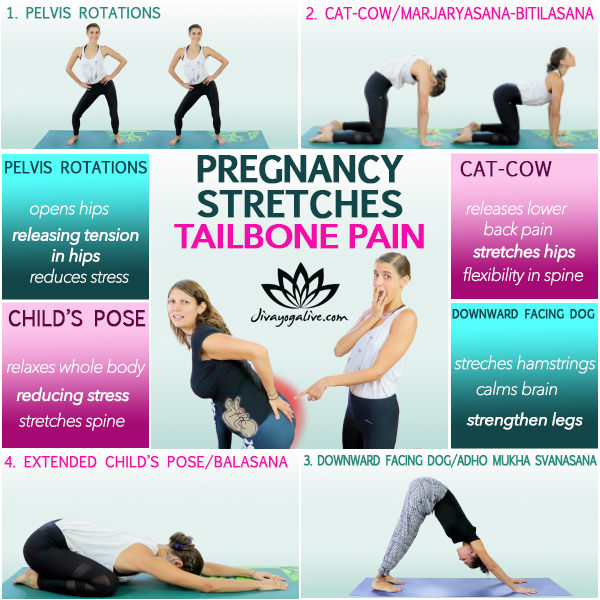
4 Stretches For Tailbone Pain During Early Pregnancy Infographic

tailbone pain during early pregnancy infographic

Pelvis Rotations

Start standing with your feet hips-width apart and bend your knees slightly. Make the motion of tucking and untucking your tailbone, letting the hips “swing” from back to front. Take your time to explore the motion. 

Then let your hips move freely from side to side. And then move them in all directions mindfully, front , right, left, back, making figure-8 motions, letting your hips move as they want, releasing any tension held in this area.

Pelvis Rotations

Cat Pose / Cow Pose – Marjaryasana / Bitilasana

From a table top position with the hands below the shoulders and the knees below the hips, start with an inhale, pressing the hands firmly on the floor, letting the belly drop, opening the chest to the front and looking up.

On the exhale, round your back, trying to press the part in the middle of your shoulder blades towards the ceiling, tucking your tailbone and looking towards your navel. Synchronize your breath with the movement and do 10 or 15 cycles.

Cat-Cow Pose - Marjaryasana-Bitilasana tailbone pain in early pregnancy

Downward Facing Dog Pose – Adho Mukha Svanasana

Still from a Table Top position, start by tucking your toe. Then slowly press your hips up and back until your arms are in line with your shoulders and legs are extended. Here feel free to bicycle your legs, move your hips around a bit. Do what feels good for your body.

This pose will nicely stretch all the main muscles of your back body.

Downward Facing Dog - Adho Mukha Svanasana   tailbone pain in early pregnancy

Extended Child’s Pose – Balasana

From the Table Top position, sit back on your ankles. Open your knees wide enough to create a space for your belly and slowly fold forward, keeping the hips as close to your feet as possible. If you want you can place a rolled-up blanket or pillow underneath your head and chest, or simply rest your forehead on the floor.

Breathe deeply in this posture, relaxing the whole body and allowing the breath to go all the way down into your lower back with every inhalation.

Extended Child's Pose - Balasana   tailbone pain in early pregnancy

Featured Video:4 Easy Stretches For Tailbone Pain During Early Pregnancy

Conclusion

Tailbone pain during early pregnancy can literally be a pain in the *ss! And the drugs you would normally take are not safe for pregnant women. But luckily, a few adjustments in your posture, your sleeping position and targeted stretches can do the trick and relieve partially or completely your pain.

You can also find a good chiropractor that will help you put everything back in place.

About

Clementine

Clementine is a multi-style prenatal yoga teacher, world traveler and animal lover. She started yoga back in 2015 and fell in love with this beautiful ancient practice. Read More..

tailbone_pain_in_early_pregnancyhttps://www.jivasoul.com/prenatal-yoga-for-healthy-pregnancy