Category: YOGA
Balasana Pose

Today’s feature Pose is Extended Child’s Pose – Utthita Balasana! It’s the ultimate relaxation pose! It’s a great starting point or ending point to any sequence and a great spot to rest and reconnect to your inner experience. For such a juicy welcoming posture that provides so much comfort and ease it’s not so easy for student to honor the call.
Let’s keep in mind that the practice of Yoga is ultimately a homecoming, and it encourages choices based on direct experience in the moment. So when Utthita Balasana calls, come running with open arms!
Utthita Balasana is pronunciation is, bah-LAHS-anna, the translation from sanskrit to english is: Utthita = Extended, Bala = Child and Asana = Pose or Seat.
It’s al all levels Asana from the Seated Forward Bend Family. The extended (utthita) version is slightly different than traditional Child’s Pose in that your knees are splayed wide rather than together and touching. The extended version allows the ribcage to sink between the inner thighs and enhance the stretch in the spine.
Balasana Benefits & Precautions
Extended Child’s Pose stretches the entire spine, hips, groins and feet and releases fatigue, stress, insomnia and brings ease to the mind-body. It strengthens our ability to take rest and turn within. You will find it in many traditions including Hatha, Vinyasa, Yin, Restorative and Prenatal Yoga.
Please refrain or vary the shape to suit your needs if you are working with spine, shoulder, neck or knee injuries.
Extended Childs Pose Introduction
In the following article learn Step- By- Step on How To enter Extended Child’s Pose and how to spend your time once you’ve arrived.
Per usual, detailed alignment on how best to stay safe. Plenty of different perspectives will be offered for all bodies, so everyone is included. Modifications and variations will be given so you can personalize your experience and make it just right for your body in the moment!
Keep in mind that if your a Teacher, you want to experience all the modifications and variations so you have a plethora of tools in your toolbox and you can serve all your students. Remember, yoga is a practice of direct experience and you must experience in order to really teach others.
I’ll also incldue the most Common Misalignments and how to best Fix It as well as precautions and who this pose is not for.
Lastly there is a final TIP, that can employ to assist you in getting the most out of your time in Balasana!
Please keep two blocks handy!
Extended Child’s Pose – Utthita Balasana Infographic

Balasana Pose Instructions
-
Balasana- Extended Child’s Pose. Start on all four in Table Top. Bring your big toes to touch and display your knees comfortably toward the outer edges of your mat.
-
Extend your hips back and down toward your heels and rest your upper body between your inner thighs. Feel your spine drop into your body.
-
Arms extend long and forward towards the front edge of your mat.
-
Forehead rests to the earth.
Here’s the hard part, receive. Receive the peace and relief that Balasana offers. Stay as long as you like and revisit as often as you please!
Balasana Pose Modifications & Variations
Modification #1– Take your forehead to a block (flattest height for most) if that feels more comforting for your neck.
Modification #2– Take a blanket behind the backs of the knees if your knees if you feel restrictions when taking your hips back.
Modification #3– Bring your inner thigh bones together and take your arm bones back along your side body, palms facing up. This is a great modification for anyone working with shoulder challenges.
Variation #1- Take a block underneath each of your palms and straighten the elbows so the forearms lift from the earth. This can help you find more articulation in the upper thoracic spine, chest and shoulders.
Variation #2- Take a bolster underneath your torso and an additional blanket under your skull. In this Restorative Variation you will turn your head to one side and stay 3-5 minutes and then turn your head in the opposite direction and enjoy another 3-5 minutes.
Common Misalignment
Common Misalignment– A super common place this pose goes south is students either take their knees too far apart (the bendie bodies) or they keep them too close (tighter bodies) and don’t benefit from the spine sinking into the back body.
The FIX – Take the knees a little closer (a few inches) so there’s no pressure on knees or explore taking the knees wider so your spine can drop down in between your thighs.
A TIP- You can assist the process of lengthening your spine by coming onto the crown of your fingertips. Crawl your fingertips forward on your inhales (your hips will naturally lift) and without losing ground gained with hands moving forward traction your hips back towards your heels on your exhales.
Featured Video: Extended Child’s Pose Stretch – Balasana
Conclusion
Extended Child’s Pose – Utthita Balasana is a quintessential yoga pose in any style of yoga. Its restorative in nature but can be used as a precursor or post pose to and asana sequence. It’s also a beautiful place to pause and reconnect to the life happening within you. Although it’s known as a resting posture I find that the ability to take it when needed is only for the mature. It’s always in your back pocket and never more than a choice away!
Utthita Balasana stretches the entire spine, hips, groins, the tops of the feet and releases fatigue. It brings ease to the mind-body and strengthens our ability to take rest and turn within. It’s considered an introverted pose and can be taken by anyone at anytime without any limitations on how long you stay.
One Last TIP: If your pregnant there’s a good chance that at some point during your pregnancy you will start to slump forward in the upper body. This is common and is a result of carrying the extra weight of the unborn baby.
The shoulders and chest are an area of tension and Extended Child’s Pose is an anecdotal shape for both pre and post natal asana. As your belly grows, you can simply adjust the pose by widening your knees and add perhaps adding a block underneath your forehead.
This is a pose that newbies often resist and over time embrace. Let us know what your favorite variation or modification is and how you benefited from it.
About
Jane
I teach a SOULFUL, slow flow alignment based Vinyasa where self inquire is encouraged and joy of being is the pinnacle.Read More..

Pelvic Floor Yoga for Pregnancy: Strengthen Core Muscles and Prepare for Labor with Four Exercises

The pelvic floor is a group of muscles located at the base of your pelvis, stretching from the pubic bone to the tailbone (coccyx). Practicing pelvic floor yoga for pregnancy helps you strengthen and become aware of this important muscle hammock that supports your womb, bladder, and intestines—key organs that play a big role during pregnancy and birth.
What Is the Pelvic Floor and Why Is It Important?
Your pelvic floor has three main openings: the urethra, through which you urinate, the vagina, through which you will give birth, and the anus, through which you defecate.
These openings are controlled by sphincter muscles—small ring-like muscles that help maintain control.
Beyond simply holding everything in place, the pelvic floor works closely with the deep core and postural muscles that support your spine. This makes pelvic floor strength essential not just for pregnancy and birth, but for your overall posture and well-being.
How to Feel Your Pelvic Floor
Because the pelvic floor is internal and not visible, many people have trouble identifying it. Here’s a simple way to locate yours:
Sit comfortably and place one hand between your legs.
Make a fist with your other hand and place it near your mouth.
Focus your awareness on the area between your legs.
Cough strongly into your fist.
You may feel a slight bulge or movement—that’s your pelvic floor responding.
Why Pelvic Floor Exercises Matter During Pregnancy
During pregnancy, your pelvic floor muscles bear the increasing weight of your growing baby. If these muscles are strong and balanced, they offer essential support and help manage the added pressure. But if they’re weak or over-tight, you may experience:
- Lower back or pelvic pain
- Poor posture
- Stress incontinence (especially when sneezing, laughing, or jumping)
- Complications during labor or postnatally
That’s where pelvic floor yoga for pregnancy can be especially beneficial.
How Yoga Supports Your Pelvic Floor
In yoga, the pelvic floor is seen as the energetic root of the body—where grounding, strength, and stability originate. Yoga can help you:
- Increase awareness of your pelvic floor muscles
- Build tone to support your organs and spine
- Release tension, which is vital for labor and delivery
- Strengthen posture through breath-synchronized movement
Importantly, yoga teaches that it’s just as crucial to relax the pelvic floor as it is to strengthen it—especially as you prepare for birth.
How to Start Practicing Pelvic Floor Yoga During Pregnancy
Pelvic tilts
Cat-cow movements
- Deep squats (with support)
Diaphragmatic breathing
Kegel exercises paired with slow, mindful exhales
The best pelvic floor yoga practices during pregnancy are gentle, intentional, and aligned with your breath. These may include:
These movements help tone the pelvic floor and surrounding muscles while promoting circulation and relaxation.
Four pelvic floor exercises before pregnancy

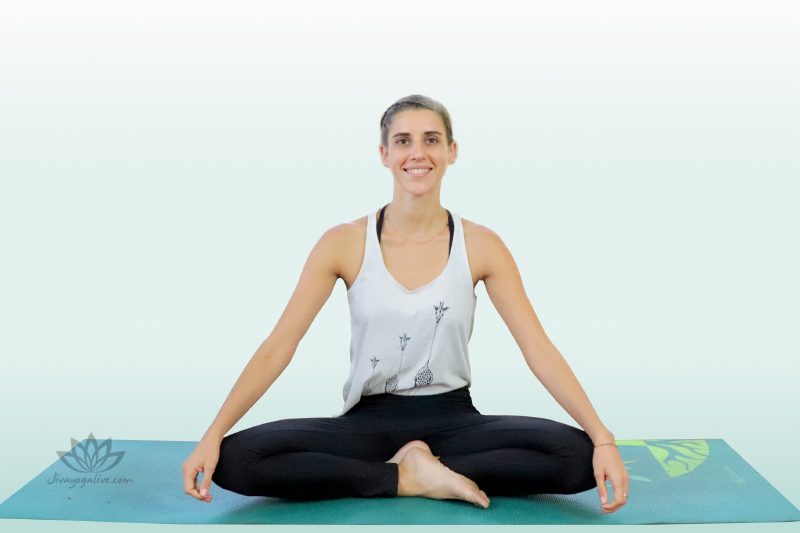
Easy Pose -Sukhasana
Sit in any comfortable position that allows you to keep your back upright. This exercise will help you to locate your pelvic floor. Start by engaging your anus, contracting it without engaging anything else. Then move on to your urethra, trying to contract it without engaging anything else.
To do so, the action is the same as when you’re peeing and trying to stop the flow midstream. Then put your focus on the part between your anus and your urethra. Try to lift up this part without engaging the rest. In yoga we call this mula bandha.
Take your time exploring the sensations, and if you don’t feel much, don’t worry, it will come with practice.
Funny Walk
This is a silly little exercise to start working on your pelvic floor with the synchronization of the breath. Start at the back of your mat, feet hips-width apart and slightly open. Take a step forward, extend your legs and engage your pelvic floor, lifting everything up inside. On the exhale, bend your knees a little and relax everything.
Take a second step forward on your inhale, engaging the pelvic floor, and repeat this exercise as you walk all the way to the top of your mat and back to where you started.

Garland Pose Malasana
Place your feet hips-width apart, the toes turning outward and come down to a deep squat position, maybe placing a block below your butt for more comfort. Place your hands in prayer at your heart center and open the chest by pushing your elbows into your shins.
On every inhale, lift up your pelvic floor, on every exhale, let everything relax. Do 10 to 20 rounds of breathing.

Bridge Pose – Setu Bandhasana
Lie down with your back on the floor and your feet close to your hips, knees pointing towards the ceiling. On every inhalation, lift up your hips and press them away from the floor as much as you can while engaging your pelvic floor muscles.
On every exhalation, bring the hips back down and relax everything. Do 10 to 20 rounds of this movement, synchronizing your breathing and the motion.

Featured Video: Easy Pelvic Floor Exercises For Pregnancy

Conclusion
I can’t stress enough how much those pelvic floor muscles exercises are important for everybody and even more during pregnancy.
You can practice them during your yoga session but you can also practice them anywhere, anytime as it is an invisible yoga exercise.
When you’re driving, working, waiting in line, cooking, brushing your teeth… Just maintain the synchronization with the breath, lifting everything up on the inhale and relaxing on the exhale. It is better to practice this exercise a little bit at a time but often rather than a big session once a week.
You want ideally to make it become a part of your routine so that you will be doing them without even thinking about it!
About
Clementine
Clementine is a multi-style prenatal yoga teacher, world traveler and animal lover. She started yoga back in 2015 and fell in love with this beautiful ancient practice. Read More..
8 Easy Exercises For Pain In Neck and Shoulders

Blocked Nose Yoga: Clear Sinuses with Targeted Pranayama and Poses

Blocked Nose Yoga Infographic

Easy Pose – Sukhasana
Come into a cross legged seated position, removing any extra flesh from underneath the sitting bones to promote length through the spine. Hands can rest down in the lap or on the knees. Spend a few moments grounding the body and the mind and close the eyes. With each breath in, lengthen the spine up nice and tall and with each exhale relax the shoulders down away from the ears. This simple seated pose combined with conscious breathing is going to help ground the body and bring awareness away from the mind. As you sit and rest in this simple pose, actively release tension from the shoulders, chest and face in order to help with any congestion that has built up in these areas.

Breath of Fire – Kapalabhati
Continue to breathe in and out through the nose, but focus on the exhales by vigorously pushing the breath out through the nose while pulling the belly in. Trust that the inhales will come naturally. Perform this breath for 20 seconds and then rest, bringing the hands down to the lap. Close the eyes and focus on the third eye or take the gaze to the nose.Breath of Fire is going help to release any congestion in the nose, while building an internal heat in the body to help loosen and release any mucus that has become congested. Sometimes this Pranayama technique can cause mild dizziness, so in order to counter this brings one hand to the heart and one to the belly to help ground and establish equilibrium.

Face Yoga
Using two fingers from each hand, gently tap around the nose to increase the blood circulation to this area. Do this for about 20 seconds, and then using the same two fingers start to tap along the inside of the eyebrows. Next, start to gently push into the skin; pulling down underneath the eyes and at the sides of the nose. Press in and pull out the skin all around the nose, cheeks and the brow.Gently pulling and tapping is going to help stimulate the areas and relieve congestion from the face and throat and encourage the lymphatic system to drain out through the nose. These micro movements invite fresh oxygen which helps to wake up the system and create some extra room for that mucus to move through.

Easy Pose Variation – Sukhasana
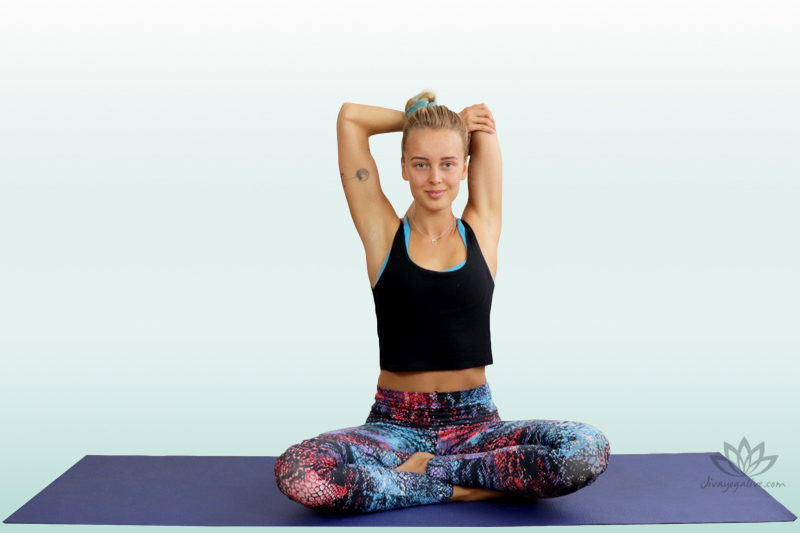
Staying seated in a comfortable Easy Pose, reach both hands up to the sky. Bend the right elbow and drop the hand down the back in between the shoulder blades. With the left hand, grab the right elbow inviting a stretch into the tricep. Focus on opening up the chest and take deep breaths to stretch into the lungs. Reach both hands up and then switch sides. Ground down into the sitting bones the entire time, lengthening up through the spine and opening the chest. Have the gaze relaxed, focused at one point or the eyes closed. This Easy Pose variation is going to strengthen and stretch the lungs and open up the respiratory system.
Downward Facing Dog – Adho Mukha Svanasana
Rock forward onto the hands and knees and send the hips high to come into Downward Facing Dog. Press into all ten fingers and stretch the legs, melting the heels down towards the mat. With a big breath in, lengthen through the side bodies stretching the rib cage, lungs and abdominal organs. Downward Facing Dog is stretching the whole body from the heels, up the legs and down the spine, while simultaneously boosting circulation and helping to clear mucus from the respiratory system.

Upward Facing Dog – Urdhva Mukha Svanasana
Move through a High Plank and then flip onto the tops of the toes and press down into the palms. Lift the knees and thighs up off the mat and come into Upward Facing Dog. Check that the shoulders are in line with the wrists and the gaze can go slightly up to lengthen the back of the neck. Actively draw the shoulders down away from the ears and shine the heart forward to continue stretching the front of the chest. Big breaths in here to open into the full capacity of the respiratory system.

Camel Pose – Ustrasana
Come to kneeling and if there is sensitivity in the knees there is the option of rolling the mat up to act as a cushion. Start to bring the gaze up and send the arms high as you open the chest, bringing an arch into the low back. Focus on lengthening the spine and send the hips forward, gently squeezing the glutes. Bring the hands now to the sacrum for more support, fingers pointing down and move slowly to find your depth. Continue to push the hands down, to increase the space at the low back. Take a big breath in and as you exhale, stick out the tongue and create a hissing sound. To come out of the pose safely, bend the knees and fold down, bringing the hips down towards the feet, coming into a kneeling posture. Bring one hand to the heart and one to the belly. Camel Pose is deep heart opening posture that increases circulation in the chest while stretching the lungs. This will help to remove the mucus that has become stuck and is causing blockages.

Featured Video:Yoga For Nose Blockage
Yoga for sinus allergies
Allergic responses are triggered by a variety of different environmental allergens; foods, dust, pollen and mold, to name a few and can wreak havoc on our respiratory system, makes our eyes and nose run. They can make heading to yoga class a little too hard basket, but luckily there are some simple postures you can practice at home. If you have access to a bed or a floor, you can invert the body. No excuses. Inverting the body is an effective means of opening up the nasal passage and combating against these sinus allergies. This doesn’t mean you have to throw yourself into a handstand, unless you can, then for sure, go get yourself upside down. BUT, if that is not in your practice, there are many more simple poses that are going to get the body above the head and get that congested mucus draining out.
Fish Pose – Matsyasana
Fish Pose is going to open the respiratory system as you stretch the lungs, chest and throat, while stimulating the lymphatic system where all this congestion is backed up. Postures like this one are going to help strengthen the respiratory system so that the body is better able to defend against allergens which are causing your allergic response.
Supported Shoulder Stand – Salamba Sarvangasana
This posture is going to open the nasal canal and encourage the sinuses to drain which will relieve pressure from the head and face. Fresh oxygenated blood is being directed down into the chest which will assist in clearing the respiratory tract.
Plow Pose – Halasana
This posture stretches into the back of the neck and the head and releases tension from these areas that can be inhibiting effective drainage of congestion in the head and sinuses.
Pranayama for blocked nose
Depending on blocked the nose is, certain Pranayama techniques might be able to provide some relief. If the blockage is severe then forceful breathing in and out of the nose is not advised, as it will likely just be too difficult and uncomfortable. However for mild congestion the technique Anulom Vilom can help to encourage a free flow of air in and out of the nasal passage.
Alternate Nostril Breathing Preparation – Anulom Vilom
Relax the body in a comfortable seat and bring the first two fingers of the right hand to rest in between the brows, in the space of the third eye. Block the right nostril with the thumb and then inhale up the left nostril completely. Cover the left nostril with the ring finger and exhale down the right. Inhale up the right nostril completely and then cover with the thumb. Exhale down the left nostril. Inhale up the left nostril completely, then cover with the ring finger. Exhale down the right nostril. Continue this practice for ten round and then rest with the hands in the lap. Perform a total of three rounds and then allow the breath to return to its natural rhythm of breathing.
Yoga for sinus headache relief
Headaches can range from mild to severe, but regardless of their level of intensity, we are so quick to reach for pain meds to dull the ache. These unfortunately only act as a temporary band aid solution and offer nothing in the way of healing or prevention.
Research has shown that yoga can effectively manage headaches, in regards to the intensity of the pain experienced during an attack and the frequency of their overall occurrence. So try some yoga instead, and see if you can actually get to the root cause of your suffering, by releasing tension in the muscles, draining the sinuses and dissolving congestion.
Blocked Nose Yoga therapy for sinusitis
Sinusitis is a condition where there is inflammation present in the membrane lining the sinuses and the suffering can be much more severe than that caused by seasonal allergies or other environmental allergens. There can be facial pressure, nasal congestion and discharge, pain in the face, jaw and teeth and even a diminished sense of smell. The most typical form of intervention is a course of antibiotics, which the body can develop resistances to over time and can wreak havoc on gut health. Research was conducted in order to find out whether or not there is a scientific basis for yoga therapy in the treatment of sinusitis and found that some Yogic Pranayama techniques are highly effective in ventilating the sinuses.
Bhramari, also known as the Humming Bee Breath is thought to help prevent infection and reduce inflammation.
Humming Bee Breath – Bhramari Pranayama. Bring the thumbs to rest gently in the opening of the ear canal. Bring the index fingers to meet at the brow, the space of the third eye. Bring the remaining three fingers to rest gently on either side of the bridge of the nose, covering the eyes. Inhale through the nose and as you exhale out the nose, create a humming sound as you drop the chin down towards the chest. At the end of the exhalation, take a breath in as you bring the head back up. Complete six rounds of Humming Bee Breath creating an audible humming sound, and then complete six more in silence, imaging the humming vibration. Notice if you can still sense the vibrations in the sinuses.
Conclusion
Sinus congestion and a blocked nose can make going to yoga class a little unappealing, but there is no reason to not roll out the mat at home or even practice some face yoga or some conscious breathing at your desk, in your car or in the comfort of your own bed. Clear the sinuses while at the same time clearing the mind and rest, rest, rest!
You are now armed with a more holistic means of unblocking the nose and fighting congestion in the body, as opposed to taking pharmaceutical interventions which only mask symptoms for a couple of hours and offer nothing of substance to the mind.
Take your time with this practice and be gentle. Trust that blockages will dissolve as you move and stretch the body, inviting in fresh oxygen and space so that excessive mucus can move through and out.
Ready to take your healing further? Click here to access yoga courses and start your journey toward lasting wellness today.
About
Charlie Hanna
Charlie is a Yoga Alliance certified Hatha, Yin Yoga & Meditation teacher with a psychology degree in her back pocket. She is currently on a mission, chasing sun and Read More..
4 Easy Yoga Poses For Constipation During pregnancy

Chair Yoga For Pregnancy

Pelvic Floor Muscle Exercises Yoga: Strengthen Your Core and Improve Bladder Control

Training your pelvic floor muscles is as necessary as training any other muscle. In this video we will go through five different pelvic floor muscle exercises yoga on how to train your pelvic muscles. A lot of people are not familiar with how it works so I’ll break it down for you so that even if it would be your first time, you’ll have no problem understanding what’s going on.
5 Pelvic Floor Muscle Exercises Yoga Infographic

Mountain Pose – Tadasana
Come standing in a Mountain Pose, with your legs together, shoulders rolled back and spine straight. Let’s start by a simple exercise. Place a block in between your thighs and squeeze it.
You should be feeling your pelvic muscles contracting themselves. Squeeze the block for 5-10 breaths at a time and release. Let’s repeat this 3 times. Remember to breath even if you’re squeezing. When done, come laying on your back.

Bridge Pose Variation – Setu Bandhasana
Pull knees close to your buttocks and place a block between your thighs. Place arms beside your body and start lifting your pelvis up slowly, keeping your upper back on the floor.
Breathe in and out and release. Let’s repeat this consciously 10 times. Then exhale, release your block and bring the soles of your feet together.

Reclined Bound Angle Pose – Supta Baddha Konasana
Inhale, relax your pelvic floor, let your knees drop on the sides. Stay here for a little and just see how your body feels. Inhale, and exhale push your knees up together. Whilst you push your knees up, lift your pelvic floor slightly up and contract your abs, so that you feel the pulse. Repeat 10 times.

Happy Baby Pose – Ananda Balasana
Exhale, bend knees to chest, toes pointing towards the roof and inhale, grab a hold of your feet (hands outside of legs). If you can’t reach your legs, hold onto a strap. Make sure your ankles are on top of your knees in a 90 degree angle. Bringing them to your armpits. Gently start pushing your legs up whilst you drag them down with your hands.

Legs-Up-the-Wall Pose – Viparita Karani
Next, move close to a wall so that you can lift your legs up and place either a blanket or a block underneath your buttocks. If your knees feel like they are more comfortable bent or your pelvis is tucked in, come a little off the wall.
First we will do a little exercise with our legs so after adjusting yourself, making sure your upper body is comfortably on the ground (place something underneath upper back and head if you can’t relax). Open legs slowly, not all the way but just so that you feel a little stretch, and then pull them back together. Repeat five times slowly.
Then we will just keep our legs up so if this feels hard you might want to strap a yoga belt around your shins to keep them together.
Now just relax, let your legs rest on the wall for as long as it feels necessary for you today. You can even place something on your eyes and have a meditative moment in here.

Featured Video:5 Good Pelvic Floor Muscle Exercises Yoga
About
Sara
I went to Tattvaa Yogashala which was the first Ashtanga school brought to Rishikesh by Yogi Kamal Singh Ji. I truly enjoyed learning about the philosophy of yoga Read More..
Ready to take your yoga practice further? Click here to access yoga courses to start your journey toward lasting wellness today.
How to Modify Yoga for Pregnancy: Keep your Practice Safe and Effective

How to modify yoga for pregnancy begins with understanding the powerful transformation a woman’s body undergoes during this incredible time. The journey of pregnancy brings about extraordinary physical changes, from increased blood volume to the creation of an entirely new organ—the placenta. The uterus itself expands dramatically, from about 5 to 8 cm to as much as 38 cm in length and 26 cm in width, resulting in the beautiful and visible baby bump. These anatomical and hormonal shifts require conscious adaptations to daily life, including your yoga practice.
Why Yoga Must Evolve During Pregnancy
As your pregnancy progresses, your body continues to change in remarkable ways. Joints soften due to hormonal changes, breasts enlarge, and the center of gravity shifts significantly. These factors influence what is comfortable and safe, both off and on the yoga mat. This is why knowing how to modify yoga for pregnancy is essential for maintaining a supportive, safe, and nurturing practice.
Common Limitations and New Needs
Many daily movements and traditional yoga poses become less accessible as the pregnancy advances. For example:
- Lying on the belly is no longer an option.
- Resting on your back without support may lead to discomfort or compromised circulation.
- Balancing poses can become risky due to your shifting center of gravity.
- Deep backbends may place undue stress on the abdomen.
Recognizing these shifts is the first step in modifying your yoga practice to meet your changing needs.
Smart Tools for Pregnancy Yoga Modifications
The good news? You can absolutely continue to enjoy yoga throughout pregnancy by creatively using props such as:
- Blocks for added height and support
- Blankets or pillows for comfort and joint protection
- Chairs or walls for stability in standing or balancing postures
These tools help maintain the integrity of the poses while ensuring they are tailored to support your evolving body. Learning how to modify yoga for pregnancy involves creativity and a deep respect for what your body needs at each stage.
How to Modify Yoga for Pregnancy – Adapting 10 Common poses
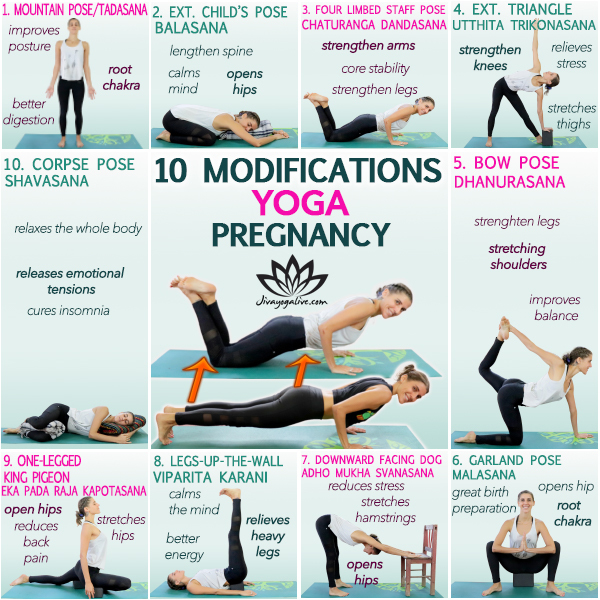
This article focuses on 10 widely practiced yoga poses and shows you exactly how to modify yoga for pregnancy so you can continue your routine safely and comfortably. Each modification prioritizes your comfort, safety, and the unique physiological changes occurring during pregnancy. From gentle twists with ample space for the belly to wide-legged forward folds supported by blocks, these tweaks allow you to maintain mobility, reduce stress, and enjoy the meditative benefits of yoga throughout your trimesters.
10 yoga poses modified for pregnancy infographic
Mountain Pose Modification- Tadasana
The traditional mountain pose is practiced with the feet touching each other. During pregnancy, the body can fall out of balance more easily due to the rapid changes of shape and weight. The solution here is to simply open your feet hip width apart to make sure you are not arching your lower back by tucking the pelvis in to avoid back pain.

Extended Child’s Pose Modification – Balasana
Child’s Pose is a great pose to release the tension in your lower back and relax during a sequence. As your belly grows, open your knees wider to create more space for your abdomen. You can also rest your forehead on a block or blanket to keep your upper body away from the floor.

Four Limbed Staff Pose Modification – Chaturanga Dandasana
You may be able to perform Chaturanga (the yoga “push ups”) normally during the first trimester. But when your belly gets bigger and heavier, it might be a little more tricky. The easy solution is to place your knees on the floor and to engage your lower back to prevent it from arching.

Extended Triangle Pose Modification – Utthita Trikonasana
Triangle Pose is an amazing stretch for the hips and side body. A simple way to make it more comfortable is to put a block underneath your hand. It will allow you to go deeper into the posture and to create more space for you to twist open.

Bow Pose Modification-Dhanurasana
All the poses on the belly are a big no-no. But it doesn’t mean you have to give up front body stretches. You can replace the traditional bow pose with tiger pose. It will stretch your shoulders and strengthen your leg the same way, as well as being a good balancing exercise accessible during pregnancy.

Garland Pose Modification – Malasana
This is a very great pose to practice throughout your pregnancy as it is a great exercise for birth preparation. If your hips or your calves are too tight, you can make the pose more comfortable by placing a rolled blanket underneath your heels or by sitting down on a block.

Downward Facing Dog Pose Modification – Adho Mukha Svanasana
Downward Facing Dog is a safe pose to practice as it is during pregnancy. But if your wrist are making you suffer when you put weight on them, you can still practice a modified version of this posture. Placing your hands on a chair, walk back until your arms are straight and your upper body is long, keeping the legs extended. Push into your hands to activate the shoulders and let your chest soften towards the floor.

Legs-Up-the-Wall Pose Modification – Viparita Karani
Legs-up-the-Wall can be your solution if you’re experiencing heavy and/or puffy legs during your pregnancy. In the first and most of the second trimester, you can practice it just as it is. But when your belly and baby get bigger and it is no longer comfortable to lie on your back, you can place a blanket or two under your hips to keep them elevated and be able to enjoy this relaxing posture.

One-Legged King Pigeon Pose-Eka Pada Raja Kapotasana
This is another common pose that holds many benefits for pregnant ladies as it helps to open the hips and reduce back pain. You can make it more comfortable by placing a block or blanket underneath your front hip. If you want to fold forward, you can create extra space for your belly by placing another block under your back thigh.

Corpse Pose Modification – Shavasana
As the belly gets bigger and the weight of the baby increases, it can become very uncomfortable to rest for a while on your back. There is also a risk that the weight of the baby presses onto veins responsible to carry the oxygen and energy for the baby so it is better to avoid it from week 30 and onward.
You have several options to pimp up your Shavasana. You can place many pillows under your back to keep the upper body higher than the hips (also works for sleeping). Or reverse, placing enough pillow under your knees and hips to elevate the hips. Or you can lie on your side with a pillow underneath your head and between your thighs. Your pick!

Featured Video: Yoga Pose Modifications For Pregnancy
Conclusion
Pregnancy is not a disease (even though it may feel like one sometimes!) and if you’re experiencing an uncomplicated pregnancy, few things are out of your reach. Like the saying goes “there is no problems, only solutions!”.
You might not be able to practice yoga the way you’re used to or to perform everyday life tasks just like you normally do. But there is always a way around everything, let go of your expectations and let the creative juice flow! And like this other saying goes “this too shall pass”!
You will not be pregnant forever and in no time you will be rolling on your tummy again and getting back on the road to handstanding (or not!)! As always, listen to your body and enjoy your pregnancy!
About
Clementine
Clementine is a multi-style prenatal yoga teacher, world traveler and animal lover. She started yoga back in 2015 and fell in love with this beautiful ancient practice. Read More..

10 Minute Prenatal Yoga Stretches

Prenatal yoga stretches are a powerful way to counter the fatigue that many pregnant women experience. Pregnancy brings intense physical transformations that demand more energy, often leaving you feeling depleted. When combined with modern lifestyle pressures, the feeling of exhaustion can become overwhelming.
Understanding Pregnancy Fatigue
This study highlights that over the last 60 years, more pregnant women have remained in the workforce and worked further into their pregnancies. These changes reflect societal evolution and the economic necessity for many women to maintain a source of income while pregnant.
While we’ve made strides toward workplace equality and independence, the reality is that pregnancy can still be physically taxing. Fatigue is especially noticeable in the first trimester as your body begins adjusting to hormonal and structural changes. Typically, energy levels rise during the second trimester and then dip again in the third.
Why Prenatal Yoga Stretches Are the Answer
In an ideal world, expectant mothers could enjoy flexible work schedules to prioritize their wellbeing. But since most women must juggle work, personal life, and family responsibilities, fitting in self-care can seem impossible.
That’s where prenatal yoga stretches come in. You don’t need an hour-long session to experience the benefits. Even a quick 10-minute stretch can recharge your energy, ease muscle tension, and boost emotional balance. By incorporating short, intentional breaks into your day, you can significantly support your health and vitality.
How Often Should You Do Prenatal Yoga?
You might be wondering: How often should I do prenatal yoga? The answer lies in consistency over duration. Aim for small, frequent sessions—even just ten minutes daily can make a significant difference. Think of it as puzzle pieces coming together: a little yoga, a short nap, a moment of deep breathing, or a self-massage session can all help you restore and reconnect.
10 Minute Prenatal Yoga Stretches Infographic

Child’s Pose – Balasana
Start in a kneeling position and let your knees open as wide as your mat while keeping your big toes in contact. From here, let your hips sit on your feet (or keep a high seat it it’s more comfortable), resting the forehead on the floor and either extending the arms in front of you or resting them by your sides. Take a few deep breaths, inhaling all the way down into your back and releasing all tensions on the exhale.
Child’s pose is a gentle hip opener and spine lengthener. Abandon your weight to the floor, let go of the tiredness, the worries, the tensions. You are being taken care of.

Extended Puppy Pose – Uttana Shishosana
From Table Top Position (hips over knees and shoulders over wrists), keep your hips aligned vertically with your knees and start walking the hands forward, letting the chest reach towards the ground. Maybe rest your forehead on the floor or maybe rest your chin. Take 5 to 10 breaths in this position and let gravity do the work for you.
Extended Puppy Pose is a heart opening pose that stretches nicely your spine and shoulders, helping to release all the tensions stuck in this area. It also can help you to breathe more deeply by creating more space for the lungs.

One-Legged King Pigeon Pose – Eka Pada Raja Kapotasana
From Plank Pose, place your right knee next to your right hand, and right foot as close as possible to your left hand. Extend the back leg making sure it’s aligned with your hip and let your hips sink towards the floor. You can also place a block or blanket below your right buttock to maintain your hips leveled. Take 5 to 10 deep breaths in this posture and switch side.
Pigeon Pose is a hip opener posture, which is ideal for getting rid of the tension in the lower back and reducing back pain in pregnancy. It can be very useful if you’re suffering from sciatica.

High Lunge Pose Variation with cactus arms – Alanasana
From Plank, bring your right foot in between your hands and press firmly the back foot on the floor, toes tucked. Engage your leg muscles and let your torso rise, arms extended overhead.
Make sure your front knee is not going over the right ankle. Inhale and reach high with your hand, exhale, bend the elbows to 90 degrees and push your chest forward. Repeat this motion combined with the breath for 5 to 10 times and repeat on the left side.
High lunge is a basic posture with many benefits. You’re building strength in your legs while working on your balance and opening your chest and shoulders. This is also a good posture to include in your practice regularly if you’re suffering from sciatica.

Wide-Legged Forward Bend – Prasarita Padottanasana A
From high lunge, straighten your legs and face the side of your mat, both feet parallel. The wider the feet, the easier the posture.
Place your hands flat on the floor on the same line as your feet and let your head reach towards the ground, pressing your inner thighs together and lengthening your spine. Take 5 to 10 breaths in this position.
This posture helps to create space in the groin area, stretching your hips and hamstrings. As the head is below the hips, you will also enjoy the benefits of any inversion. More clarity, less anxiety and nicer skin!

Garland Pose – Malasana
Place your feet mat width apart with the toes facing outwards and then simply let your hips sink towards the floor. If your heels are coming off the floor, you can place a blanket underneath them or you can place a block underneath your hips to sit on.
Place your hands together at your heart center and press the elbows into your shins, opening the chest and lengthening the back. Take a few long deep breaths here.
Garland Pose is one of the top poses to practice during your pregnancy. Opening your hips and strengthening your pelvic floor, helping your body get ready for birth.
Sideways Easy Pose – Parivritta Sukhasana
Sit in an easy seat, shins crossed and a blanket under your buttocks if it feels more comfortable. Let your right hand find the floor next to you and reach your left hand towards your right, trying to open the chest to the ceiling at the same time.
If it feels comfortable, rest your right elbow on the floor to deepen the stretch. Breathe deeply a couple times in your side body and switch sides.
This posture works on your hip flexibility while stretching your side body, liberating more internal space for deep breathing and better oxygenation.

Legs-Up-the-Wall Pose – Viparita Karani
Seat with your body close and parallel to a wall. Lie down on your side, body away from the wall. Then roll onto your back and extend your legs up the wall. If need be, wiggle your hips closer to the wall. You can also place a pillow under your hips if you’re over 30 weeks pregnant. Stay here and relax, breathing mindfully.
This is the pose for heavy legs during pregnancy. You can use it to finish any yoga practice or any time you want to just rest and relax. Your legs will feel lighter and you will feel overall better thanks to the extra amount of blood coming into your upper body.

Featured Video: 10 Minute Prenatal Yoga Stretch & Flow
Conclusion
Incorporating prenatal yoga stretches into your daily routine is one of the most effective ways to manage fatigue during pregnancy. All the pregnancy pains and ailments are not a fatality. There is always a solution to improve your wellbeing and overall comfort. Time being scarce should not have to be a problem either. Plan for yourself little 10 minute self-care dates throughout your day. It’s all about the quality and not the quantity right?!
And know that if you’re struggling with fatigue during your first trimester, it usually gets better as you move forward along your pregnancy.
In the meantime, take as many little breaks as you can!!
Want more short, revitalizing flows for pregnancy? Click here to access our full prenatal yoga course and start nurturing your body and spirit today.
About
Clementine
Clementine is a multi-style prenatal yoga teacher, world traveler and animal lover. She started yoga back in 2015 and fell in love with this beautiful ancient practice. Read More..
