Nine Yoga Poses for Reflux Acidity

This article is going to set you up with the tools needed to combat against digestive disturbances like reflux acidity and indigestion so that you have an alternative to over the counter drugs and a means of keeping stress and discomfort at bay. 

I remember when I was a beginner and first started out on my yoga journey,”by myself” and this was before it began to dominate the online realm. I had heard great things, but had no clue what I was doing. I would spend an embarrassing few minutes trying and failing to get into the splits, feel defeated and call it quits for the day.

Resigning to the idea that I was just not born into a body that could stretch that way. (Too hard basket) Eventually I found a studio that I liked and this gave me a little more insight into what it was all about (I still couldn’t do anything that resembled the splits), but I still felt that as I needed the structure of a class and the guidance of a teacher in order to practice. This also kept me accountable, as even though my intentions were great, rarely did I follow through with a full hour when left to my own devices.

Over time as I started to reap  yogic rewards here and there; a slightly more flexible body and a hugely more stable state of mind. I really started to prioritise my practice. I didn’t just want to float around on my yoga high on the days when the studio timetable fitted, I wanted that buzz everyday. So it was time to start practicing at home. This is the great thing about yoga! When you are consistent, the ball starts rolling and then there really is no stopping it. Even if you don’t practice for sometime, you will ALWAYS come back to it. Once you know, you know.

Once I made a commitment to practicing at home, I realised it didn’t have to be an hour and a half every time. It didn’t have to be an hour. Even just fifteen minutes a day, and my world around me began to shift profoundly. It no longer mattered if I could make it to class or not. I could always find at least ten minutes to stretch the body and the mind, connect to the breath and the beauty of the present moment. The effects were phenomenal. How to start yoga by yourself is a beginner guide which will dive deep into all the things needed to start a good yoga practice from home.

childs pose vector

TRAINING TYPE: FLOW SEQUENCE

CATEGORY:YOGA

SUBCATEGORY:BEGINNER YOGA

PLANNED TIME:10-15 MIN 

LEVEL:BEGINNER  

PROPS:NONE

What Is The Best Way to Start Yoga?

​ 

The best way to begin yoga, is to just start! All you really need is yourself and an open mind.  If you don’t have a mat, roll out a towel or sarong. If you don’t have props like blocks and straps, find things around the home like books and a belt. Use cushions for support and jump online to find yoga videos that you can connect with and suit the level you are at. Once the ball is rolling, it’s much easier to commit to practicing. Over time you can work on getting all the right equipment and creating a space that invites you in every day.

There is no end goal with yoga, the journey is life long and every step should be enjoyed. It’s always important to listen to your body and respect where it’s at and trust in the process. Over time and with commitment the body and the mind will expand and grow.

It doesn’t take long until you’ll start to notice the benefits across all aspects of your life. The best rewards from yoga are actually those you reap out in the world and in your relationships with others and with yourself. That quiet, calm mind that you cultivate on the mat, will start coming with you to other places. You’ll find yourself more content in the moment and less triggered or caught up in the stories of the mind. All of this and more is yours when you start practicing yoga regularly, so what are you waiting for?

What will you need to start a good at home Yoga Practice?


All you really need is yourself and an open mind. Also, preferably a yoga mat, but if you don’t have one right now, even just a sarong or towel will suffice! When it comes to props, they are not essential, but there are so many things lying around the house you’ll be surprised you can use. Instead of a block you can use books. Grab a belt in the place of a strap and instead of a bolster grab yourself a blanket and roll it up.Create the SpaceCreating a space that is inviting and conducive to stillness can really help motivate you onto your mat and into your practice. You know what they say about a clean room being the key to a clear mind, well it’s definitely true. We want to create a space that is a reflection of the state of mind we are trying to cultivate – quiet, clear and free from distraction! This will help set the tone and drop you into the zone a little easier. Jump OnlineIf there isn’t the confidence there yet to lead yourself through a practice, there is still absolutely no reason to not practice at home! There are so many teachers and yoga videos online to offer you support and guidance, you might just have to flick through a few videos to find one that resonates.

The great thing about the online yoga realm, is that there is an abundance of options out there. You can really get specific with what you are after, what parts of the body you want to target and how long you want to practice for. Schedule a TimeIf you’ve gone through all of these steps, then you’re pretty much ready to go. All that’s left is to get on your mat! However, we all know It’s one thing to plan and create the space to do yoga at home, but actually committing to your practice, that’s another thing entirely. In order to make sure you see it through, it’s recommended to schedule a time in advance.

Yoga is only going to be effective if you are persistent and show up regularly! One of the benefits of a home practice is that you aren’t restricted to a specific class schedule or length of class. This can also be your downfall as there is no teacher or time frame to keep you accountable. So with that in mind, I recommend looking at your week ahead and scheduling a time in advance to practice and treat it like a non-negotiable appointment. Aim for a minimum of 15 minutes, it’s short enough that it’s not overwhelming, but still long enough that it will encourage a steady habit.

Yoga Practice at Home Sequence

We will break down the steps needed to be taken to set up a successful home yoga practice for beginners. It goes over what is needed, the type of space you want to create, the importance of scheduling a time and finding a videos online that can provide guidance until there is more confidence in practicing alone.

When you are practicing at home without support it is important that you listen to your body and take modifications when needed. Never be afraid to simply rest in Child’s Pose and don’t push yourself past your limits, as the body takes time to open up. The real benefits of yoga are the transformations you start to see off of the mat, and they will come with consistent practice. Trust the process and enjoy the ride.

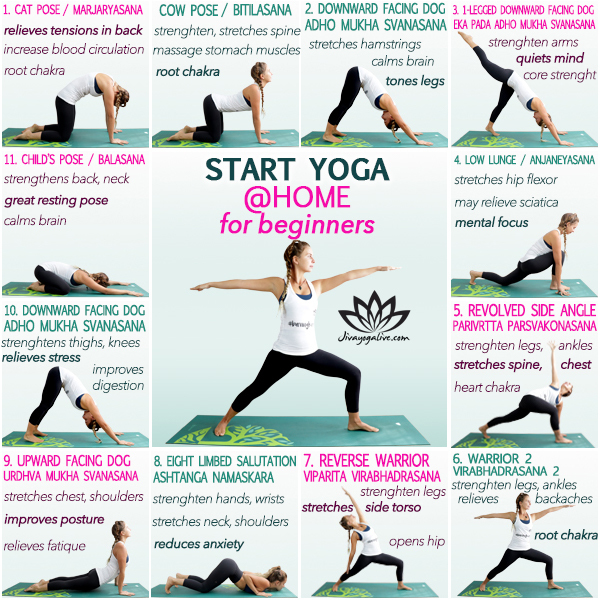
Start Yoga at Home For Beginners ​Infographic 

how to start yoga at home for beginners infographic

Cat-Cow – Marjaryasana-Bitilasana 

Coming into a Table Top position, making sure that the wrists are in line with the shoulders and that the knees are in line with the hips. Spine is neutral, head and neck in one line, and the gaze is slightly down and towards the top edge of the mat. Inhale, drop the belly down, take the heart forward, arching the back, coming into Cow.

Exhale and move into Cat Pose by pushing into the palms, rounding the upper back, bringing the belly button back towards the spine and dropping the chin to the chest. Inhale, again coming forward, opening the chest. Exhale, pushing back, rounding the spine. It’s good to work through a few rounds of these Cat-Cow movements in order to warm up the spine and let it know we’re going to move into it.

This pose mobilises the spine, shoulders and the neck and is the perfect warm up for all levels of yogi. It is a gentle way of preparing the body and the spine for deeper stretches and is a safe way of relieving tension from the back.

cat-cow

Downward Facing Dog – Adho Mukha Svanasana

Tuck the toes and push into the palms and take the hips up into Downward Facing Dog. Start by pedalling out the legs and bending the knees. Pushing down into the palms, fingers are spread wide and allow the head and neck to drop.

Downward Facing Dog is an opportunity to catch you breath and balance before moving onto the other side of the body during your flow.

downward facing dog pose

One Legged Downward Facing Dog – Eka Pada Adho Mukha Svanasana

Rise the right leg back and up, coming into a One Legged Downward Facing Dog.

It is very common to dump the weight of the body into the left shoulder here, but try to keep the shoulders square by pressing evenly into both hands.

one legged downward facing dog

Low Lunge – Anjaneyasana

Bend the right knee and come forward, transferring the weight into the hands and step in between the palms, coming into Low Lunge. Hands will frame either side of the front foot and you can use the fingertips for support. There is the option to rise the back knee or you can take it down for more support. Make sure that the neck and head are in line with the spine.

In Low Lunge you can start to work into the flexibility of the back hip flexor by squeezing the gluteus muscles. Try to keep the hips square, by sending the back hip forward.
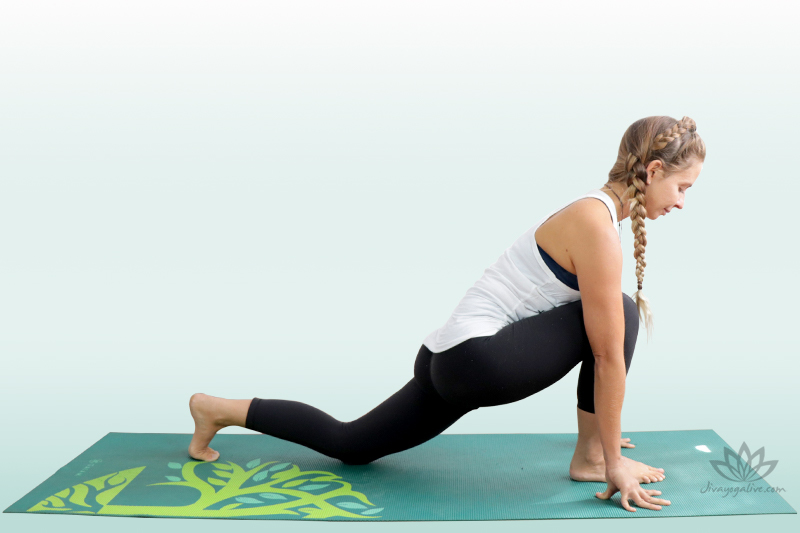
low lunge 2

Revolved Side Angle – Parivrtta Parsvakonasana 

Take the left palm and press it flat down into the earth and take the right arm. Spinning the chest open coming into an Revolved Side Angle. Gaze is up to the top hand. Really pressing down into the left palm and the ball of the back left foot. Take a breath, and open the chest more.

This pose strengthens and stretches legs, groin, hamstrings and at the same time opens the chest, the shoulders and the spine.

revolved side angle pose - twist

Warrior 2 – Virabhadrasana II  

Spin the back foot down and cartwheel the arms, coming into a Warrior Two. The front toes are facing forward, and the back foot is in on an angle. Press down firmly into the outer blade of the back foot. Arms are extending long to the sides and as you exhale, drop a little deeper, staying low in the legs.

Warrior 2 is working deep into the strength of the legs and is particularly powerful if you energetically hug the legs together. This turns on the underside of the thighs and requires strength, determination and concentration. All of this is going on, while you are cultivating balance and groundedness.

warrior 2

Reverse Warrior – Viparita Virabhadrasana   

Inhale and lean the torso forward and flip the front palm. Lean back, stretching the front hand up and back, coming into a Reverse Warrior. Stay low in the legs and find strength by hugging the feet to the midline, activating the underside of the thighs.

The key in Reverse Warrior is to stay low in the legs. It might seem like a reprieve and a moment to take rest after a strong Warrior 2, but keep in mind that the mind will often bow out before the body is ready, so see if you can stay low for a couple more breaths!

reverse warrior pose

Eight Limbed Salutation – Ashtanga Namaskara    

Cartwheel the arms down to the ground and push back into a Downward Facing Dog momentarily. Take a deep breath here and then move into Eight Limbed Salutation, also known as Knees-Chest-Chin Pose. Drop the knees directly down, take the chest down in between the palms and have the weight is in the hands. Hips and tailbone are staying up to the sky. Hugging the elbows in towards the body, with the chin slightly resting on the earth.

Knees-Chest-Chin Pose pose can seem tricky at first, but the key is to have the weight in the hands and to be drawing the elbows in towards the body. Everything else is relatively light and the chin is only gently resting on the mat.

Eight limbed salutation - ashtanga namaskara

Upward Facing Dog – Urdhva Mukha Svanasana    

Come down onto the belly and then slide forward into Upward Facing Dog. Make sure the shoulders are down away from the ears and draw the shoulder blades back and together. Exhale, and bend the elbows and lower the torso and forehead back down to the earth.

Here you are stretching and strengthening the spine and shoulders, toning the abdomen and opening the chest and lungs. The key is to really lift the chest and squeeze the shoulder blades back and together. There should be ample room between the shoulders and ears.

upward facing dog

Downward Facing Dog – Adho Mukha Svanasana  

Push back into a Downward Facing Dog and then preparing to move into the other side of the body. Notice the difference between your first Downward Facing Dog of your practice and your last. When the body is stiff this pose can feel like a full workout, but as the body warms and opens, it gets easier and easier to hang out here.

downward facing dog pose

Extended Child’s Pose – Balasana   

After finishing up the other side of the body, drop the knees down as wide as the mat and settle back into a Extended Child’s Pose. Dropping the forehead down to the earth, allow the belly to be soft in between the thighs and take rest.

This is the perfect pose to take rest in, both during and after your practice. It’s an opportunity to bring everything back into balance, to find your breath and to elongate the spine.  

Downward Facing Dog – Adho Mukha Svanasana   

extended child pose

Featured Video How to Start Yoga at Home for Beginners

Yoga Poses for Beginners

If you are still feeling a little lost on your mat, its ok, because Ive got your back :). I want to share with you some very beginner friendly poses that lay the foundations for most of the yoga flows you will be introduced to in a class. It also means if you don’t have access to the internet and an online tutorial. You can simply move through these simple poses two or three times, spend some time is Savasana (laying flat on your back) at the end and bam, you’ve got yourself a solid yoga practice. If you can get comfortable with these poses, and even better their Sanskrit names, you’ll be ahead of the game when you finally do make it into a class.

Cat-Cow – Marjaryasana-Bitilasana Moving through a few rounds of Cat-Cow is extremely juicy and therapeutic for the whole back and neck. The opposing movements allow you to both stretch and compress the spine, inviting more space and increasing mobilisation. Really be dramatic with the postures by pulling the shoulder blades apart when you’re imitating an angry cat and sucking the belly button right back to the spine in Cow. Spend a few extra minutes working into some intuitive free movement, moving the spine back and forth, the hips from side to side and taking some body rolls – anything that feels good in YOUR body in order to warm up the spine.  Downward Facing Dog – Adho Mukha SvanasanaDownward Dog is one of those poses that in the beginning it simply sucks! Your heels refuse to reach the floor, the shoulders and arms are quick to tire and it feels like your instructor is making you hang out there for hours. You’d rather drop the knees and take a Child’s Pose. However, over time, and once you have the proper alignment down, Downward Dog starts to become your home base. It becomes a pose you can relax into and it provides a reset and full body stretch between flows and the more difficult poses. The key is getting the foundations of the pose down right from the get go. I encourage you to get an instructor to guide you into the pose in class or find a tutorial online!  Low Lunge – AnjaneyasanaGet the alignment of the legs and feet right in a simple Low Lunge and you already have the the foundational base ready to jump into other standing poses, such as the Warriors! Here you have the option to work into both your strength and flexibility; and there is always the option to take a modification and drop the back knee down to the earth. This makes this pose very accessible and beginner friendly, yet you will still be working to stretch, strengthen and simultaneously improve balance and focus. Revolved Side Angle – Parivrtta ParsvakonasanaThe trick to finding some ease in the perceived effort of this pose, is to hug the feet towards the midline. This goes for all the standing poses in order to find strength and activate the underside of the legs. This will tap into your power reserves and you’ll be surprised at the strength you have. Remember, the mind will always want to quit before the body does, so when you feel like coming out of a pose, firm into the legs and see if you can find just two more breaths!

Warrior 2 – VirabhadrasanaI invite you to stand in your strength in this pose, as an incarnation of a fierce warrior, Shiva. When that front leg starts to tire, keep in mind that zen archers would practice holding a bow for two years in this position before they were allowed to shoot their first arrow. Find some ease in the effort by energetically drawing the feet towards the midline, as though you want to bunch up your mat at the middle. The aim is to stand firm and strong, yet at the same time relaxed and at ease.Cobra – Bhujangasana An energizing back bend to open the chest and heart. Bhujang means ‘serpent’, and this pose is an essential component of the Surya Namaska – the Sun Salutations. It is a powerful chest opener and at the same time, it is extremely therapeutic for the spine. It also works to stretch and tone the abdominal muscles and organs and stimulate the digestive fires.

Is Doing Yoga at Home Effective?

The more consistent you are with your yoga practice at home, the more effective it is going to become. The same with anything, consistency is the key, but this doesn’t mean that you have to practice for an hour, seven days a week! Spending twenty minutes each day on your mat, to stretch the mind and the body is going to have profound effects on your life across the board. If there are days you don’t feel up to yoga, give some meditation or Pranayama a go.

MeditationIf you are new to meditation, then the chances are that sitting in silence trying to quiet the mind is going to lead to a whole lot of frustration and very little stillness. Meditating in this way is actually very advanced, as you’ll find out quickly that it can be very challenging to quiet down the stories of the mind. A better option in the beginning is to find some guided meditations that resonate. 

Pranayama Breathing is something we do so naturally, that it requires no conscious effort. It is an involuntary action that is happening whether we are awake or sleeping. To breathe, is to live. Pranayama is the practice of controlling the breath, with Prana meaning ‘life force’ and yama meaning extending or stretching in Sanskrit. Controlled breathing can decreases the effects of stress, instil focus and mental clarity and can energize and detox the body.

One simple Pranayama technique, is known as the Cooling Breath Pranayama / Sitali Pranayama. Find a comfortable easy seat. Curl the tongue into a U shape and project it out of the mouth slightly. If you can’t curl the tongue it is fine to make an O shape with the mouth. Take the chin to the chest and then begin to inhale through the mouth, taking the chin up and dropping the neck back as far as is comfortable. Close the mouth and exhale through the nose as you drop the chin back down to the chest.

Repeat for eight to twelve breaths. Any time spent on your mat, is time well spent and over time there is an accumulative effect that takes place and the benefits start to ripple out and have a domino effect across so many aspects of your life.

How to Start Yoga When Overweight

Going into a yoga studio can seem a little daunting if you don’t think you fit the typical yogi image, but yoga can (and should!!), be practiced by everyone. At all ages and stages of life, and by all shapes and sizes. We all start somewhere and there are so many styles of yoga and variations of the poses, that make them accessible to all. If there is some doubt and anxiety in the mind though, there is the perfect opportunity here to start practicing at home.

Jessamyn Stanley is a great role model to check out! She is using yoga to promote positive body image and breaking down mental and emotional barriers to practicing. She emphasizes how you FEEL, as opposed to how you look and she celebrates her students bodies in all the shapes and sizes that they come in. She has a top selling book on Amazon called, Every Body Yoga: Let Go of Fear, Get on the Mat, Love Your Body, and I HIGHLY recommend checking that out!

Yoga is a mindset that cultivates self love and body confidence. Love your body where it is at and show it some kindness by taking this time for self care. With consistency your body will open and start to change, so enjoy the journey and allow the transformation to unfold.

Conclusion

A few things to keep in mind before you jump in! Firstly, always make sure to listen to your body. You know it best and are the only one that can hear its subtle cues. Never force your body into a pose and don’t be scared to take modifications or rest in Child’s Pose when needed. Trust that over time and with consistency your body will open up along with your flexibility. You have the necessary steps in mind now to really get your at home practice going. I promise that the hardest part is just making it onto your mat. Make the time, prioritise this self care and watch yourself blossom and grow.

This article has provided the necessary steps to establishing an at home yoga practice. Grab the essentials, create the space, find some videos online that resonate and schedule the time like a non-negotiable appointment! Prioritise taking care of yourself and loving yourself just as much, if not MORE than you love others. This is not selfish, this is KEY to being the best version of who you already are, for yourself and for others. You have to fill your cup first and yoga is a great tool to do just that.

About

Charlie Hanna

Charlie is a Yoga Alliance certified Hatha, Yin Yoga & Meditation teacher with a psychology degree in her back pocket. She is currently on a mission chasing sun and Read More..
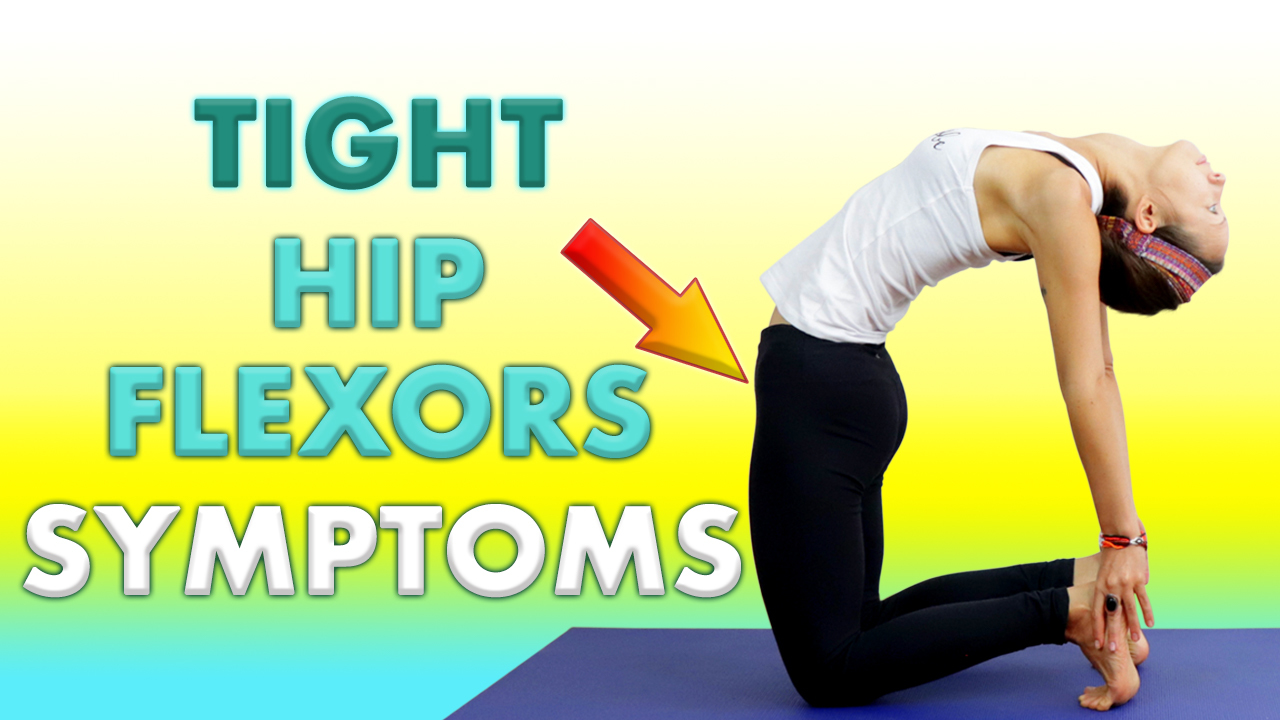
Yoga for Tight Hip Flexors: Release Tension and Improve Mobility Fast

When we push for immediate results and instant healing, we never inhabit the important in-between phase, which is where much of the learning and growth actually happen.” ― Bo Forbes, Yoga for Emotional Balance

Yoga for Tight Hip Flexors: Stretch to Relieve and Realign

Yoga for tight hip flexors offers a powerful, natural way to reduce chronic pain, improve posture, and prevent injury. The hip flexors are a group of muscles responsible for essential movements in the spine, hips, and legs. When these muscles become tight—often due to prolonged sitting or repetitive motion—it can lead to serious issues including back pain, misalignment, and mobility limitations.

Understanding the Hip Flexors and Their Role

The hip flexors connect the legs to the pelvis and spine, making them critical for walking, bending, running, and sitting. These muscles run from the lumbar spine down through the pelvis into the upper thighs. When they remain in a flexed position too long, such as during extended periods of sitting, they shorten and become tight, leading to discomfort or even injury when you attempt to extend or lengthen them.

Common Symptoms of Tight Hip Flexors

The most reported symptom is lower back pain, particularly after movements like bending or squatting. Additional signs include:

  • Discomfort in the upper legs and groin
  • Limping or cramping while walking
  • Difficulty with extension-based movements like kicking or sprinting

A simple way to test tightness: lie flat on your back in a corpse pose. If your lower back arches significantly off the floor, your hip flexors may be tight and are affecting spinal alignment.

Root Causes of Tight Hip Flexors

While genetics and activity level play roles, the most common causes include:

  • Sitting for extended periods (desk work, driving)
  • Lack of proper stretching before and after exercise
  • Overtraining with poor form in sports like running or martial arts

Runners, dancers, and martial artists are particularly prone to tight hip flexors, as their movements often involve high-impact flexion and extension.

How Yoga Can Help

Yoga for tight hip flexors combines conscious breathing with intentional stretching, promoting both flexibility and awareness. Yoga poses that focus on hip extension help lengthen these muscles and restore functional range of motion.

A Holistic Approach To Tight Hip Flexor Muscles

There is no one reason for tight hip flexors and there is no one solution. A holistic approach that considers biology and lifestyle and targets the whole body rather than one specific area is most likely to give the greatest relief. When working to create more flexibility or relieve pain, be consistent everyday. At the same time, be patient. Don’t try everything at once, this will likely only stress these muscles even more, resulting in more soreness and tightness. Just choose one or two gentle stretches or exercises to practice and practice it consistently for two weeks. 

Featured Video: Tight Hip Flexor Symptoms

Conclusion

Advice for dealing with tight hip flexors: give your body the most range of motion that you can. Incorporate more activity into your daily routines, especially if your circumstances require you to be sitting for long amounts of time. By taking even just one minute a day to stand up, make some circles with your hips, and take a few stationary lunges, overtime will increase your flexibility and relieve tightness and pain.

About

Hillary

Hillary is a natural-born wanderer and wonderer. A digital nomad and pilgrim of the heart, she often feels herself a poster child of the Spiritual Millennial. As a writer, health coach and yoga instructor Read More..

Want to learn more about yoga to unlock your hip flexors? Click here to access our complete guide and start your journey to pain free movement today.

Top 10 Post Run Yoga Poses

Today will be going through a beginner yoga sequence for runners which can be used for post and pre running.

I remember when I was a beginner and first started out on my yoga journey,”by myself” and this was before it began to dominate the online realm. I had heard great things, but had no clue what I was doing. I would spend an embarrassing few minutes trying and failing to get into the splits, feel defeated and call it quits for the day.

Resigning to the idea that I was just not born into a body that could stretch that way. (Too hard basket) Eventually I found a studio that I liked and this gave me a little more insight into what it was all about (I still couldn’t do anything that resembled the splits), but I still felt that as I needed the structure of a class and the guidance of a teacher in order to practice. This also kept me accountable, as even though my intentions were great, rarely did I follow through with a full hour when left to my own devices.

Over time as I started to reap  yogic rewards here and there; a slightly more flexible body and a hugely more stable state of mind. I really started to prioritise my practice. I didn’t just want to float around on my yoga high on the days when the studio timetable fitted, I wanted that buzz everyday. So it was time to start practicing at home. This is the great thing about yoga! When you are consistent, the ball starts rolling and then there really is no stopping it. Even if you don’t practice for sometime, you will ALWAYS come back to it. Once you know, you know.

Once I made a commitment to practicing at home, I realised it didn’t have to be an hour and a half every time. It didn’t have to be an hour. Even just fifteen minutes a day, and my world around me began to shift profoundly. It no longer mattered if I could make it to class or not. I could always find at least ten minutes to stretch the body and the mind, connect to the breath and the beauty of the present moment. The effects were phenomenal. How to start yoga by yourself is a beginner guide which will dive deep into all the things needed to start a good yoga practice from home.

childs pose vector

TRAINING TYPE: FLOW SEQUENCE

CATEGORY:YOGA

SUBCATEGORY:BEGINNER YOGA

PLANNED TIME:10-15 MIN 

LEVEL:BEGINNER  

PROPS:NONE

What Is The Best Way to Start Yoga?

​ 

The best way to begin yoga, is to just start! All you really need is yourself and an open mind.  If you don’t have a mat, roll out a towel or sarong. If you don’t have props like blocks and straps, find things around the home like books and a belt. Use cushions for support and jump online to find yoga videos that you can connect with and suit the level you are at. Once the ball is rolling, it’s much easier to commit to practicing. Over time you can work on getting all the right equipment and creating a space that invites you in every day.

There is no end goal with yoga, the journey is life long and every step should be enjoyed. It’s always important to listen to your body and respect where it’s at and trust in the process. Over time and with commitment the body and the mind will expand and grow.

It doesn’t take long until you’ll start to notice the benefits across all aspects of your life. The best rewards from yoga are actually those you reap out in the world and in your relationships with others and with yourself. That quiet, calm mind that you cultivate on the mat, will start coming with you to other places. You’ll find yourself more content in the moment and less triggered or caught up in the stories of the mind. All of this and more is yours when you start practicing yoga regularly, so what are you waiting for?

What will you need to start a good at home Yoga Practice?


All you really need is yourself and an open mind. Also, preferably a yoga mat, but if you don’t have one right now, even just a sarong or towel will suffice! When it comes to props, they are not essential, but there are so many things lying around the house you’ll be surprised you can use. Instead of a block you can use books. Grab a belt in the place of a strap and instead of a bolster grab yourself a blanket and roll it up.Create the SpaceCreating a space that is inviting and conducive to stillness can really help motivate you onto your mat and into your practice. You know what they say about a clean room being the key to a clear mind, well it’s definitely true. We want to create a space that is a reflection of the state of mind we are trying to cultivate – quiet, clear and free from distraction! This will help set the tone and drop you into the zone a little easier. Jump OnlineIf there isn’t the confidence there yet to lead yourself through a practice, there is still absolutely no reason to not practice at home! There are so many teachers and yoga videos online to offer you support and guidance, you might just have to flick through a few videos to find one that resonates.

The great thing about the online yoga realm, is that there is an abundance of options out there. You can really get specific with what you are after, what parts of the body you want to target and how long you want to practice for. Schedule a TimeIf you’ve gone through all of these steps, then you’re pretty much ready to go. All that’s left is to get on your mat! However, we all know It’s one thing to plan and create the space to do yoga at home, but actually committing to your practice, that’s another thing entirely. In order to make sure you see it through, it’s recommended to schedule a time in advance.

Yoga is only going to be effective if you are persistent and show up regularly! One of the benefits of a home practice is that you aren’t restricted to a specific class schedule or length of class. This can also be your downfall as there is no teacher or time frame to keep you accountable. So with that in mind, I recommend looking at your week ahead and scheduling a time in advance to practice and treat it like a non-negotiable appointment. Aim for a minimum of 15 minutes, it’s short enough that it’s not overwhelming, but still long enough that it will encourage a steady habit.

Yoga Practice at Home Sequence

We will break down the steps needed to be taken to set up a successful home yoga practice for beginners. It goes over what is needed, the type of space you want to create, the importance of scheduling a time and finding a videos online that can provide guidance until there is more confidence in practicing alone.

When you are practicing at home without support it is important that you listen to your body and take modifications when needed. Never be afraid to simply rest in Child’s Pose and don’t push yourself past your limits, as the body takes time to open up. The real benefits of yoga are the transformations you start to see off of the mat, and they will come with consistent practice. Trust the process and enjoy the ride.

Start Yoga at Home For Beginners ​Infographic 

how to start yoga at home for beginners infographic

Cat-Cow – Marjaryasana-Bitilasana 

Coming into a Table Top position, making sure that the wrists are in line with the shoulders and that the knees are in line with the hips. Spine is neutral, head and neck in one line, and the gaze is slightly down and towards the top edge of the mat. Inhale, drop the belly down, take the heart forward, arching the back, coming into Cow.

Exhale and move into Cat Pose by pushing into the palms, rounding the upper back, bringing the belly button back towards the spine and dropping the chin to the chest. Inhale, again coming forward, opening the chest. Exhale, pushing back, rounding the spine. It’s good to work through a few rounds of these Cat-Cow movements in order to warm up the spine and let it know we’re going to move into it.

This pose mobilises the spine, shoulders and the neck and is the perfect warm up for all levels of yogi. It is a gentle way of preparing the body and the spine for deeper stretches and is a safe way of relieving tension from the back.

cat-cow

Downward Facing Dog – Adho Mukha Svanasana

Tuck the toes and push into the palms and take the hips up into Downward Facing Dog. Start by pedalling out the legs and bending the knees. Pushing down into the palms, fingers are spread wide and allow the head and neck to drop.

Downward Facing Dog is an opportunity to catch you breath and balance before moving onto the other side of the body during your flow.

downward facing dog pose

One Legged Downward Facing Dog – Eka Pada Adho Mukha Svanasana

Rise the right leg back and up, coming into a One Legged Downward Facing Dog.

It is very common to dump the weight of the body into the left shoulder here, but try to keep the shoulders square by pressing evenly into both hands.

one legged downward facing dog

Low Lunge – Anjaneyasana

Bend the right knee and come forward, transferring the weight into the hands and step in between the palms, coming into Low Lunge. Hands will frame either side of the front foot and you can use the fingertips for support. There is the option to rise the back knee or you can take it down for more support. Make sure that the neck and head are in line with the spine.

In Low Lunge you can start to work into the flexibility of the back hip flexor by squeezing the gluteus muscles. Try to keep the hips square, by sending the back hip forward.

low lunge 2

Revolved Side Angle – Parivrtta Parsvakonasana 

Take the left palm and press it flat down into the earth and take the right arm. Spinning the chest open coming into an Revolved Side Angle. Gaze is up to the top hand. Really pressing down into the left palm and the ball of the back left foot. Take a breath, and open the chest more.

This pose strengthens and stretches legs, groin, hamstrings and at the same time opens the chest, the shoulders and the spine.

revolved side angle pose - twist

Warrior 2 – Virabhadrasana II  

Spin the back foot down and cartwheel the arms, coming into a Warrior Two. The front toes are facing forward, and the back foot is in on an angle. Press down firmly into the outer blade of the back foot. Arms are extending long to the sides and as you exhale, drop a little deeper, staying low in the legs.

Warrior 2 is working deep into the strength of the legs and is particularly powerful if you energetically hug the legs together. This turns on the underside of the thighs and requires strength, determination and concentration. All of this is going on, while you are cultivating balance and groundedness.

warrior 2

Reverse Warrior – Viparita Virabhadrasana   

Inhale and lean the torso forward and flip the front palm. Lean back, stretching the front hand up and back, coming into a Reverse Warrior. Stay low in the legs and find strength by hugging the feet to the midline, activating the underside of the thighs.

The key in Reverse Warrior is to stay low in the legs. It might seem like a reprieve and a moment to take rest after a strong Warrior 2, but keep in mind that the mind will often bow out before the body is ready, so see if you can stay low for a couple more breaths!

reverse warrior pose

Eight Limbed Salutation – Ashtanga Namaskara    

Cartwheel the arms down to the ground and push back into a Downward Facing Dog momentarily. Take a deep breath here and then move into Eight Limbed Salutation, also known as Knees-Chest-Chin Pose. Drop the knees directly down, take the chest down in between the palms and have the weight is in the hands. Hips and tailbone are staying up to the sky. Hugging the elbows in towards the body, with the chin slightly resting on the earth.

Knees-Chest-Chin Pose pose can seem tricky at first, but the key is to have the weight in the hands and to be drawing the elbows in towards the body. Everything else is relatively light and the chin is only gently resting on the mat.

Eight limbed salutation - ashtanga namaskara

Upward Facing Dog – Urdhva Mukha Svanasana    

Come down onto the belly and then slide forward into Upward Facing Dog. Make sure the shoulders are down away from the ears and draw the shoulder blades back and together. Exhale, and bend the elbows and lower the torso and forehead back down to the earth.

Here you are stretching and strengthening the spine and shoulders, toning the abdomen and opening the chest and lungs. The key is to really lift the chest and squeeze the shoulder blades back and together. There should be ample room between the shoulders and ears.

upward facing dog

Downward Facing Dog – Adho Mukha Svanasana  

Push back into a Downward Facing Dog and then preparing to move into the other side of the body. Notice the difference between your first Downward Facing Dog of your practice and your last. When the body is stiff this pose can feel like a full workout, but as the body warms and opens, it gets easier and easier to hang out here.

downward facing dog pose

Extended Child’s Pose – Balasana   

After finishing up the other side of the body, drop the knees down as wide as the mat and settle back into a Extended Child’s Pose. Dropping the forehead down to the earth, allow the belly to be soft in between the thighs and take rest.

This is the perfect pose to take rest in, both during and after your practice. It’s an opportunity to bring everything back into balance, to find your breath and to elongate the spine.  

Downward Facing Dog – Adho Mukha Svanasana   

extended child pose

Featured Video How to Start Yoga at Home for Beginners

Yoga Poses for Beginners

If you are still feeling a little lost on your mat, its ok, because Ive got your back :). I want to share with you some very beginner friendly poses that lay the foundations for most of the yoga flows you will be introduced to in a class. It also means if you don’t have access to the internet and an online tutorial. You can simply move through these simple poses two or three times, spend some time is Savasana (laying flat on your back) at the end and bam, you’ve got yourself a solid yoga practice. If you can get comfortable with these poses, and even better their Sanskrit names, you’ll be ahead of the game when you finally do make it into a class.

Cat-Cow – Marjaryasana-Bitilasana Moving through a few rounds of Cat-Cow is extremely juicy and therapeutic for the whole back and neck. The opposing movements allow you to both stretch and compress the spine, inviting more space and increasing mobilisation. Really be dramatic with the postures by pulling the shoulder blades apart when you’re imitating an angry cat and sucking the belly button right back to the spine in Cow. Spend a few extra minutes working into some intuitive free movement, moving the spine back and forth, the hips from side to side and taking some body rolls – anything that feels good in YOUR body in order to warm up the spine.  Downward Facing Dog – Adho Mukha SvanasanaDownward Dog is one of those poses that in the beginning it simply sucks! Your heels refuse to reach the floor, the shoulders and arms are quick to tire and it feels like your instructor is making you hang out there for hours. You’d rather drop the knees and take a Child’s Pose. However, over time, and once you have the proper alignment down, Downward Dog starts to become your home base. It becomes a pose you can relax into and it provides a reset and full body stretch between flows and the more difficult poses. The key is getting the foundations of the pose down right from the get go. I encourage you to get an instructor to guide you into the pose in class or find a tutorial online!  Low Lunge – AnjaneyasanaGet the alignment of the legs and feet right in a simple Low Lunge and you already have the the foundational base ready to jump into other standing poses, such as the Warriors! Here you have the option to work into both your strength and flexibility; and there is always the option to take a modification and drop the back knee down to the earth. This makes this pose very accessible and beginner friendly, yet you will still be working to stretch, strengthen and simultaneously improve balance and focus. Revolved Side Angle – Parivrtta ParsvakonasanaThe trick to finding some ease in the perceived effort of this pose, is to hug the feet towards the midline. This goes for all the standing poses in order to find strength and activate the underside of the legs. This will tap into your power reserves and you’ll be surprised at the strength you have. Remember, the mind will always want to quit before the body does, so when you feel like coming out of a pose, firm into the legs and see if you can find just two more breaths!

Warrior 2 – VirabhadrasanaI invite you to stand in your strength in this pose, as an incarnation of a fierce warrior, Shiva. When that front leg starts to tire, keep in mind that zen archers would practice holding a bow for two years in this position before they were allowed to shoot their first arrow. Find some ease in the effort by energetically drawing the feet towards the midline, as though you want to bunch up your mat at the middle. The aim is to stand firm and strong, yet at the same time relaxed and at ease.Cobra – Bhujangasana An energizing back bend to open the chest and heart. Bhujang means ‘serpent’, and this pose is an essential component of the Surya Namaska – the Sun Salutations. It is a powerful chest opener and at the same time, it is extremely therapeutic for the spine. It also works to stretch and tone the abdominal muscles and organs and stimulate the digestive fires.

Is Doing Yoga at Home Effective?

The more consistent you are with your yoga practice at home, the more effective it is going to become. The same with anything, consistency is the key, but this doesn’t mean that you have to practice for an hour, seven days a week! Spending twenty minutes each day on your mat, to stretch the mind and the body is going to have profound effects on your life across the board. If there are days you don’t feel up to yoga, give some meditation or Pranayama a go.

MeditationIf you are new to meditation, then the chances are that sitting in silence trying to quiet the mind is going to lead to a whole lot of frustration and very little stillness. Meditating in this way is actually very advanced, as you’ll find out quickly that it can be very challenging to quiet down the stories of the mind. A better option in the beginning is to find some guided meditations that resonate. 

Pranayama Breathing is something we do so naturally, that it requires no conscious effort. It is an involuntary action that is happening whether we are awake or sleeping. To breathe, is to live. Pranayama is the practice of controlling the breath, with Prana meaning ‘life force’ and yama meaning extending or stretching in Sanskrit. Controlled breathing can decreases the effects of stress, instil focus and mental clarity and can energize and detox the body.

One simple Pranayama technique, is known as the Cooling Breath Pranayama / Sitali Pranayama. Find a comfortable easy seat. Curl the tongue into a U shape and project it out of the mouth slightly. If you can’t curl the tongue it is fine to make an O shape with the mouth. Take the chin to the chest and then begin to inhale through the mouth, taking the chin up and dropping the neck back as far as is comfortable. Close the mouth and exhale through the nose as you drop the chin back down to the chest.

Repeat for eight to twelve breaths. Any time spent on your mat, is time well spent and over time there is an accumulative effect that takes place and the benefits start to ripple out and have a domino effect across so many aspects of your life.

How to Start Yoga When Overweight

Going into a yoga studio can seem a little daunting if you don’t think you fit the typical yogi image, but yoga can (and should!!), be practiced by everyone. At all ages and stages of life, and by all shapes and sizes. We all start somewhere and there are so many styles of yoga and variations of the poses, that make them accessible to all. If there is some doubt and anxiety in the mind though, there is the perfect opportunity here to start practicing at home.

Jessamyn Stanley is a great role model to check out! She is using yoga to promote positive body image and breaking down mental and emotional barriers to practicing. She emphasizes how you FEEL, as opposed to how you look and she celebrates her students bodies in all the shapes and sizes that they come in. She has a top selling book on Amazon called, Every Body Yoga: Let Go of Fear, Get on the Mat, Love Your Body, and I HIGHLY recommend checking that out!

Yoga is a mindset that cultivates self love and body confidence. Love your body where it is at and show it some kindness by taking this time for self care. With consistency your body will open and start to change, so enjoy the journey and allow the transformation to unfold.

Conclusion

A few things to keep in mind before you jump in! Firstly, always make sure to listen to your body. You know it best and are the only one that can hear its subtle cues. Never force your body into a pose and don’t be scared to take modifications or rest in Child’s Pose when needed. Trust that over time and with consistency your body will open up along with your flexibility. You have the necessary steps in mind now to really get your at home practice going. I promise that the hardest part is just making it onto your mat. Make the time, prioritise this self care and watch yourself blossom and grow.

This article has provided the necessary steps to establishing an at home yoga practice. Grab the essentials, create the space, find some videos online that resonate and schedule the time like a non-negotiable appointment! Prioritise taking care of yourself and loving yourself just as much, if not MORE than you love others. This is not selfish, this is KEY to being the best version of who you already are, for yourself and for others. You have to fill your cup first and yoga is a great tool to do just that.

About

Charlie Hanna

Charlie is a Yoga Alliance certified Hatha, Yin Yoga & Meditation teacher with a psychology degree in her back pocket. She is currently on a mission chasing sun and Read More..

8 Gentle Yoga Poses For IBS & Ulcerative Colitis

This article introduces some gentle, easy poses that are going to help to relieve symptoms of IBS and Ulcerative Colitis.

As is the story for most people, my yoga journey began with hopes of having a more flexible and bendy body. I had images of these intricate poses such as Birds of Paradise and Forearm Stand dancing in my mind; I had no idea of the kind of strength these poses required. As my yoga journey progressed, I let go of attachments to mastering any one pose and began to work on developing strength and flexibility across the whole body. If anything it was my mind that began to really strengthen before anything else. Over time I did start to build some muscle and my movements started to become much more graceful. The stronger and more open my body became, the easier my practice was and the more fluid my movements were. There are so many great poses that target strength, balance and flexibility. I always make sure to incorporate a little bit from each element into my daily practice.

TRAINING TYPE:  FLOW SEQUENCE 

CATEGORY:YOGA

SUBCATEGORY:YOGA FOR FLEXIBILITY 

 PLANNED TIME:15 MINUTES 

LEVEL:BEGINNER  

PROPS:NONE

What Are The Best Yoga Poses for Flexibility and Strength?

​ 

Standing Poses provide a great opportunity to work into both flexibility and strength – so long as we are not being lazy and dumping our weight down into our hips! With seated and supine poses we can often utilise the effects of gravity and the weight of the body to pull us deeper into poses, and there isn’t a need to exert too much effort. However, when we come up to standing, we can engage more effort by firming down into the feet and drawing them energetically in towards the midline. This turns on and activates all the muscles of the legs and allows us to simultaneously becomes stronger and more flexible.

High Lunge – Alanasana

We are tasked to find both strength and balance in this pose. The key is to create that stable base with the feet and legs. Rooting down into the feet will lend you more power so you can go a little deeper into your flexibility and open up the back hip flexor. This is notoriously tight for most people as a result of countless hours of sitting. As this area begins to stretch and open, we are simultaneously strengthening the front thigh, hamstring and glute. Warrior Two – Virabhadrasana II

This pose will strengthen and lengthen you from head to toe and is renowned for being one of the most powerful lower body strength builders. It’s important to build this pose from the ground up; firm down into the feet and activate the legs by hugging them toward the midline. Stand in your strength here and welcome any shaking in the legs, as this is a sign that you are really working into the muscles. This pose is also doing wonders above the belt, as it stretches the back, neck and shoulders. Tap into strength and relaxation and don’t forget to breathe!Reverse warrior – Viparita Virabhadrasana

When moving into this pose, there is a tendency to back off and come up out of the bend in the front knee, as you look for some relief from your Warrior Two Pose. However, the key is to staying low in the legs! If you can get away from your mind and any thoughts of perceived effort and commit to your depth here, you are really encouraging strength to build in that front leg. At the same time you are opening and stretching the side body and solidifying the core.Remember to balance the whole body and take each of these poses to the other side!

Yoga Stretches for Beginners

You will learn beginner friendly sequence that will lay the foundations for deepening into your flexibility. Although the poses are simple, they are great building block asanas to start to open the body in a way that is safe. I invite you to grab some props if you have them available, if you don’t have a block or a bolster, a book and a rolled up blanket or cushion will work great. The poses you will learn will work to open your legs, groins, hips, back, chest and neck. These poses include; Standing Forward Bend, Garland Pose, Seated Forward Bend, Head to Knee Pose, Half Wild Thing Variation, Bound Angle Pose and Half Lord of the Fishes Pose. If this is the very beginning of your yoga journey, expect there to be a little tightness in the body and be ok with that. They body will open over time, but you only if you respect its boundaries and work with where it is at.

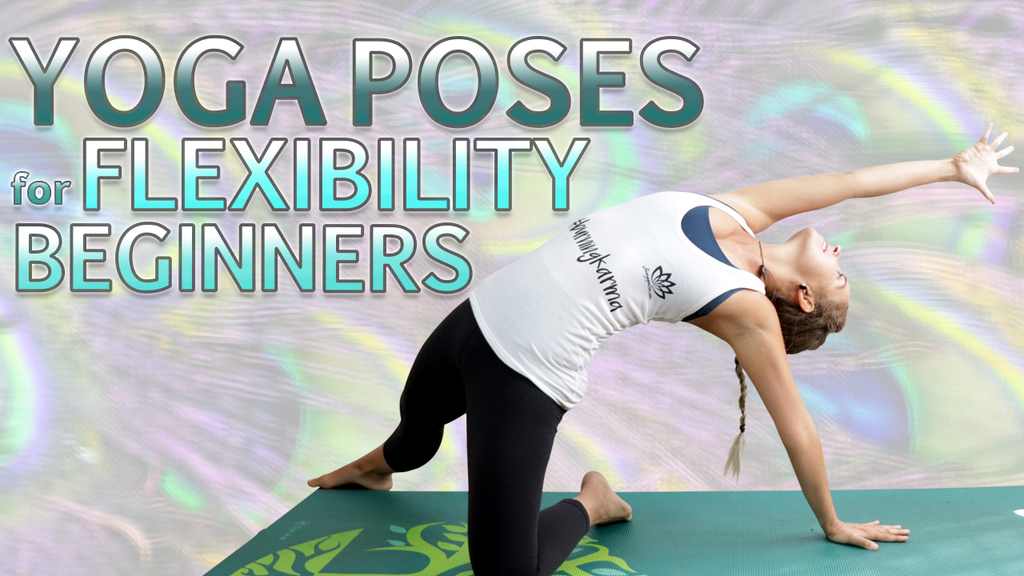
INFROGRAPHIC:#CH1023 Yoga Poses Flexibility Beginners

yoga poses for flexibility beginners_CH1023

Upward Salute – Urdhva Hastasana

Begin with the hands together at the center of the chest in Prayer and then inhale as you raise them overhead. Take a moment here to move and stretch the arms and body and then settle into Upward Salute, arms raised above, palms facing the midline.

Upward Salute is usually one of the first opportunities you get to create some space in the body. It stretches the sides of the body, spine, shoulders, armpits, and belly.

upward salute

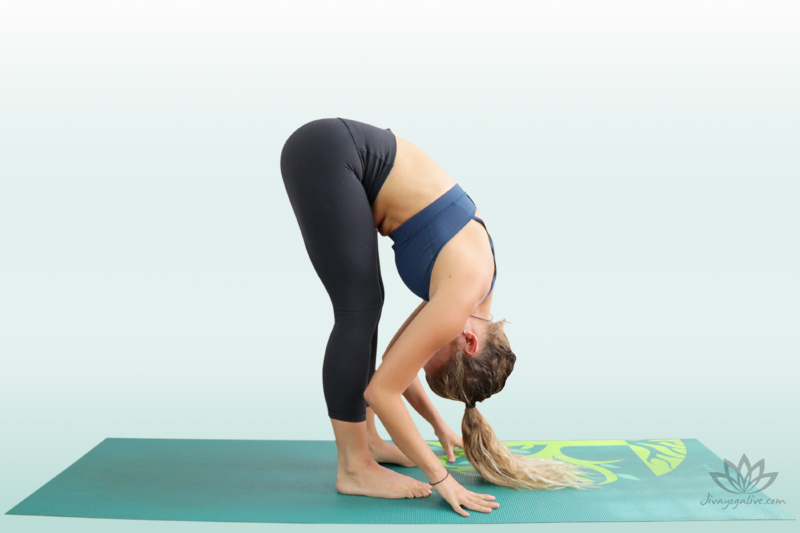
Standing Forward Bend – Uttanasana 

Hinging at the hips, start to fold forward, keeping the spine straight and the neck and head in line. The hands are extending forward as you come down into Standing Forward Bend. Hands can come down to the mat or we use a block to bring the earth a little closer. Inhale and press down into the feet and slowly start to roll up to standing, neck and head coming up last.

This is a great beginner pose for opening up the back of the legs as there is not much physical effort required, as the torso hangs down heavy and gravity does the work of elongating the spine. Especially when starting out, it is perfectly fine to have a slight bend in the knees and to rest the hands down onto the thighs or the shins.

Standing forward Bend

Garland Pose – Malasana

Take the feet slightly wider than hip width and with an inhale raise the arms up, palms come together to touch and then bending the knees, drop down into Garland Pose. Press the palms firmly together and bring the elbows into the thighs to create a resistance and stretch into the inner thighs.

Garland Pose stretches the thighs, groin, hips, ankles, and the torso and is often easier than it looks, especially for beginners. The heels don’t necessarily have to touch the earth, but try to keep the spine straight and the chest open.

garland pose

Seated Forward Bend – Paschimottanasana 

Come down to sitting, legs extended out long in front, making sure your strap is handy. Remove the flesh from underneath the sitting bones and create a long spine through to the crown of the head. Begin to fold down, forehead aiming towards the toes, the heart towards the knees. Looping the strap around the soles of the feet and settle into Seated Forward Bend.

The seated Forward Bend offers a deep stretch for entire back side of body from the heels to the neck and is an opportunity to relax down over yourself. As you go internal with this pose, focusing on the breath and the sensation of stretching, you can calm down the mind and relieve stress

seated forward bend

Head to Knee Pose – Janu sirsasana 

Bring the right leg out on a diagonal and the left sole of the foot in to meet the right thigh. Keep the strap handy and turn the torso to face the extended leg. Inhale the arms up and exhale, folding down. The strap can go around the sole of the foot in order to keep the leg straight.

Head to Knee Pose is going to stretch the spine, shoulders, hamstrings, and groins. It is calming and relaxing, while offering a deep stretch.

head to knee pose - half seated forward bend 4

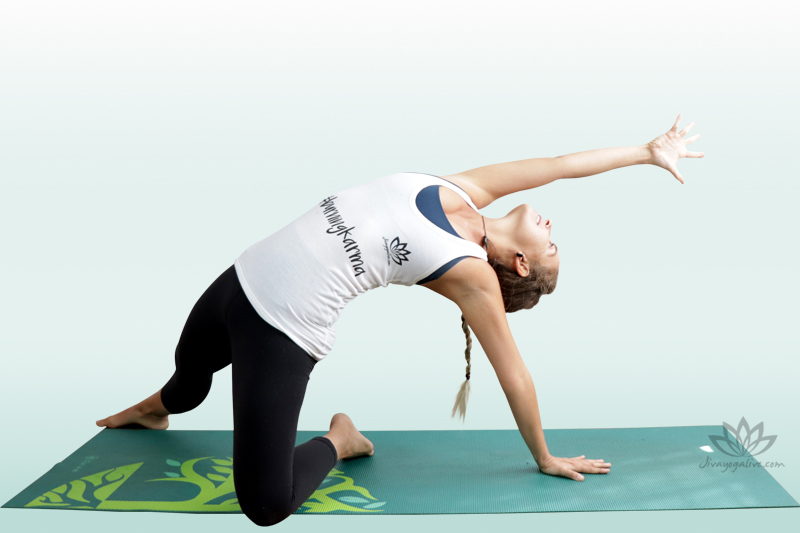
Wild Thing Variation – Camatkarasana 

Bring the left hand to the base of the lower spine. Press into the palm and into the toes of the front foot. Come up onto the left knee. Sweep the right arm and hand up and behind, coming into Wild Thing Variation. Bring the hips back down to the earth. Take Head to Knee Pose and Wild Thing Variation to the other side.  

This variation of Wild Thing is an more accessible way to open up the shoulders, lungs, and chest. It also opens the hip flexors and the front of the legs. It is one of the juiciest counter stretches out there.

wild thing pose knee to floor variation

Bound Angle Pose – Baddha Konasana  

Bring the soles of the feet together and interlace the fingers around the toes. Walk the groins towards the feet for a more intense stretch. Inhale the spine straight and exhale, start to lean forward. Elbows can come into the calf muscles. Drop the head down, coming into Bound Angle Pose.

This pose is great for beginners because you can take it as deep or as easy as you like. While the hips and inner thighs are receiving a deep opening, the spine is being elongated from the base right through to the crown of the head.

bound angle pose 3

yoga poses for flexibility beginners Video

CH1023 yoga poses for flexibility beginners v1

Yoga for Flexibility and Balance

When practicing balance poses you want to cultivate a lightness of body and mind, and by that I mean to try not take yourself so seriously! When you wobble, it is a sign that the body is building strength. When you fall out of a pose, you simply jump back in. The balance in the body is different from day to day – whether that be the fault of the moon or a reflection of your state of mind, who knows, but even the most advanced yogi can and will have an off day. Another thing to keep in mind, is that you should never expect both sides of the body to feel the same as we are not perfectly symmetrical beings. Here are three poses if practiced daily, you will start to find yourself a little more balance body and mind, both on and off the mat.

Better balance is something we can all benefit from, especially if we are engaged with other sports. A 2017 study on The Effects of Yoga on Flexibility and Balance, found evidence to support that yoga was able to boost athletic performance across a range of activities and that a regular practice could lead to significant improvements in a little as six weeks.  Lord of the Dance Pose – NatarajasanaThis pose is an expression of power, grace and strength. Multiple things are happening in the body as we stretch into the shoulders, chest, thighs, groin and abdomen. Simultaneously you are strengthening the legs and ankles. However, the cherry on top of the mindfulness cake, is the ability of this pose to improve the quality of the mind. You are required to find balance and concentration, yet remain graceful and poised. Frustration will likely come as you fall out of this pose time and again, so your patience and resilience can be tested. Find balance in the body with this pose and you’ll cultivate more balance in the mind.  

Eagle Pose – GarudasanaThis pose requires endurance and unwavering concentration to find the balance. The trick is to squeeze everything to the midline of the body. Squeeze the elbows and knees and try to keep them stacked in one line. This pose really has it all when it comes to flexibility and balance. The challenge really comes from having your Drishti Point (single point of focus) obstructed by the hands. When you come out of this pose and unwind the body there is a beautiful experience of unbinding the mind too.   

Half Moon Pose

This pose relies on the stability of the standing leg and ankle; while you extend the top leg straight and strong, to find that perfect tipping point of balance. In Hatha Yoga, Half Moon is an expression of channeling the lunar energies in order to maintain a sense of body orientation in space. You are building strength in the lower body as you work to firm down into the standing leg – at the same time you are encouraging a dynamic sense of balance in both the body and the mind.  Repeat these poses on the other side to work with both the yin and yang aspects of the body. This balances the masculine and the feminine energies to ensure whole body harmony.

TEACHERS INSIGHTS

Don’t be afraid to use props and take modifications, especially in the beginning. The body wants to open and will become more flexible over time. Moving slowly and taking the options for support are only going to strengthen your practice, and the key is not how far you can push yourself in a single practice, but instead showing up over time and practicing with consistency.

CONCLUSION

These poses are great foundational asanas for a beginner who is looking to work on flexibility across the whole body. Sometimes we can have a specific advanced pose in mind, such as the splits and the focus might be directed on soley trying to open the legs, but you are more likely to reach these poses when we work at opening the whole body, as it is all connected. This is also relevant when it comes to ailments such a low back pain, which is usually the result of tight hips. It’s so important that we see and keep the bigger picture in mind and trust both the process and in the body’s ability to open up.

PDF DOWNLOAD

CH1023 yoga poses for flexibility beginners pdf book cover400

How to Start Yoga at home for beginners  PDF, will guide you through the best way to start yoga at home. Includes a beginner sequences designed to give you the best poses to get started. Easy poses accessible to all ages and levels,  you will find in this  pdf simple poses and their benefits,Images and  tips.  Included in this Free Yoga PDF Download:

  • Yoga asanas names with pictures and benefits
  • Printable Sequence Infographic
  • Teacher Tips
  • Resource Links

Best Hip Abductor Stretches to Instantly Improve Flexibility and Mobility

Strengthening and stretching the hips properly is a critical component of any exercise regime. The hips are truly a powerhouse of the body, not only bearing the weight of most of our activity, but also giving us the range of motion we need to do so.

How Posture and Pain Connect: Discover the Best Hip Abductor Stretches to Relieve Tension

The best hip abductor stretches can play a crucial role in relieving body tension that leads to discomfort in unexpected areas—like your head and neck. Often, we experience pain in one area of the body that actually stems from dysfunction somewhere else. This connection is especially true when it comes to posture and its widespread impact. If you suffer from frequent headaches, the root cause might surprise you. The culprit? Poor posture and weak hip stabilizers, including the hip abductors.

Understanding the Chain Reaction of Pain

What feels like a head problem often starts elsewhere. Take frequent headaches as an example. These are rarely isolated issues. There’s almost always an underlying cause. In many cases, it’s the forward-head posture that places continuous strain on the neck and jaw, building tension that translates into persistent headaches. The body functions as an interconnected system—and when one link weakens, the others compensate, often painfully.

One area that silently contributes to poor posture is the hip. The hip abductors, which stabilize the pelvis and support upright alignment, often become underused or tight. This imbalance leads to compensatory movements, increasing strain on the spine and neck. By incorporating the best hip abductor stretches into your routine, you help reset the posture chain and relieve the pressure.

Why Yoga Works: Healing Through Movement

Yoga is one of the most effective tools to correct posture and release stored tension. It strengthens weak muscles, elongates tight areas, and encourages body awareness. Research shows that when yoga is added to conventional treatments, it significantly reduces the intensity and frequency of migraines.

In particular, yoga stretches that focus on the hips, spine, and shoulders can correct misalignments that strain the head and neck. Incorporating the best hip abductor stretches into a yoga sequence can have an upstream effect on your posture and pain levels.

Personal Insight: How Habit Shifts Reveal the Pain Source

I grew up in a military family, took dance classes, and started practicing yoga in college—so I was trained early on to value good posture. But even with that foundation, it’s easy to slip. Whether it’s reading all day on vacation or staring down at my phone during long travel days, I notice immediate shifts in my posture and, consequently, tension in my neck and shoulders.

This tension often starts in the hips. When my hips tighten, my posture collapses, and the stress travels up. By adding the best hip abductor stretches into my daily routine, I bring my body back into balance and reduce overall discomfort.

Expert Validation: Science Supports Stretching for Posture

According to the American Council on Exercise, yoga supports better posture by massaging the skeletal system, maintaining bone mass, and releasing muscular tension. The hip abductors are key players in this system. When they are functioning properly, your posture becomes naturally upright and relaxed.

If you frequently experience headaches and shoulder pain, your posture might be trying to tell you something. Improving your posture with the best hip abductor stretches could unlock the relief you’ve been missing.

TRAINING TYPE: FLOW SEQUENCE

CATEGORY:YOGA

SUBCATEGORY:RECOVERY 

 PLANNED TIME:15 MIN 

LEVEL:ALL LEVELS  

PROPS:NONE

 20 Minute Restorative Yoga Flow For Neck Pain and Headaches

 This restorative flow for neck pain and headaches will cover a sequence of seven poses that will leave you feeling open and relieved in your neck and shoulders. These poses focus on opening through the upper back and neck in order to release tension and pain. These stretches can accommodate any level of practice from beginner to advanced yogi. This flow is perfect for relieving pain from poor posture, time spent over a desk or device, and residual soreness from other physical activities. For those suffering from chronic pain in the neck and shoulders, practicing this sequence daily will maximize the benefits of the postures. No props are needed for this sequence and it’s perfect for practicing anytime, anywhere!

Yoga For Neck and Shoulder Pain Infographic

yoga poses for neck and shoulder pain infographic

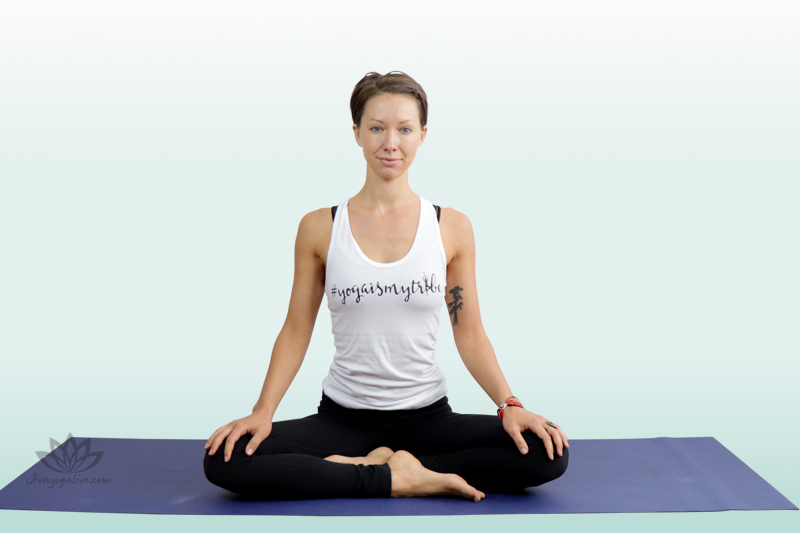
Easy Pose – Sukhasana

Starting from an easy sitting posture, we’ll begin this practice by warming up the neck and shoulders with some gentle rolling movements. With the hands resting gently on the knees, raise the shoulders towards the ears and roll the shoulder blades down the back. Continue this movement while breathing into the space at the base of the neck and between the shoulders. After a few breaths, reverse the direction and continue the same movement in the forward direction.

From Easy Pose, make sure the spine is tall with heart over hips and head over heart. Breathe deeply from the base of the spine all the way to the crown of the head. Exhale and follow the nose down toward the chest. Inhale and follow the nose toward the sky. Exhale the nose back down toward the chest and continue the flow matching your breath with each movement allowing space to open in the back of the neck.Return the gaze to neutral, inhale. Exhale turn the gaze over the right shoulder. Inhale back to center, exhale look over the left shoulder. Continue inhaling back to center and exhaling over the shoulder for a few breaths.

Coming back to neutral in the center, inhale and exhale drop the right ear to the right shoulder. Inhale to center and exhale the left ear to the left shoulder. Continue this for a few breaths, making sure to focus the breath on expanding the space in the neck and tops of the shoulders.

easy pose sukhasana

Thread The Needle Pose –  Parsva Balasana 

Come into a table top position, perhaps taking a moment to move through a few cat/cows and when you’re ready, open the right hand up towards the sky allowing the gaze to follow and opening across the chest and through the back of the right shoulder. Exhale, return the right hand to the mat, palm spread wide. Inhale, repeat by opening on the left side. Exhale the left hand back to the mat. Inhale the right arm up, open through the chest.

Exhale, bring the right arm down and “thread” underneath the left arm as the hips sink back to heels. Let the right arm, shoulder and cheek rest against the mat. Breathe deeply here into the shoulder blades and neck, keeping the left arm active and palm wide. Breathe. On an inhale, unwind, exhale return to table top. Inhale the left arm up, exhale “thread” the left hand under the right arm and repeat on this side. After a few breaths, return to Table Top.

Thread the Needle Pose - Parsva Balasana


Rabbit Pose – Sasangasana 

Come to a kneeling position with toes tucked under the glutes. Inhale and reach both hands behind the body to cup the heels with thumbs on the outside of the foot. Exhale the chin towards the chest and fold forward bringing the crown of the head to the floor with the forehead coming as close to the knees as comfortable. Inhale and lift the hips to the sky allowing the arms to extend. Breathe deeply into the back body, especially focusing on the thoracic spine. Be careful not to place too much weight on the head. Allow the legs to support the posture. Release the posture by lifting the head and rolling the torso up one vertebrae at a time. 

Rabbit Pose - Sasangasana

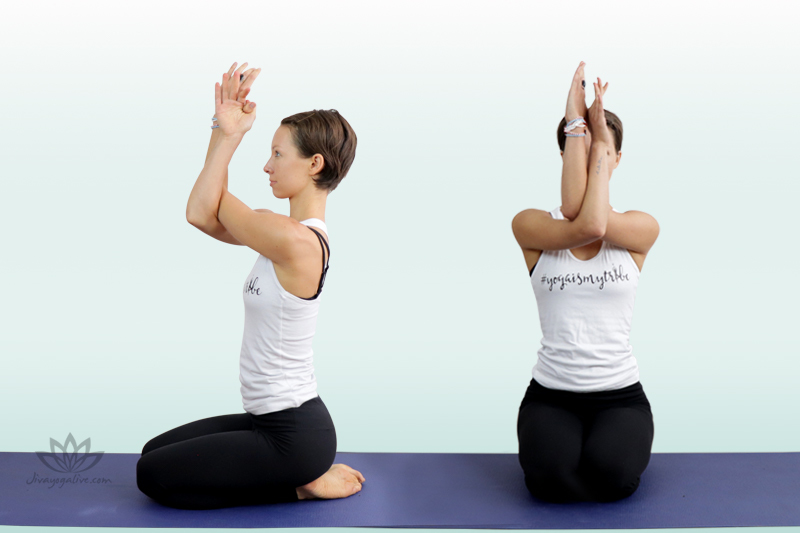
Eagle Pose Variation  – Garudasana 

Return to sitting on the knees and heels. Inhale the arms wide into a T position, exhale and cross the arms in front of the chest, left arm over right. Bend the elbows and hook thumbs together allowing the forearms to connect. Lift the hands toward the sky, feeling the stretch in the back of the neck and shoulders. Breathe here. Uncross the arms, inhaling again to a T shape and exhale cross the arms again, this time bringing the right arm over the left. Hook the thumbs, raise the hands, and breathe again, creating space with each inhalation and finding release and ease with each exhalation. After a few breaths, release the posture.

Eagle Arms - Garudasana

Half Lord of the Fishes Pose  – Ardha Matsyendrasana 

Come into a seated position, sit bones on the floor and legs extended in front of the body. Flex the feet and acctivate through both legs. Make the spine tall. Bend the right knee bringing the right heel parallel with the left knee. Inhale the right arm over head and exhale bring it behind the body, pressing the palm into the ground and the arm against the back body for support. Inhale the left arm over head and exhale, bend the left elbow as it crosses over to the outside of the right knee. Tuck the navel into the spine and twist from the lower abdomen. Press the elbow and knee into each other and turn the gaze over the right shoulder.

With each inhale think about lifting the spine, with each exhale think about opening through the chest and right shoulder. On an exhale, unwind releasing the posture. Change the legs, extending the right and bending the left. Repeat the posture on the left side.

Half Lord of the Fishes - Ardha Matsyendrasana

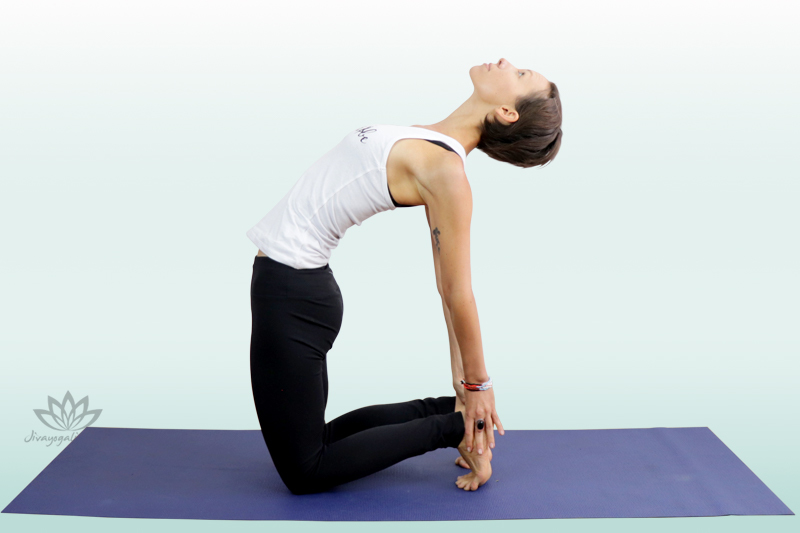
Camel Pose – Ustrasana  

Come into Easy Pose. Inhale both arms above the head and exhale bring fingertips to tops of shoulders. Ground through sit bones, open through chest. Inhale and with the exhale quickly twist the whole torso and gaze to the right. Inhale quickly unwinding to center and carry the movement across on the exhale, twisting to the left. Continue this movement for twenty exhales, maintaining momentum and the same pace for each breath.

The focus of the breath should be on the exhale, the inhale will occur naturally as the body unwinds back to center. This breathing practice helps open the whole spine and move breath and prana throughout the entire torso.

Camel Pose – Ustrasana  

Camel Pose - Ushtrasana

Kundalini Pranayama – Side Twists 

Come into Easy Pose. Inhale both arms above the head and exhale bring fingertips to tops of shoulders. Ground through sit bones, open through chest. Inhale and with the exhale quickly twist the whole torso and gaze to the right. Inhale quickly unwinding to center and carry the movement across on the exhale, twisting to the left. Continue this movement for twenty exhales, maintaining momentum and the same pace for each breath.

The focus of the breath should be on the exhale, the inhale will occur naturally as the body unwinds back to center. This breathing practice helps open the whole spine and move breath and prana throughout the entire torso.

Kundalini Pranayama side twists

Featured Video: 7 Neck and Shoulder Yoga Poses For Instant Pain Relief

 Yoga for Neck and Shoulder Pain Relief

To begin reconditioning the body with better posture, start by finding more mobility in the neck and shoulders. This helps loosen up the muscles, thus relieving tension, and with consistency of practice, will lead to a greater range of motion. Having more range of motion and strength in the muscles are keys to creating good posture to support the body. Before jumping into any deep stretches in this area, start by working out a little tension and creating a little space with simple warm ups. An easy way to warm up the area is to take a minute or two doing some gentle neck and shoulder rolls. Take semi-circles with the neck, leading the motion from the tip of your nose in order to protect the neck from hyper-extension. Hunch the shoulders up and down and alternate rolling them forward and then backward. Keep in mind that you can always incorporate this into postures like Cat and Cow, Downward Facing Dog, Reverse Prayer, or any stabilized posture that allows you to safely find organic movement in your neck and shoulders. If you spend many hours at a desk, computer, in a vehicle, etc., try giving yourself some moments throughout the day to open this space a little. It will relieve tension and allow the body to release stress and pain.

Yoga for Upper Back and Neck Pain 

For upper back and neck pain, especially pain coming from posture, finding that happy balance between flexibility and strength is key. There are many postures that give us the option to explore these benefits in a way that meets us wherever we are in our practice, whether we’ve just begun our first yoga classes, or we’re half-way to enlightenment. Cobra and Child’s Pose are two of my favorites that offer this range of depth.Cobra Pose, Bhujangasana, is practiced on the floor, so right from the get-go we have the benefit of the ground right below us supporting this posture. (Remember Newton’s third law and don’t forget to use the energy of the ground in your postures!) The movement of Cobra stretches from the lower abs and hip flexors to the chest, the upper back and into the neck. By pushing into the earth and keeping the elbows tucked close to the body, we build strength in the muscles of our arms, back and chest and shoulders. This “baby backbend” is so good for opening and strengthening the upper body.Counter your Cobra Pose with restorative Child’s Pose, Balasana. This is a very gentle, semi-inversion that lowers the heart rate and calms the nervous system, allowing the mind to become calm and the body to relax. Not a bad complement to relieving painful tension. For an active experience in this posture, keep the arms lifted away from the ground and breath deeply, extending from the tailbone to the crown of the head.

Healing Your Neck and Shoulders After Pain

Exploring modifications of poses is one of the best ways to bring more healing into your yoga practice. There is so much respect and wisdom that comes from honoring the body where it is, rather than forcing it to where it “should” be. Don’t be afraid to have props on standby when you go to a studio class. If you don’t have blocks, bolsters and straps at home, get creative with books, blankets and scarves! Matsyasana, Fish Pose, is a beautiful and highly beneficial posture for neck and shoulder pain. None of this is lost when practiced with the support of a block or two. Placing a block between the space of the shoulder blades allows the chest to lift and the shoulders to stretch and open. Support from the block alleviates stress in the neck if your muscles are not yet strong enough to hold the backward extension on their own. If you are practicing with a migraine or neck injury, definitely support the head with a block, rather than dropping it entirely to the floor.This supported Fish Pose opens the lumbar, thoracic and cervical spine, conditioning the body for better posture. It also opens the chest, the heart space, physically and energetically, which is so critical for the process of healing. This healing posture gets its name from the incarnation of Lord Vishnu as the fish, Matsya, who came to Earth during a time of extreme corruption. A flood was filling the planet, purging it from the excessive evil. In order to preserve goodness and balance, Matsya saved the sages of the earth, protecting their wisdom and knowledge for new generations.As you practice this pose and breathe space and healing into your body, connect to the innate wisdom of your body as a self-healing machine and the wisdom that has been carried through generations of yogic tradition. 

How Yoga Can Help Shoulder Blade Pain

For relieving pain and tension in the upper body, Child’s Pose is an anytime, anywhere go-to pose. If you want to take it a little further to get deeper into your shoulder blades, thread the needle pose is a great variation to practice. The restorative nature of this posture is already great for relaxing the parasympathetic nervous system, allowing both the mind and body to find stillness. The twist of the torso and extension of the raised arm helps you to find a deeper stretch in the back of the shoulder blade, the chest and in the neck. From the rotation you can also feel the release of some tension in the lower back. Vinyasa teacher Jason Crandell writes, “Yoga is the perfect opportunity to be curious about who you are.” I love that and couldn’t agree more. I encourage you to see your practice as an opportunity to explore who you are and who you could be, and practice letting go of any “should bes”. Allow your healing process to unfold without force, to blossom. Be curious in your poses, in your mind and with your spirit. May you be well!

Conclusion

Finish the practice by coming into Savasana and allow the body to relax completely, letting go of control of the breath. Hopefully this flow has helped to release any excess tension of stress that’s been held in the neck and shoulders.

The chest and upper back should feel much more open and the posture of the torso overall should feel more lifted and straightened. Try practicing these postures every day to relieve stiffness and pain and to improve your posture.

About

Hillary

Hillary is a natural-born wanderer and wonderer. A digital nomad and pilgrim of the heart, she often feels herself a poster child of the Spiritual Millennial. As a writer, health coach and yoga instructor Read More..

Ready to take your healing further? Click here to access yoga courses for for abductor stretching and start your journey toward lasting wellness today.

How To Improve Flexibility Fast

Join me on this short but effective flow to improve your flexibility fast! This is a sequence designed for all level practitioners. Increase your blood flow, stretch your muscles and gain clarity!

How To Improve Flexibility Fast: A Surprising Personal Journey

If you’re wondering how to improve flexibility fast, my story might offer some unexpected inspiration. I never considered myself a flexible person, and improving flexibility wasn’t even on my radar when I began practicing yoga. In fact, I came from a background of heavy weight training and almost zero stretching, which eventually led to persistent lower back pain.

The Turning Point: Discovering Yoga

My journey started casually. About two years ago, I decided to give yoga a try, not with the intent to become more flexible but simply to move better and relieve some pain. Even casual yoga sessions made a noticeable difference. My posture improved, and I gradually became more aware of my body’s capabilities. Flexibility, as it turns out, became a side benefit.

An Accidental Breakthrough in Flexibility

Here’s where it gets interesting. One day, after a standard warm-up at the gym, I was experimenting with stretches and decided to attempt a half split. To my surprise, it felt easy. On a whim, I thought, “Why not try the full split?” Just a few years prior, I could barely get a meter from the ground.

But this time? I slid my front leg forward and suddenly—I was in a full split. I couldn’t believe it. That’s when I realized: yoga had massively improved my flexibility, even though that was never my original goal.

No More Back Pain and Sky-High Energy

Since starting yoga and unintentionally learning how to improve flexibility fast, my chronic lower back pain has completely disappeared. I feel energized and more aligned every single day. My movements are more fluid, my posture has improved, and I now enjoy a physical freedom I never experienced during my weight training days.

The Takeaway: You Can Improve Flexibility Faster Than You Think

You don’t need to aim for the splits to begin your own flexibility journey. Whether your goal is to relieve pain, improve performance, or simply feel better in your body, incorporating yoga or intentional stretching into your routine can deliver powerful results. If you’re wondering how to improve flexibility fast, consistency and awareness are key. Even a few sessions a week can lead to dramatic changes.


childs pose vector         How To Improve Flexibility Fast

TRAINING TYPE: FLOW SEQUENCE

CATEGORY:YOGA

SUBCATEGORY:FLEXIBILITY & STRENGTH

PLANNED TIME:10-15 MINUTES

LEVEL:ALL LEVELS 

PROPS:NONE

How You Can Improve Flexibility Fast 

Start applying flexibility in your life daily. As in, on top of your stretching routine that you’ve created to yourself sit in Garland pose when waiting or for example eating. It is actually our natural resting pose but we have lost it thanks to the western invention: chairs. Do some warming up straight when you start moving and stretch your stiff parts one minute each. It really is about the constancy on how often you do it and whether you do it well each time. As you do anything, you do everything. Prioritize stretching, I’m pretty sure that each one of us have 5-10 minutes each day to take care of our bodies. 🙂 “Blessed are the flexible, for they shall not be bent out of shape.” -Michael McGriffy

Join me on this short but effective flow to improve your flexibility! This is a sequence designed for all level practitioners. Increase your blood flow, stretch your muscles and gain clarity!

6 Poses To Improve Flexibility Infographic

How to improve flexibility fast         How To Improve Flexibility Fast

Big Toe Pose – Padangusthasana

You might need a block or a strap for this sequence, so keep them handy. Starting from standing in Mountain Pose, inhale, jump or walk you feet so that they are hip width apart. Place your hands on hips, pull the kneecaps up by activating legs, inhale, gaze up and lift chest and with an exhale start folding forward from your hips. Grab onto your big toes with your peace fingers. If you can not grab your toes, grab a strap, place it underneath your feet and hold onto the strap. Remember to keep a slight bend in your knees so that they are not locked. Inhale, straighten back and look up. Exhale, move the crown of your head towards the floor, bend elbows to the sides. Bend knees if necessary. Stay for five breaths.

Big Toe Pose - Padangushtasana          How To Improve Flexibility Fast

Extended Triangle Pose – Utthita Trikonasana

Place hands on hips. Inhale, looked up with a straight spine. Make a step to the right, right foot parallel to the edge of the mat, left heel turned inwards. Exhale, lift arms parallel to the floor and reach out over right foot and bend down. Lift left arm up, following it with your gaze. Now, there are a few different variations in here. You can either grab onto your toes with your  peace fingers, place the hand on the floor, place it on a block or on your shin wherever you reach. It is important to not to put much weight on it, you should basically be able to hold yourself up without the support of the hand. Use your core. Tuck your pelvis in opening it to the front. Open your chest and make sure your legs are straight. Engage your inner thighs and your abdominal muscles. Stay for five breaths. Inhale come up slowly. Exhale, do the other side. Inhale come up, keeping your arms to the sides.

How To Improve Flexibility Fast

Pose Dedicated to the Sage Marichi A – Marichyasana A

Start sitting on your mat coming into Staff pose. Exhale, bend your right knee and bring your feet close to your groin. Be careful if your knee hurts don’t force it. Keep the left leg active, toes pointing towards you. Inhale reach your right arm up to the sky and exhale, wrap it around your right leg and grab the left wrist behind your back. If you can not reach your arm, use a strap. Make sure your both sitting bones are still on the ground. If they are rising up, stay here. If they are firmly on the ground continue with me. Exhale bring your chin towards the shin of the left leg, lengthening forward. Inhale, head up, look up. Exhale bend even deeper. Bow down, recognizing the ray of light that shines within you. Hold for five breaths. Inhale come up. Exhale release. Inhale switch sides.

Pose Dedicated to the Sage Marichi A - Marichyasana A      How To Improve Flexibility Fast

Bridge Pose – Setu Bandhasana

Lowering yourself to the ground, coming to lay on your back. Bend your knees and walk your feet close to your glutes. Make sure your weight is equally distributed on both your feet and that your legs are hips distance apart. Place arms beside your body, reach fingers touching heels. Make sure your knees do not fall to the sides here. Roll shoulders slightly underneath yourself and with an inhale start pushing your hips up to the sky. Interlace fingers behind your back and press your forearms to the ground, giving yourself a slight push higher. If it is hard for you to keep your knees together you can place a block in between them and keep pushing it whilst lifting up. Stay for five breaths. Exhale lowering down, hugging feet into chest. Rocking on your back.


Bridge Pose - Setu Bandhasana

Tricep Stretch in Easy Pose – Sukhasana

Sit comfortably with your spine straight cross legged in Easy Pose. Inhale, raise your right arm up and bend it so that your fingers touch in between your shoulder blades. Exhale. Inhale raise the left arm up and place hand on right elbow, and gently push your arm back. Stay here for five breaths and switch sides. Roll your neck a couple times and give yourself a hug.


Tricep stretch in easy Pose - Sukhasana

Featured Video: Stretching Routine To Increase Flexibility

How You Can Become More Flexible in One Week

Becoming flexible in a sustainable way takes time. But here are some tips on how to increase your flexibility fast. Define where do you want to become more flexible. Is it your upper or lower body? Both? More hamstrings than quads? Make a plan. Create a sequence and time to follow that sequence of stretches each week. Biomechanist Michael Rowley recommends you to do the stretches about 6 times a week, each one for about  30-60 seconds. I’ll link you a video with the contortionist Sofie Dossi where they break down what stretching does to your body. Eat well and hydrate your body properly. Being hydrated and having a well nourished body will support you in this.

About

Sara

I then realized how big of a shift my life had taken to a better direction since starting yoga. I felt passionate about sharing it with others and Read More..

Ready to unlock your body’s full potential? Click here to access our complete course and discover exactly how to improve flexibility fast with expert-backed techniques and step-by-step guidance.

Beginner Yoga Sequence For Lower Back Pain

I remember a time when I was backpacking in Cambodia and somehow I had pulled a muscle in my back. I couldn’t even lie down straight in bed, let alone explore the exciting new world I was in, without there being excruciating pain.

I remember a time when I was backpacking in Cambodia and somehow I had pulled a muscle in my back. I couldn’t even lie down straight in bed, let alone explore the exciting new world I was in, without there being excruciating pain. Whenever my back is suffering, I get onto the floor and move through some of the most simple yoga poses out there. I move slowly and feel instant satisfaction and release when on the lucky occasion my back cracks and softly opens up.

Yoga is one of the most effective and natural tools that we have at our disposal for treating and preventing back issues and if you have experienced back pain, you know just how debilitating it can be. It can make even the most simple tasks impossible and will have you reaching for over the counter drugs quite quickly, just so you can manage your everyday life.

A regular yoga practice will allow the back and the spine to become strong and resilient over time, but it can also be used as a tool to provide pain relief in time of crisis if done mindfully. When I couldn’t even find relief in lying in bed, I was so grateful that I had a yoga background to support me.

childs pose vector

TRAINING TYPE: FLOW SEQUENCE

CATEGORY:YOGA

SUBCATEGORY:BEGINNER YOGA

 PLANNED TIME:10-15 MINUTES 

LEVEL:BEGINNER  

PROPS:BLOCK

What are the best beginner yoga poses for lower back pain?

​ 

  • Extended Child’s Pose – Balasana
  • Downward Facing Dog – Adho Mukha Svanasana
  • One-Legged King Pigeon Pose forward bend variation – Eka Pada Rajakapotasana
  • Sphinx Pose – Salamba Bhujangasana
  • Easy Beginner Yoga Sequence For Lower Back Pain

    You will be introduced to a beginner yoga sequence for lower back pain. Grab a block or a book if you have one handy so there is the option to take modifications and for a little extra support. Back pain is often caused by tightness in other areas of the body such as the hips, which means it is essential that we work on the whole body, making sure to move with caution and care. Listening to the body when working with back pain is key! 

    Keep in mind this sequence is not about pushing the body, instead we are wanting to move with caution and respect in a way that is therapeutic and conducive to healing. So it’s important that we work to open up and release stagnant energies in the whole body.

    Beginner Yoga For Lower Back Pain Sequence Infographic

    beginner yoga for lower back pain infographic

    Extended Child’s Pose – Balasana

    Take the knees as wide as the mat and come down into an Extended Child’s Pose. A gentle way to elongate the spine, stretching it from tailbone right through to the crown of the head. Allow the forehead to come down to the mat and breathe into the pose, sending the breath into the back of the body, into the kidneys.

    This pose is the perfect place to take rest and is available at all times during your practice. Think of it as your home base. It’s is restorative and relaxing but also offers a gentle stretch to the whole spinal column.

    extended child pose

    Downward Facing Dog – Adho Mukha Svanasana

    Pushing back next into Downward Facing Dog, by tucking the toes and pushing into the palms, sending the hips and tailbone up. Take your time here to pedal out the legs, bending one knee and then the other.

     When you think about inversions, you typically think of the Headstand and Shoulder Stand, but Downward Facing Dog also brings the head below the hips, making it a gentle and more easily available inversion for the body. It strengthens the chest, arms, wrists and core, making it a great preparatory pose for those more advanced balances.  

    downward facing dog pose

    One-Legged King Pigeon Pose forward bend variation – Eka Pada Rajakapotasana

    Take the right knee and place it down behind the right wrist, and walk the back leg down along the mat, top of the foot resting down. Aim to have the right shin parallel with the top edge of the mat, or in towards the groin. Come onto the fingertips and lengthen the spine up. Exhale, bring the torso down, coming to rest on the forearms. To go deeper, bring the forehead down to the earth. There is the option here to slide the block underneath the hips to make the square.

    Use the hands and arms to walk the torso back up, lift the back knee and press into the palms and push back into Downward Facing Dog. Take One-Legged King Pigeon Pose forward bend variation to the other side, making sure the block is handy for support.

     We all hold a lot of tension in the hips, whether that be from other athletic activities, sitting at a desk or as a result of high stress, and this pose provides a powerful release to this area. It can feel extremely intense, but at the same time deeply satisfying. Use the breath to help drop you deeper into this pose over time.

    one legged king pigeon pose - forward bend variation

    Sphinx Pose – Salamba Bhujangasana

    Transitioning down onto the belly next so you can move into Sphinx Pose. Press the forearms and palms down into the mat, making sure that the elbows are in line with the shoulders. As we press down into the earth we can work to drag the heart forward, opening the chest and at the same time creating a healthy compression in the lower back.

    Sphinx Pose is one of the most therapeutic backbends you can move through when working with low back pain. It’s very gentle, but very rewarding, especially is practiced with consistency. It lengthens the abdominal muscles and stretches the spine, all whilst opening the shoulders and the chest.

    sphinx

    Featured Video: Beginner Yoga For Lower Back Pain

    Yoga for Lower Back Pain and Sciatica

    Sciatica is the experience of tenderness or pain anywhere along the Sciatic nerve, a nerve which runs from the spinal cord, down the leg and into the foot. We house two of these nerves, one in each leg. Studies show that lower back pain is one of the most common causes of limited activity in people under the age of 45 and the second biggest reason that people are making doctor’s appointments! One review on Trajectories of Low Back Pain (2013), indicates that between 25-80% of low back pain patients will experience some form of recurrent back problem in the following year.

    The Journal of Neurosurgery: Spine (2005), claims that there is a 40% probability that each of us will experience Sciatica over the course of a lifetime and often we will opt for treatment in the form of creams and injections. However, yoga can provide a more natural way to soothe, as opposed to these over the counter drugs or painful needles.

    Saucha, one of our founders here at Jivayogalive was recently bed bound with excruciating pain, unable to walk or to sit without immense suffering (from clocking way too many hours hunched over the computer, working too hard if you ask me!).

    He was quickly diagnosed with sciatica and what did the doctor order? Yoga. Of course. Lol. He was directed to perform a series of very simple and very accessible poses daily and in a matter of days he was up and walking again, and of course,  back at the computer working way too hard.

    3yoga poses that target the specific areas for Sciatic pain

    Cow Face Pose variation – Gomukhasana In this variation you want to extend the bottom leg straight. This is often a tricky pose for beginners, so having a blanket underneath the hips will help tilt the pelvis forward and make it a little more accessible.

    Cow Face Pose is a great way to internally rotate the thigh bones which stretches into the hips, which will provide relief along the sciatic nerve. There is the option to lean the torso down over the knees to deepen the stretch.

    One-Legged King Pigeon Pose forward bend variation – Eka Pada Rajakapotasana

    When the piriformis is tight there is often pressure being exerted onto the sciatic nerve and this pose can provide one of the deepest stretches to this muscle. There are a number of tell-tale signs to look for that can indicate that sciatic pain is linked to a tight piriformis; is there pain when walking on the heels and toes? Any burning sensation in the back of the calf extending down to the heel? Pain when sitting? All of these can indicate tightness in the piriformis.   

    Half Lord of the Fishes – Ardha Matsyendrasana This pose will help to restore the spines natural range of motion and relieve back ache and sciatic pain. Be sure to keep the spine straight and use a blanket underneath the hips so as to tilt the pelvis forward.

    Spinal twists are extremely therapeutic, but take care to move slowly and with awareness so as to not strain the back further. Make sure to perform each of these poses on both sides of the body, spending a few minutes in each, allowing the breath to guide you.

    3 Yoga Exercises For Instant Lower Back Pain Relief

    Yoga works to strengthen and stretch the muscles that support the back and spine and a regular practice is a great preventative measure to take that will help to avoid future injury. However, if you are reading this a little too late and there is already suffering in the lower back specifically, there are a number of great poses that will support your road to recovery and provide you with relief. Cat-Cow Pose – Marjaiasana-Bitilasana

    This pose is such a simple and accessible way to work with lower back pain. It stretches the back, the hips and the abdomen and when combined with Cat Pose, there is the opportunity to move back and forth, stretching and compressing the whole length of the spine.  Puppy Dog Pose – Uttana Shishosana

    The Sanskrit translation for the word Uttana is intense, and this means Puppy, so imagine a puppy taking an intense stretch forward with its whole upper body. Although it is considered an intense stretch, there is also an element of relaxation for the shoulders and back. The more you bend your knees and push into your extended finger tips the more you will feel the stretch and experience relief from pain. Wind Relieving Pose – Pavana Muktasana

    After compressing the spine, a nice therapeutic way to finish up can be to come into the Wind relieving Pose. There is the option to roll around on the lower spine and the sacrum just giving the low back a massage and really showing this area some love.

    3 Beginner Yoga Poses For Back Pain

    When back pain is at its worst and you are at the point of no return, often there is the inability to do even the most simple things such as walking and sitting. Some yoga poses will not be accessible, so below are three of the most beginner friendly poses to help ease your pain. Stretching and lengthening movements are often what are needed for the back to feel better, so give these simple poses a go.

    Standing Forward Fold

    Usually we come in to the Standing Forward Fold with the aim of stretching the back of the hamstrings, but in the instance of back pain, we want to take our awareness into the spine. This means we can take a bend to the knees and allow the belly to sandwich down onto the thighs. Now it’s time to really let the upper body hang forward and down. Here we are working to lengthen and mobilize the spine, so there is to be no tension in the torso at all. Just hang out, and let gravity stretch the spine from tailbone right through to the crown of the head.

    Supine Spinal Twist

    Twisting the spine can really aid recovery and relieve pain when done with care and when it comes to twists, the Supine Spinal Twist is the most beginner friendly one there is. This pose can relieve the entire back and the neck and requires no physical effort. The job is left to gravity and all you have to do is relax and breathe. Support yourself by putting blankets and cushions under the knees if they don’t reach the floor and just focus on your breath and settle in for five minutes either side. 

    Sphinx

    This pose if one of the most therapeutic when it comes to working with back pain! If we spend a lot of time sitting, the lower back tends to flatten and this can cause a great deal of pain over time. Sphinx Pose accentuates the natural curve of the lower spine, is very beginner friendly and is great at providing a means of preventative care for the future.

    Conclusion

    Lower back pain, and back pain in general can be triggered by a number of things. From injury, to poor posture and even tightness in other unrelated areas of the body. A regular yoga practice encourages mobility of the spine and back in order to prevent injury, but if you are already working with a current injury, these poses when done with caution and respect, will be extremely therapeutic. It is important to keep the body moving to prevent any stiffness settling in further, but make sure to listen to the body. Use props and take modifications to support yourself when necessary and always practice patience with yourself and your healing journey. So give it a go! Namaste

    About

    Charlie Hanna

    Charlie is a Yoga Alliance certified Hatha, Yin Yoga & Meditation teacher with a psychology degree in her back pocket. She is currently on a mission, chasing sun and Read More..

    11 Incredible Yoga Poses For Stomach Bloating You Can Do Anytime to Relieve Pressure and Gas

    Gas problems are never fun to talk about, despite how common they are. They aren’t something you typically want to discuss openly, but if not, then how are you then meant to find advice or figure out what is a normal amount of gas to build up in the body!

    How Yoga Poses for Stomach Bloating Can Support Gut Health

    Yoga poses for stomach bloating have become one of my most trusted tools over the past six years as I’ve worked to restore my gut health. While digestive issues may seem like an uncomfortable topic, they are all too common and deserve open discussion. It’s time to normalize conversations around bloating, constipation, and gas so we can better understand what’s part of healthy digestion—and what signals a deeper issue. Research continues to show how effective yoga can be in supporting those with IBS and other digestive conditions, and for me, these yoga poses have become essential to easing discomfort and maintaining balance.

    Understanding the Gut: The Mind-Body Connection

    You may have heard it before: “The road to health is paved with good intestines.” While the phrase may sound humorous, the truth is deeply rooted in science. Our gut, often referred to as our second brain, directly reflects our mental and emotional well-being. For instance, it’s no coincidence that anxiety can manifest as stomach discomfort. A thriving gut contributes to long-term health and vitality. On the other hand, if the intestines are congested or obstructed, they can foster harmful pathogens, parasites, and inflammation—leading to chronic issues.

    This is why practicing yoga poses for stomach bloating is so vital. These movements not only relieve gas and pressure but also promote overall digestive flow, helping you feel lighter, more energized, and less weighed down.

    Why Gas and Bloating Shouldn’t Be Ignored

    Excess gas can leave you feeling sluggish, bloated, and awkward—even if it’s a common experience. While many consider bloating a normal side effect of enjoying food, persistent symptoms may indicate underlying blockages or imbalances. If the digestive system isn’t working optimally, it can create a breeding ground for bacteria and disrupt your body’s natural rhythm.

    Using targeted yoga poses for stomach bloating can support the body’s natural elimination process. These poses help move trapped gas downward and out of the system, relieving discomfort and aiding in better digestion. When practiced consistently, they also tone and strengthen the digestive tract to prevent future flare ups.

    TRAINING TYPE: FLOW SEQUENCE

    CATEGORY:YOGA

    SUBCATEGORY:MEDICINAL YOGA

    PLANNED TIME:10-15 MINUTES

    LEVEL:BEGINNER  

    PROPS:BLOCK

    What are the best positions to release gas from stomach ?

    This is a series of 11  easy poses that will help to release gas from the stomach. Incorporate them into your daily practice to help strengthen the digestive system so that there is more resilience when these gases start to build up.

    Yoga Poses For Stomach Bloating Infographic 

    yoga for stomach gas infographic

    11 Yoga Poses For Stomach Bloating

    Garland Pose – Malasana 

    Come into a yogic squat pose, by coming down onto your feet with the heels towards the midline of the body and the toes pointing out. Root down through the pinky toe edges of both of your feet and open up your inner thighs and invite your knees out wide. Bring your hands to heart center and use your elbows to help push your knees out a little bit wider. Drop your tailbone down and lengthen up through the spine all the way through to the crown of the head, gently drawing the chin back towards the centerline of the body.When you bring your knees above your hips, this motion activates the downward movement encouraging gas to leave the body. Whenever you bring the knees above the hips, it tells the body to let everything go. This pose invites gentle compression into the abdomen area which helps to massaging the internal organs.

    Garland Pose - Malasana

    Low Lunge – Anjaneyasana

    Step your feet apart with your right foot forward and your left foot to the back of your mat. Square the hips forward and support yourself up on your fingertips either side of your front foot. Ensure that your right knee is stacked over your right ankle and send your heart forward here. Lengthen through the spine and and open your chest. This Low Lunge Pose provides an intense stretch to the groin, quadriceps, and back of the legs, while working into your balance, opening the back and stretching the length of the spine.

    Low Lunge - Anjaneyasana

    Revolved Side Angle Pose – Parivrtta Parsvakonasana

    Plant your left hand down firmly into the mat and reach your right arm up towards the sky, coming into an easy Revolved Side Angle Pose. Keep your hips up and squared and keep the outer edge of your leg engaged. Take your gaze up to follow and breathe in to lengthen and exhaling to twist. Twisting at the core here is working to massage the internal organs which will help to relieve gas. 

    Revolved Side Angle pose - Parivrtta Parsvakonasana

    Standing Forward Bend – Uttanasana

    Step your right foot forward and coming into a Standing Forward Bend, so your hips are squared, your feet are about hip width distance apart and your just letting yourself hang heavy here for a moment, releasing your head and your neck and then compressing that lower abdomen here and just hanging heavy.

    standing forward bend - uttanasana

    Low Lunge – Anjaneyasana 

    Take the lunge to the other side. Bring your left foot forward in between the hands and bring your fingertips down to the ground, either side of the front foot for support. Keep your hips engaged and high and squaring forward towards the front and ensure that the left knee is stacked over your left ankle.

    Low Lunge - Anjaneyasana

    Revolved Side Angle Pose – Parivrtta Parsvakonasana 

    Ground down through your right hand and come into a Revolved Side Angle Pose on the left side. Lift your left hand up towards the sky and use the breath to exhale and to twist deeper. Keep the hips lifted and engaged.

    Revolved Side Angle pose - Parivrtta Parsvakonasana                   yoga poses for stomach bloating

    Chair Pose – Utkatasana  

    Walk your feet together and bring the big toes to touch with the heels slightly apart. Bend your knees, drop the hips down and bring the hands to heart center to come into Chair Pose. Squeeze the inner thighs together and root down through the pinky toe edges of your feet. Pull the lower belly in and reach your hands up towards the sky. Chair Pose is going to build energy and engage the entire body which will enliven your entire system, including your digestive functioning.

    chair pose - utkatasana

    Revolved Chair Pose – Parivrtta Utkatasana    

    Hinge the torso forward and bring your left elbow to the outside edge of your right knee, press the palms in towards one another, inhale and then exhale to twist deeper. Draw the hips down one more inch. Bring the arms back through center, reaching both hands up towards the sky. Inhale and then exhale the hands back to heart center and bring the right elbow to the outside edge of your left knee and squeeze the inner thighs. Press the palms in towards one another, inhale to lengthen the spine and exhale to twist. This pose invites strength into the body as it activates the core and the legs. Twist and compress the abdomen, so that any gas that is trapped inside of the body will be encouraged to move through and out. 

    revolved chair pose - Parivrtta Utkatasana

    Downward Facing Dog – Adho Mukha Svanasana    

    Step your feet back to come in to Downward Facing Dog. The hips are up towards the sky and melt your heels down towards the mat. Press into the palms and spread the fingertips wide and find some ease in any perceived effort of the pose. Downward Facing Dog improves circulation while stimulating our digestive system which will help to relieve uncomfortable gas buildup in the abdomen.

    Downward Facing Dog - Adho Mukha Shvanasana             yoga poses for stomach bloating

    Wide Legged Child’s Pose – Balasana  

    Bend your knees and bring your knees down towards the outside edge of your mat and come down to the ground. Bring the big toes to connect and drop your hips down towards your heels. Reach your hands forward and relax your forehead on to the ground. So want to give the belly this unrestricted space so that you can take full breaths in and out. This wide legged position provides extra space so that the belly can be soft and open.

    Wide legged child's pose - prasarita Balasana

    Hero Pose with Block – Virasana

    Come back up onto the knees and close the legs and sit down on a block to come into that Hero Pose variation with a block. Remove the extra flesh from underneath the sitting bones bring the hands into the lap, palms facing down.This pose allows you to connect to your body. Keep the eyes closed and take cleansing breaths in and relaxing breaths out. Visualise any stress in the body and specifically in the belly, to melt away as you surrender into this easy pose. Trust that the body knows what to do with this excess gas and let the mind be at ease.

    Hero Pose on block - Virasana            yoga poses for stomach bloating

    Featured Video: Yoga Poses To Relieve Gas

    Yoga Poses for Stomach Bloating -Gas Problems 

    Gas problems are never fun to talk about, despite how common they are. They aren’t something you typically want to discuss openly, but if not, then how are you then meant to find advice or figure out what is a normal amount of gas to build up in the body!

    I can assure you that excessive gas is not something that should be chalked up as being a normal part of eating. It is an indication of obstruction in the body and it will likely serve your body to consider a cleanse.

    As you work to detox and purify your colon, yoga is going to twist, compress and help to move gas along. Some of the following poses might seem counter-intuitive, as you put your body into a position where the bum is up higher than the hips, but they do the trick! Spend several minutes in each pose to ensure that you can give the body enough time to respond and release that which is not serving you.

    Supine Spinal Twist – Supta Matsyendrasana

    This first pose is going to twist, constrict  and stretch your digestive system as your work from left to right. This movement wrings out the length of the digestive tract and cuts off circulation momentarily and then when you release the pose there is a fresh rush of blood into the area, which pushes against any obstruction and encourages movement of stagnant gases.

    Plow Pose – Halasana

    Sending the legs up and then behind the head is going to compress the belly and work to pump any gas that has been built up in the stomach. It is the perfect follow up pose after your Supine Spinal Twist which has stretched and wrung out the digestive system and loosened up any waste matter that is causing gas to become trapped.

    Eight Limbed Salutation – Ashtanga Namaskara

    The first two poses have encouraged what is blocking the free flow of movement in the body, to loosen and release and it is now time to send the hips and bum up, while lengthening the torso. This might seem a little counter intuitive, seeing as you are wanting what is trapped inside of the body to move down, but this position works!

    Extended Puppy Pose

    This posture is a little more intense than the previous Eight Limbed Salutation, but provides a deeper variation! It works in the same way, with hips and tailbone up to the sky and at the same time provides a deep stretch for the chest and the shoulders.

    How to Remove Gas in Stomach Instantly?

    If you have had no luck with any of the tried and tested the yoga poses for stomach bloating from this article so far, then it is likely that there is some serious obstruction in the colon. My first recommendation is to cleanse your body.

    Eating a diet of easily digestible fruits and leafy greens will help to not add any more obstruction to the body and you can support this process with yoga and movement, which will ease the release of gas and help to promote intestinal mobility. 

    Upward Abdominal Lock – Uddiyana Bandha

    This technique will stimulate the abdominal organs and massage and tone the core, while working to remove any gas that is trapped. Its involves the pulling in and lifting up of the muscles and it can be used as a part of your sequence or as a stand alone technique to ease digestive distress. Only perform this Upward Abdominal Lock on an empty stomach or ensure to leave a considerable gap after your last meal.

    Breath of Fire – Kapalabhati Pranayama

    Pranayama and other breathing techniques are a great way to stimulate the internal organs and strengthen the core. For Breath of Fire you can take your right hand to the belly and inhale through the nose. When you exhale, actively suck the belly button back towards the spine. Your focus will be on the exhales which will pump the stomach each time. The inhales will come naturally. This technique is an effective means of cleansing even the most remote parts of the body and the vigorous exhalations are going to help to dispel toxins and waste matter from the body quickly.

    Wind Relieving Pose – Pavana Muktasana

    This article would not be complete without a shout out to this very simple yogic asana, as it is renowned for being the ultimate gas eliminator. You want to use this pose as an opportunity to work with the breath, to really send it down into the belly. As you exhale, actively use the strength of the arms to pull the thighs down into the abdomen to really compress into the problem area which will help to send this unwanted gas out of the body.

    What Are The Best Sleeping Position for Gas?

    The digestive system is built in such a way that gas will leave the body voluntary or involuntary, and this involuntary action usually happens while we are sleeping. You simply have to trust in the body and allow it to do its thing, but there are some sleeping positions that can help to promote intestinal fluidity. Studies have been conducted in order to investigate which particular sleeping positions promote better health, including that of the gut and I am going to share the results with you now so you can go to sleep knowing that body will be releasing gas and toxicity while you are resting.

    Left Side Sleeping

    Sleeping on your left side can boost digestion as the position of the transverse colon encourages the movement of waste matter, which could be causing constipation and gas. 

    Lying Prone (Flat on Your Front)

    This position ensures that the gastrointestinal tract is stretched out which can help to free trapped gas. Lying prone applies mild pressure to the abdomen which can gently massage into this space as you breathe. When you sleep curled up, you are constricting the intestines

    Sleeping Elevated

    Try propping yourself up on pillows so that gravity can come into play and do some of the work while you sleep. Being elevated will also help with other digestive discomfort, such as acid reflux, as it brings the oesophagus higher than the stomach.

    Conclusion: Start Your Gut-Healing Journey Today

    The physical body—and specifically the state of your digestion—can be a direct reflection of your mental and emotional well-being. When your mind is calm and at ease, the body naturally becomes softer, more open, and more fluid. This ease supports healthy intestinal movement and overall digestive harmony.

    This article has introduced yoga poses for stomach bloating that can help relieve unwanted gas and digestive discomfort. Use them any time for symptom relief, or integrate them into your regular yoga practice to support long-term digestive health. Movement is key—when there is stagnation in the body, that’s when gas, constipation, and bloating tend to show up.

    Ready to go deeper and unlock a healthier, lighter you? Click here to access our full course and learn how to naturally support your digestion with targeted yoga and holistic practices.

    About

    Charlie Hanna

    Charlie is a Yoga Alliance certified Hatha, Yin Yoga & Meditation teacher with a psychology degree in her back pocket. She is currently on a mission chasing sun and Read More..
    The Six Best Hip Stretches For Tight Hips

    Hip-hip-hooray! This hip-opening sequence has been created specifically for tight hips. It targets all the areas of the hips so you will definitely get the most bang for your stretching buck!

    Often, what we feel in one area of our body will result in sensations elsewhere in the body. Obviously, this makes sense, since the body is a machine of many parts working together as one, but as we all know, figuring out which sensation is the source of another is not often so obvious. Frequent headaches, for example, can seem like an isolated problem of its own, but, in fact, almost never is. No smoke without fire, right? One of the most common causes of frequent headaches is simply poor posture. When the head is constantly pulled forward, it strains the neck and the jaw causing headache-inducing tension. As you can imagine, or perhaps already know, yoga can be truly magical for improving posture. Consequently, it stands to improve headaches and migraines as well. Researchers in this study concluded that in addition to conventional treatment, yoga therapy notably helped patients to reduce the frequency and intensity of migraines.Personally, I come from a military family, grew up taking dance classes and began my yoga practice early in college, so good posture has been reinforced throughout my entire life. I’m very lucky that it’s something my body has learned to do well, but for sure there are times when it forgets. This happens when something out of the ordinary is changing my regular habits, like spending lots of time reading on vacation, or too much time looking down at my phone/book/journal on a day of traveling from flight to flight. In these instances it’s extremely obvious for me that the pain and tension I begin to feel is coming from extended time in these hunched posturesThe American Council on Exercise praises yoga’s effectiveness for improving posture, explaining that the practice “massages the skeletal system, which supports bone mass and growth, while reducing tension in the supporting muscles and tendons.”If you find yourself suffering from frequent headaches, especially if you often have pain or tension in your neck and shoulders, see how your posture is looking these days. It could be time to bring a new intention to your yoga practice and get your posture into a proud and healthy position.

    childs pose vector

    TRAINING TYPE: FLOW SEQUENCE

    CATEGORY:YOGA

    SUBCATEGORY:RECOVERY 

     PLANNED TIME:15 MIN 

    LEVEL:ALL LEVELS  

    PROPS:NONE

     20 Minute Restorative Yoga Flow For Neck Pain and Headaches

     This restorative flow for neck pain and headaches will cover a sequence of seven poses that will leave you feeling open and relieved in your neck and shoulders. These poses focus on opening through the upper back and neck in order to release tension and pain. These stretches can accommodate any level of practice from beginner to advanced yogi. This flow is perfect for relieving pain from poor posture, time spent over a desk or device, and residual soreness from other physical activities. For those suffering from chronic pain in the neck and shoulders, practicing this sequence daily will maximize the benefits of the postures. No props are needed for this sequence and it’s perfect for practicing anytime, anywhere!

    Yoga For Neck and Shoulder Pain Infographic

    yoga poses for neck and shoulder pain infographic

    Easy Pose – Sukhasana

    Starting from an easy sitting posture, we’ll begin this practice by warming up the neck and shoulders with some gentle rolling movements. With the hands resting gently on the knees, raise the shoulders towards the ears and roll the shoulder blades down the back. Continue this movement while breathing into the space at the base of the neck and between the shoulders. After a few breaths, reverse the direction and continue the same movement in the forward direction.

    From Easy Pose, make sure the spine is tall with heart over hips and head over heart. Breathe deeply from the base of the spine all the way to the crown of the head. Exhale and follow the nose down toward the chest. Inhale and follow the nose toward the sky. Exhale the nose back down toward the chest and continue the flow matching your breath with each movement allowing space to open in the back of the neck.Return the gaze to neutral, inhale. Exhale turn the gaze over the right shoulder. Inhale back to center, exhale look over the left shoulder. Continue inhaling back to center and exhaling over the shoulder for a few breaths.

    Coming back to neutral in the center, inhale and exhale drop the right ear to the right shoulder. Inhale to center and exhale the left ear to the left shoulder. Continue this for a few breaths, making sure to focus the breath on expanding the space in the neck and tops of the shoulders.

    easy pose sukhasana

    Thread The Needle Pose –  Parsva Balasana 

    Come into a table top position, perhaps taking a moment to move through a few cat/cows and when you’re ready, open the right hand up towards the sky allowing the gaze to follow and opening across the chest and through the back of the right shoulder. Exhale, return the right hand to the mat, palm spread wide. Inhale, repeat by opening on the left side. Exhale the left hand back to the mat. Inhale the right arm up, open through the chest.

    Exhale, bring the right arm down and “thread” underneath the left arm as the hips sink back to heels. Let the right arm, shoulder and cheek rest against the mat. Breathe deeply here into the shoulder blades and neck, keeping the left arm active and palm wide. Breathe. On an inhale, unwind, exhale return to table top. Inhale the left arm up, exhale “thread” the left hand under the right arm and repeat on this side. After a few breaths, return to Table Top.

    Thread the Needle Pose - Parsva Balasana

    Rabbit Pose – Sasangasana 

    Come to a kneeling position with toes tucked under the glutes. Inhale and reach both hands behind the body to cup the heels with thumbs on the outside of the foot. Exhale the chin towards the chest and fold forward bringing the crown of the head to the floor with the forehead coming as close to the knees as comfortable. Inhale and lift the hips to the sky allowing the arms to extend. Breathe deeply into the back body, especially focusing on the thoracic spine. Be careful not to place too much weight on the head. Allow the legs to support the posture. Release the posture by lifting the head and rolling the torso up one vertebrae at a time. 

    Rabbit Pose - Sasangasana

    Eagle Pose Variation  – Garudasana 

    Return to sitting on the knees and heels. Inhale the arms wide into a T position, exhale and cross the arms in front of the chest, left arm over right. Bend the elbows and hook thumbs together allowing the forearms to connect. Lift the hands toward the sky, feeling the stretch in the back of the neck and shoulders. Breathe here. Uncross the arms, inhaling again to a T shape and exhale cross the arms again, this time bringing the right arm over the left. Hook the thumbs, raise the hands, and breathe again, creating space with each inhalation and finding release and ease with each exhalation. After a few breaths, release the posture.

    Eagle Arms - Garudasana

    Half Lord of the Fishes Pose  – Ardha Matsyendrasana 

    Come into a seated position, sit bones on the floor and legs extended in front of the body. Flex the feet and acctivate through both legs. Make the spine tall. Bend the right knee bringing the right heel parallel with the left knee. Inhale the right arm over head and exhale bring it behind the body, pressing the palm into the ground and the arm against the back body for support. Inhale the left arm over head and exhale, bend the left elbow as it crosses over to the outside of the right knee. Tuck the navel into the spine and twist from the lower abdomen. Press the elbow and knee into each other and turn the gaze over the right shoulder.

    With each inhale think about lifting the spine, with each exhale think about opening through the chest and right shoulder. On an exhale, unwind releasing the posture. Change the legs, extending the right and bending the left. Repeat the posture on the left side.

    Half Lord of the Fishes - Ardha Matsyendrasana

    Camel Pose – Ustrasana  

    Come into Easy Pose. Inhale both arms above the head and exhale bring fingertips to tops of shoulders. Ground through sit bones, open through chest. Inhale and with the exhale quickly twist the whole torso and gaze to the right. Inhale quickly unwinding to center and carry the movement across on the exhale, twisting to the left. Continue this movement for twenty exhales, maintaining momentum and the same pace for each breath.

    The focus of the breath should be on the exhale, the inhale will occur naturally as the body unwinds back to center. This breathing practice helps open the whole spine and move breath and prana throughout the entire torso.

    Camel Pose – Ustrasana  

    Camel Pose - Ushtrasana

    Kundalini Pranayama – Side Twists 

    Come into Easy Pose. Inhale both arms above the head and exhale bring fingertips to tops of shoulders. Ground through sit bones, open through chest. Inhale and with the exhale quickly twist the whole torso and gaze to the right. Inhale quickly unwinding to center and carry the movement across on the exhale, twisting to the left. Continue this movement for twenty exhales, maintaining momentum and the same pace for each breath.

    The focus of the breath should be on the exhale, the inhale will occur naturally as the body unwinds back to center. This breathing practice helps open the whole spine and move breath and prana throughout the entire torso.

    Kundalini Pranayama side twists

    Featured Video: 7 Neck and Shoulder Yoga Poses For Instant Pain Relief

     Yoga for Neck and Shoulder Pain Relief

    To begin reconditioning the body with better posture, start by finding more mobility in the neck and shoulders. This helps loosen up the muscles, thus relieving tension, and with consistency of practice, will lead to a greater range of motion. Having more range of motion and strength in the muscles are keys to creating good posture to support the body. Before jumping into any deep stretches in this area, start by working out a little tension and creating a little space with simple warm ups. An easy way to warm up the area is to take a minute or two doing some gentle neck and shoulder rolls. Take semi-circles with the neck, leading the motion from the tip of your nose in order to protect the neck from hyper-extension. Hunch the shoulders up and down and alternate rolling them forward and then backward. Keep in mind that you can always incorporate this into postures like Cat and Cow, Downward Facing Dog, Reverse Prayer, or any stabilized posture that allows you to safely find organic movement in your neck and shoulders. If you spend many hours at a desk, computer, in a vehicle, etc., try giving yourself some moments throughout the day to open this space a little. It will relieve tension and allow the body to release stress and pain.

    Yoga for Upper Back and Neck Pain 

    For upper back and neck pain, especially pain coming from posture, finding that happy balance between flexibility and strength is key. There are many postures that give us the option to explore these benefits in a way that meets us wherever we are in our practice, whether we’ve just begun our first yoga classes, or we’re half-way to enlightenment. Cobra and Child’s Pose are two of my favorites that offer this range of depth.Cobra Pose, Bhujangasana, is practiced on the floor, so right from the get-go we have the benefit of the ground right below us supporting this posture. (Remember Newton’s third law and don’t forget to use the energy of the ground in your postures!) The movement of Cobra stretches from the lower abs and hip flexors to the chest, the upper back and into the neck. By pushing into the earth and keeping the elbows tucked close to the body, we build strength in the muscles of our arms, back and chest and shoulders. This “baby backbend” is so good for opening and strengthening the upper body.Counter your Cobra Pose with restorative Child’s Pose, Balasana. This is a very gentle, semi-inversion that lowers the heart rate and calms the nervous system, allowing the mind to become calm and the body to relax. Not a bad complement to relieving painful tension. For an active experience in this posture, keep the arms lifted away from the ground and breath deeply, extending from the tailbone to the crown of the head.

    Healing Your Neck and Shoulders After Pain

    Exploring modifications of poses is one of the best ways to bring more healing into your yoga practice. There is so much respect and wisdom that comes from honoring the body where it is, rather than forcing it to where it “should” be. Don’t be afraid to have props on standby when you go to a studio class. If you don’t have blocks, bolsters and straps at home, get creative with books, blankets and scarves! Matsyasana, Fish Pose, is a beautiful and highly beneficial posture for neck and shoulder pain. None of this is lost when practiced with the support of a block or two. Placing a block between the space of the shoulder blades allows the chest to lift and the shoulders to stretch and open. Support from the block alleviates stress in the neck if your muscles are not yet strong enough to hold the backward extension on their own. If you are practicing with a migraine or neck injury, definitely support the head with a block, rather than dropping it entirely to the floor.This supported Fish Pose opens the lumbar, thoracic and cervical spine, conditioning the body for better posture. It also opens the chest, the heart space, physically and energetically, which is so critical for the process of healing. This healing posture gets its name from the incarnation of Lord Vishnu as the fish, Matsya, who came to Earth during a time of extreme corruption. A flood was filling the planet, purging it from the excessive evil. In order to preserve goodness and balance, Matsya saved the sages of the earth, protecting their wisdom and knowledge for new generations.As you practice this pose and breathe space and healing into your body, connect to the innate wisdom of your body as a self-healing machine and the wisdom that has been carried through generations of yogic tradition. 

    How Yoga Can Help Shoulder Blade Pain

    For relieving pain and tension in the upper body, Child’s Pose is an anytime, anywhere go-to pose. If you want to take it a little further to get deeper into your shoulder blades, thread the needle pose is a great variation to practice.The restorative nature of this posture is already great for relaxing the parasympathetic nervous system, allowing both the mind and body to find stillness. The twist of the torso and extension of the raised arm helps you to find a deeper stretch in the back of the shoulder blade, the chest and in the neck. From the rotation you can also feel the release of some tension in the lower back. Vinyasa teacher Jason Crandell writes, “Yoga is the perfect opportunity to be curious about who you are.” I love that and couldn’t agree more. I encourage you to see your practice as an opportunity to explore who you are and who you could be, and practice letting go of any “should bes”. Allow your healing process to unfold without force, to blossom. Be curious in your poses, in your mind and with your spirit. May you be well!

    Conclusion

    Finish the practice by coming into Savasana and allow the body to relax completely, letting go of control of the breath. Hopefully this flow has helped to release any excess tension of stress that’s been held in the neck and shoulders.

    The chest and upper back should feel much more open and the posture of the torso overall should feel more lifted and straightened. Try practicing these postures every day to relieve stiffness and pain and to improve your posture.

    About

    Hillary

    Hillary is a natural-born wanderer and wonderer. A digital nomad and pilgrim of the heart, she often feels herself a poster child of the Spiritual Millennial. As a writer, health coach and yoga instructor Read More..

    Exercise for Strength & Flexibility

    This article will introduce you to seven different asanas to improve your flexibility and strength, we will be moving through a short but challenging flow using ocean breath helping us to keep warm and to get deeper into our practice. You will be feeling calm but very energized with gained clarity after completing the flow.

    7 Essential Asanas: Exercise for Strength & Flexibility

    This article introduces a powerful exercise for strength & flexibility by guiding you through seven targeted asanas. Each pose in this sequence is carefully selected to enhance mobility and build full-body strength. As we move through this short but challenging flow, we’ll use ocean breath (Ujjayi breathing) to stay warm and deepen our focus, allowing for a more effective practice.

    Why Exercise for Strength & Flexibility Matters

    Combining strength and flexibility in your yoga routine supports functional movement, reduces injury risk, and promotes body awareness. This flow is designed not only to stretch and open tight areas but also to stabilize muscles, helping you feel both calm and energized.

    Ocean Breath: Deepen Your Flow

    Throughout the practice, we use Ujjayi breathing (ocean breath) to build internal heat. This breath control technique allows you to:

    • Stay focused
    • Improve oxygen flow
    • Release tension from the body

    With each inhale and exhale, your body becomes more resilient, and your movements grow more intentional.childs pose vector

    TRAINING TYPE: FLOW SEQUENCE

    CATEGORY:YOGA

    SUBCATEGORY:FLEXIBILITY & STRENGTH

    PLANNED TIME:15 MINUTES

    LEVEL:ALL LEVELS 

    PROPS:NONE

    7 Yogic Exercises For Strength & Flexibility

    Come and join me in this short challenging flow to improve your flexibility and strength! Pause your day by treating your body with this 15min practice, leaving you feeling empowered and calm with gained clarity.

    Yoga Exercises For Strength & Flexibility Infographic

    exercises for strength and flexibility

    Mountain Pose – Tadasana

    Coming into a mountain pose, grounding your feet on the ground, rolling shoulder back and engaging legs. Starting your practice with Ujjayi breath. Start by inhaling deep, pulling our pelvic floor up, engaging your abs and exhaling as if you would like to fog the glass. Instead of exhaling through the mouth, exhale through the nose. This is also known as the ocean breath and it is commonly used in practice because it heats the body and keeps you warm throughout the flow.

    Mountain Pose - Tadasana

    Extended Side Angle Pose – Utthita Parsvakonasana

    Inhale, step or jump your feet about 4ft apart, extending arms on the sides, turning the left heel in, right foot parallel to the front edge of the mat. Exhale, bend your right knee over the right ankle, extend right arm out as far as possible before placing it on the floor, outside of the right foot. Now here are a few variations, you can either place your palm completely on the floor, come onto your fingertips, use a block or place your elbow on your knee. Listen to your body and do as it feels today.

    Keep your pelvis tucked in, open chest up towards the ceiling, press your right knee into right arm and push the floor with you back foot. If you can not keep your left heel on the ground, you can move yourself close to a wall and place the left foot so that you can press against the wall with it.

    Gaze the left hand. If you have any neck problems, don’t try to follow your arm with your gaze, instead, look straight in front of you. Stay here for five long breaths, inhale come up, exhale repeat to the other side. This asana strengthens and stretches the knees, legs and ankles. 

    Extended Side Angle Pose - Utthita Parsvakonasana

    Revolved Side Angle Pose – Parivrtta Parsvakonasana

    Exhale, shift the weight so that your right knee is directly bent over your right ankle. Bring your left elbow outside of your right knee and place your hands in Anjali Mudra. Inhale, open chest towards the ceiling with the help of your arms, press mudra on the knee and adjust your arms so that your hands are in front of your heart center, shoulders wide open. If you want to deepen this posture, place your left arm inside of your right foot, and send your right arm over above your head, following it with your gaze. Again, if your neck is not okay, just keep your gaze directly in front of you. Hold for five breaths, inhale come up, exhale do the other side. This asana improves balance, digestion and stamina.

    Revolve Side angle Pose - Parivrtta Parsvakonasana                   Exercises for Strength & Flexibility

    Intense Side Stretch Pose – Parshvottanasana

    Inhale, come into tadasana, place your hands in namaste behind your back, or if this is not possible, hold opposite elbows behind the back. Inhale, step your right foot back, exhale, turn the left foot in, turn the hips to the right and make sure your legs are active so that you are protecting your knees. Inhale, look up and open chest, exhale press palms together, stretch to the front and then bend down from the hips, bring your chin towards your shin. Make sure your back stays straight. Pull your right hip back so that your hips are square, and lift elbows. Stay for five breaths. Inhale, come up, exhale, turn your hips to the left, shift feet. Inhale open chest, look up, exhale, bend forward. Stay for five breaths.


    Intense Side Stretch Pose - Parshvottanasana            Exercises for Strength & Flexibility

    Eagle Pose – Garudasana

    Inhale, returning to Mountain Pose, exhale, bend your knees. Activate your left leg pulling your kneecap up, and inhale, raise your right leg, and cross you right thigh over your left. You can also help your right leg by lifting it with your hands. If you are able to, exhale and bring your right foot into a hook behind you left calf. If this feels impossible and your balance is not quite there yet (don’t worry, it’ll get there after a little practice!), you can also place the right foot on top of a block. Inhale lift arms and cross your left elbow above the right one and bring either your palms or the back of your hand together. If you cannot bring your palms to touch but want a little bit of a deeper stretch, you can hold your left thumb with the fingers of your right hand. Inhale, lift your elbows, and exhale, draw your shoulder blades back. Now from here if you feel good, sit down a little lower, keeping your back still straight. If you have a drishti, a steady point of focus, it will make it a whole lot easier to balance. Stay for 3-8 breaths. Inhale come up, exhale release, inhale repeat to the other side.

    This is a great pose because the compression that it builds in the body, it then brings fresh blood everywhere, creating an energizing and detoxifying effect in your body. It also is great for improving your balance, strengthening your lower body, opening your hips and it even helps with pain in the upper back.


    Eagle Pose - Garudasana               Exercises for Strength & Flexibility

    Wide-Legged Forward Bend – Prasarita padottanasana

    Returning to Mountain Pose, inhale, raise your arms straight to the sides, walk your your ankles underneath your wrists, feet parallel with the outer edges of the mat, hands on hip joints. Engage and activate your legs by pulling your kneecaps up, inhale deep and look up, lifting chest and the heart up to the sky, tucking pelvis in. Exhale bend forward from your waist, drawing your shoulder blades together whilst you keep on lowering yourself down. Never lock your knees but keep them microbended, not to damage your joints. If you feel pain in your lower back, bend knees even more or come out of the asana. After lowering yourself halfway with a straight back, place both hands on the floor, pressing palms on the mat. between your feet about a shoulder width apart. Relax neck. Lengthen your spine more by bending your elbows, the goal is to bring the crown of your head to the mat. If your head is very far from the mat, try walking your legs out a bit wider, carefully. Remember to keep your fingers wide, pressing to the mat with your palms and feet. Stay in for 10 breaths. To release this pose place hands on your hips, and with an inhale lift your elbows towards the ceiling, draw your belly in and come up with a straight neck and back.

    Benefits of this asana are that it creates a better posture, improves digestion, helps with lower backache, stretches the lower body and it calms stress and anxiety. This exercise for strength & flexibility is so beneficial.

    Wide-Legged Forward Bend - Prasarita Padottanasana             Exercises for Strength & Flexibility

    Supported Shoulderstand Pose – Salamba Sarvangasana

     From Wide-legged forward bend we move into our last pose which is a Supported Shoulderstand Pose. Now this is considered to be the queen of the poses. It soothes the nervous system, increases strength and flexibility, relieves the flu, helps with sleep and strengthens the immune system. Coming into a seated position, taking a grip from behind your thighs, lowering yourself gently to the floor. Walk your heels close to your sitting bones, place your arms beside your body and reach your heels with your fingertips. Start rolling your shoulders gently underneath you, lifting the heart center up a little. Make sure heels, knees, and hips are on the same line. Before we go into the asana, remember to never move your head from side to side when in a shoulderstand. And now with an inhale, lifting your legs up, exhale, lift legs over head, toes touching the floor, placing hands on the back, as close to your shoulders as it is possible for you today. Make sure your elbows are not wide open, walk them in towards each other and take chin away from the chest. Inhale, raise your legs up, over your head supporting your back with your arms. If possible walk hands even closer to shoulder, but remembering to keep your elbows still close to each other. Hold the Supported Shoulderstand for 5-15 breaths. When coming out, exhale, bend knees and let yourself slowly to the ground. Stay lying on your back for a few breaths, relaxing, closing your eyes and seeing how this practice affects your body. Give yourself thanks for challenging your mind and body today.

    Supported Shoulderstand Pose - Salamba Sarvangasana

    Featured Video: 7 Challenge Yoga Pose Exercise For Flexibility & Strength

    About

    Sara

    I then realized how big of a shift my life had taken to a better direction since starting yoga. I felt passionate about sharing it with others and Read More..

    Ready to try and exercise for flexibility and strength? Click here to access the full yoga courses and explore more transformative flows tailored to energize your body and mind.